

Some of them are young, some old; most of them appear to be men. Some of them could be sleeping, except for the mud that covers their bodies. Some, it seems, would be impossible to recognise even if you knew them well.
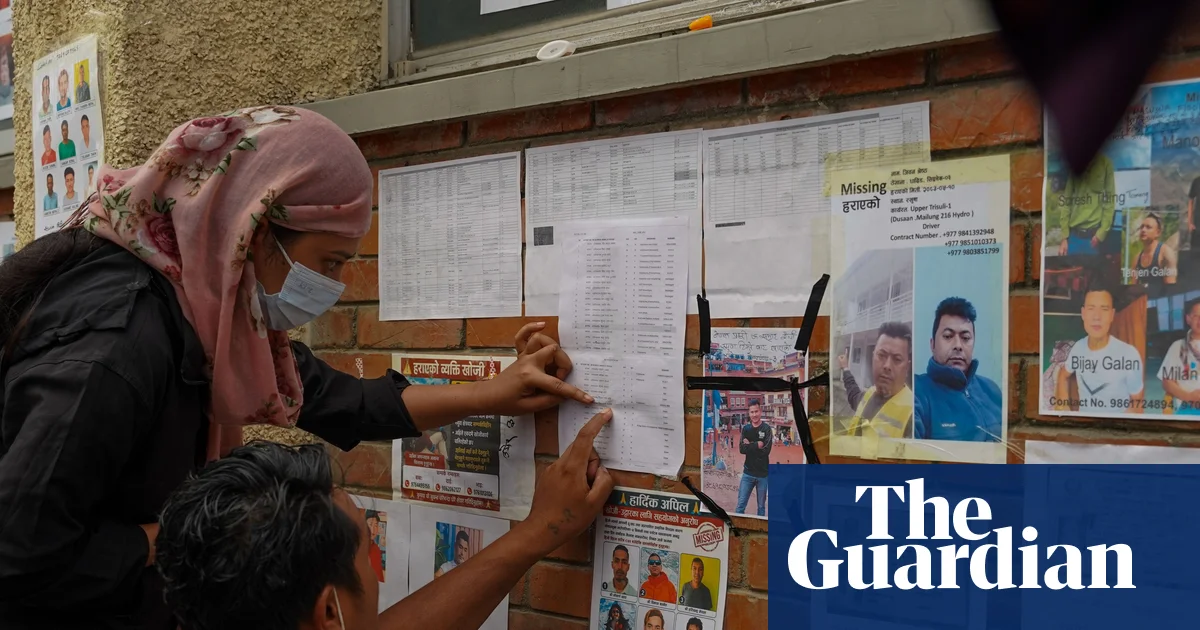
Every few hours Nepalese authorities hang pictures of the deceased, who have not been identified, on a wall at the back of a teaching hospital in Kathmandu.
Saluja, a young woman who did not give her last name, stood among a group of more than 100 people watching. Her cousin, 31, was not on the wall that day.
“It’s very hard to identify their faces,” Saluja says.
As she speaks, some in the crowd take videos to send to other relatives; they stand around comparing them, trying to work out whether the person in the photo is their loved one. The bodies have a piece of paper lying on top of them, showing which district they were found in, with a number to contact.
“My cousin is missing,” Saluja says. “He worked in a hydro power plant … Since the flood, we have not been able to contact him.
“It was the first area to get affected, so we really don’t know. But we are hoping for the best.”
While she talked, her other cousin, his older brother, was on the plane flying home from Australia. Since Wednesday, Kathmandu has swelled with international visitors – not tourists but people looking for their loved ones.
The Nepalese government has deployed about 15,000 personnel – from the army to the police – to move up the valley and into the areas decimated by the flood, hoping to find survivors.
While they battle arduous search conditions – areas completely cut off, roads destroyed, bridges washed away and a new lake threatening to burst – loved ones from Australia rush to Nepal to be with their families. They come to chase leads and to wait.
“My older cousin, he’s a doctor in Australia, and his wife is a dentist,” Saluja says. “So they both are coming back. They’re going to try with the search and to be with the family as well. They obviously want to be with the family.”
It’s been four days since the glacier collapsed high in the Himalayas, sending a wall of water, ice and mud down to destroy everything in its path.
The number of people killed has risen to 669, with nearly 3,000 people lost. On the Chinese side, more than 550 people are unaccounted for. Forty-two Australians are still missing, according to Dfat, including six identified as missing by Chinese authorities.
On Saturday, New South Wales man Michael Keats was confirmed to be one of them. He had reached the Nepal-Tibet border just moments before disaster struck, his family said in a statement.
“Confusion around the timing of the floods initially led us to believe our beautiful Michael would be safe in Kathmandu, preparing to fly home,” they said.
“Unfortunately, it was confirmed relatively quickly by the Isha Foundation that Michael and his Kailash travel group had arrived at Gyirong Port on the Nepal-Tibet border just 10 minutes before the tragic floods hit.”
Keats’ family said their thoughts and prayers were with everyone affected by the tragedy.
“[Michael] is gentle and kind, with a unique light that touches everyone lucky enough to know him,” they said.
Sagar Shrestha serves as the director of the Disaster and Crisis Management Department at the Nepal Red Cross Society in Kathmandu. He said the death toll could climb into the thousands.
“But they are still finding survivors,” he says. “Some of them are being found in the jungle; they’ve gone up the mountain and are being helicoptered out.”
He said there were 14 hydropower plants along the river, six of which were under construction. It’s believed people could still be alive in the majority of them.
One of the key issues has become “the dignified management of the dead”, he says, as morgues and hospitals have filled up in some areas. According to local media, officials in the Chitwan district will collect DNA samples from 229 bodies that are starting to decay and are no longer identifiable, before burying them.
“It is now the major concern,” Shrestha says. “And the second thing is that if we are not being able to manage the dead bodies, there could be some kind of health issues.”
after newsletter promotion
Since the crisis started, Sagar Pandey has barely slept. Pandey, the chief executive of the Himalaya Glacier Company, says 47 people from the trekking service are lost, including 15 Australians.
He had Australians in two different locations: five people 1.5km from the border of Tibet and Nepal, who were meant to be coming back that morning after breakfast and another 10 who had left the Syabrubesi valley and were driving towards the border checkpoint.
“I believe they were trapped because all three cars and jeeps are missing,” he says. “There were a total of 14 people: three drivers and then one guide and 10 Australians.”
Pandey has been spending his days going between the hospitals and checking in with the morgues to see if anyone on his tours has shown up. He is contacting family members of loved ones who are overseas and helping those who have just arrived. He has also been grieving his brother, who was guiding one of the treks.
On Wednesday, he chartered a helicopter to the disaster zone – he could see about 800 people standing on the mountain, who have all been rescued now, he says.
“There is a very low chance of survival that someone can still be alive,” he says. “The next process is to find the body if possible.”
There has been one glimmer of hope – on Saturday afternoon the foreign affairs minister, Penny Wong, announced Australian woman Cara Severino was found safe after consular officials worked out where she was, and reached her via four-wheel drive.
In a statement, Severino said she got out safely by teaming up with other survivors and using a tractor to drive out of the national park.
“My heart goes out to all the Nepalese families who are grieving loved ones,” she said. “We passed a guy hiking up to Thulu Safru who lost his whole family when their whole town was destroyed. It’s just so devastating and undeserving.”
“I feel for the families of those still missing; I know how much my family and friends went through.”
On Saturday afternoon, the Australian ambassador to Nepal, Simon Ernst, was waiting at the airport. Six more members of the Department of Foreign Affairs and Trade’s crisis response team had just arrived to help.
“There is a lot of damage to infrastructure, damage to power generation capability, damage to phone lines, telegraph poles, so communications is out,” he says. “Even the Nepali forces have lost contact with some of their personnel.
“Given the nature of search, rescue, and recovery operations, there are people in the water, in the mud. They’re obviously in danger should further flooding occur, and we can get heavy rainfall at any time given the monsoon.”
The disaster unfolded over three Nepalese districts – the one closest to Kathmandu has been the easiest to conduct search and rescue operations, because the accessibility is better and the valley is wider. Most Australians were last heard from in the top district, which was hit first by the flood.
No one knows how long it will take to search the area and find everyone, Ernst says, but in the event an Australian is found, the embassy will be told immediately.
“We understand that this is an incredibly difficult situation for [families],” Ernst says. “They should feel confident that the Australian government and the Nepalese government are doing everything we can to find their loved ones.
“They are very welcome to maintain contact with the Department of Foreign Affairs through our contact numbers and our contact centre in Canberra. If they’re here in Kathmandu, they’re welcome to make contact directly with the embassy, including with me.”
