

This article is an on-site version of our Moral Money newsletter. Premium subscribers can sign up here to get the newsletter delivered twice a week. Standard subscribers can upgrade to Premium here, or explore all FT newsletters.
Visit our Moral Money hub for all the latest ESG news, opinion and analysis from around the FT
Hello from Shanghai, where the traffic is notably quieter than just a few years ago. The soft hum of electric cars — produced overwhelmingly by Chinese companies — is rapidly replacing the roar of combustion engine vehicles.
The trend has been painful for foreign carmakers who had grown used to lucrative profits in China. Now it’s beginning to play out in Europe too. How will the continent’s carmakers, and its political leaders, respond?
Does Europe want Chinese cleantech factories?
These are scary times for workers in Europe’s automotive sector.
Volkswagen plans to end production at four German factories, we learnt last week, in a drive to cut its global workforce by up to 100,000. Stellantis, the continent’s second-biggest auto company by volume, has been laying off workers in Germany, Italy and Poland, and is drawing the curtain on car production in the Paris region.
A key driver of these cutbacks is the relentless expansion of Chinese rivals — which now dominate their domestic market and have been growing rapidly in others, including Europe.
Could they emerge as an unlikely saviour of the continent’s auto sector jobs?
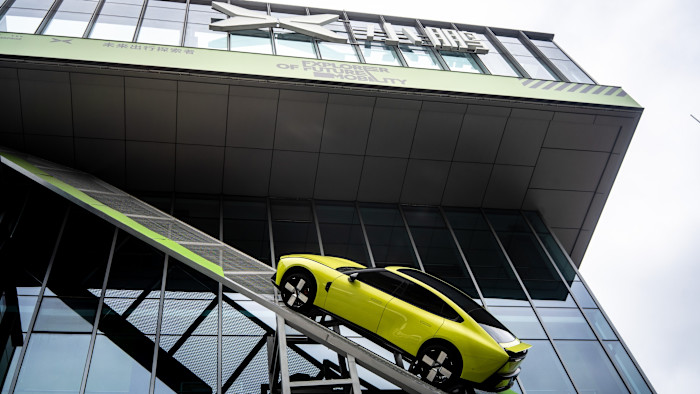
I explored that question this week during a visit to the Guangzhou headquarters of Xpeng Motors, a premium electric car producer sometimes billed as China’s answer to Tesla.
Headed by He Xiaopeng, a billionaire former software entrepreneur, Xpeng has been expanding into advanced AI chip design, humanoid robots and electric helicopters.
At its Guangzhou base, I walked through the hiss and clang of one of the company’s Chinese factories that together produced more than 400,000 cars last year.
With prices towards the higher end of China’s car market, Xpeng is keen to pursue growth opportunities in prosperous Europe, which is already its biggest export destination. Now it wants its own factories in that continent — potentially using space freed up by its partner VW, which acquired a 4.99 per cent stake in Xpeng in 2023.
That idea — a stark reflection of the contrasting trajectories of Europe’s and China’s auto sectors — is now being discussed openly by both companies. It could help VW reduce the costs of its capacity cutbacks, while offering Xpeng an economical way to start local production.
Other Chinese electric car companies have also been moving to gain a production foothold in Europe, with a notable flurry of activity in Spain. Chinese state-controlled SAIC plans to build its first EU car factory in Galicia, the Spanish region’s government said last month. Stellantis is pursuing a joint venture with China’s Leapmotor to build EVs, and another with battery giant CATL to produce lithium-ion cells, near the northeastern city of Zaragoza.
This reflects a sustained effort by Spain’s government to attract Chinese investment. There’s been a similar push from Hungary, where BYD will start production from its first European car factory later this year, cutting its exposure to EU tariffs on Chinese auto imports.
But EU policymakers have been growing concerned about the implications of Chinese cleantech investment for Europe’s industrial strength. In March, the European Commission published a draft of its Industrial Accelerator Act, which would impose new restrictions on direct investment in cleantech sectors such as batteries and EVs.
The rules would apply to companies from any nation that holds more than 40 per cent of manufacturing capacity in the relevant sector. In practice, where these green industries are concerned, that means one country: China.
The IAA would create a series of conditions for Chinese companies in these sectors seeking to build large-scale production capacity in Europe. They should own no more than 49 per cent of the venture, employ mostly European workers, and share technology with European partners, among other things. The Chinese investor must meet most (albeit not necessarily all) of these conditions — and even then, national authorities would have discretion to reject their investment.
This sounds much like the conditions imposed by China’s government when it opened its market to foreign carmakers from the 1980s (VW was the first to take advantage, through a 1984 joint venture with SAIC).
But it’s actually more restrictive, argued Yeqing Zheng, Xpeng’s general counsel, over coffee at the company’s headquarters.

“In China, it was always 50-50,” Zheng said, referring to the auto joint ventures in the country. “If it’s 51-49, we’ll have to be very specific about the reserved rights . . . From a contract negotiation or governance perspective, it’s much more difficult.”
Even if Xpeng wanted to go ahead with an investment under the terms set out in the proposed law, it would be “quite challenging for us to justify these kind of investments in front of the Chinese government”, Zheng said.
China’s government has condemned the proposed law, arguing it would result in “serious investment barriers and systemic discrimination”.
Some European analysts have also criticised the proposals. They would “slow clean-energy deployment and raise input costs for EU industry without targeting the specific dependencies that genuinely threaten economic security”, warned the Bruegel think-tank in a recent paper.
On Monday, Beijing and Brussels launched a new series of “trade and investment consultations” aimed at reaching consensus on these issues. The outcome of these talks will shape the strategies of companies such as Xpeng for one of their key foreign markets — with big implications for Europe’s long-term industrial landscape.
Xpeng has already been moving towards European car production, Zheng noted. Last year, contract manufacturer Magna Steyr began assembling Xpeng cars in Graz, Austria, using “kits” produced in China. Xpeng is now keen to explore full-scale production in Europe through a joint venture with a European partner.
“But if the IAA makes these kind of joint ventures exceedingly difficult or burdensome or expensive, we probably will just revert to our old ways of exporting [fully assembled cars] directly from China and just pay the tariffs,” Zheng said. “And that is sort of a lose-lose position for both of us.”
Smart reads
Shares in China Resources New Energy, one of the country’s largest renewable power providers, nearly tripled on their first day of trading in Shenzhen.
The FT takes an in-depth look at the record of ExxonMobil boss Darren Woods, the most powerful oil executive for a generation.
