

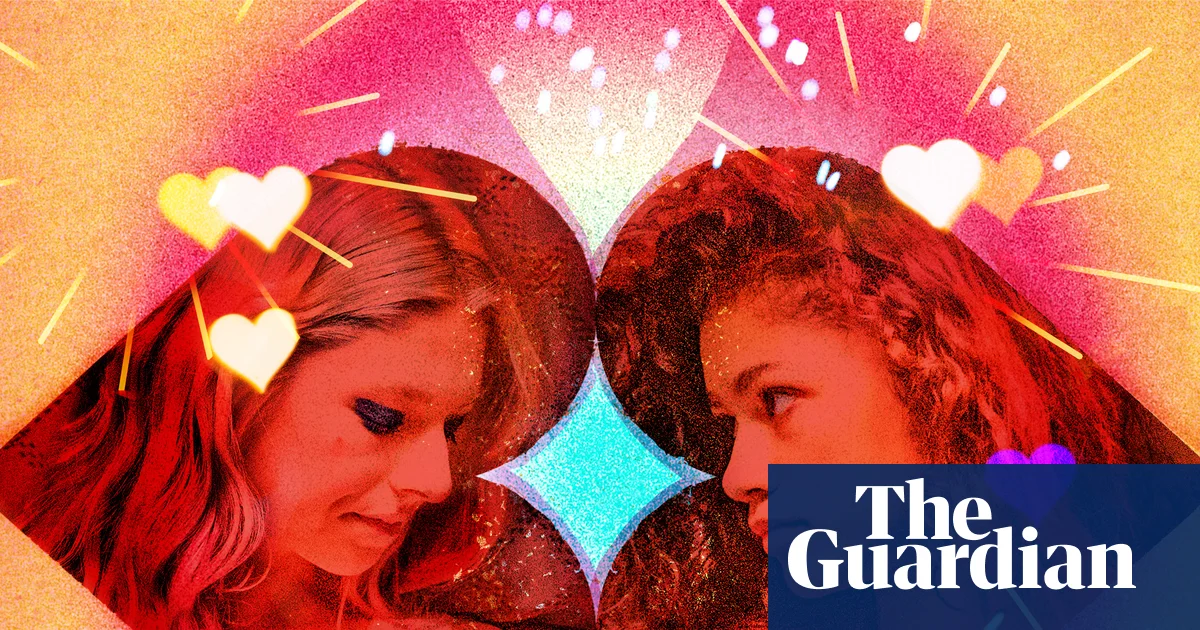
I don’t remember the exact moment when I started catching feelings for my friend Ellen. It might have been when she trusted me to cut her hair into a feathered bob, or when I noticed she’d taken to keeping my favourite tea at her parents’ house. But in the summer of 2019, a month before our final year of school together, I realised I was falling in love.
We were 17 at the time and had been best friends since our first year of high school, both of us part of the same tight-knit group of girls. Ellen and I knew each other well and were quick to make each other laugh, but we were also very different. Whereas Ellen is reserved and gentle, I’m loud and loquacious. So my sudden attraction to her was confusing – especially since neither of us was openly queer.
I had been raised in an accepting, liberal household in Stockholm, where queerness was never frowned upon. And yet, I had always assumed that I was straight. It was the default script that had been handed to me. So, each time Ellen greeted me with her one-dimpled smile, I tried to ignore the fluttering in my chest, thinking it would be too complicated, too daunting. Even as I sensed those feelings might be mutual, I didn’t dare act on them. I was worried it might damage our friendship.
This all changed when I watched the first season of Sam Levinson’s television show Euphoria. Set in suburban California, the show (an adaptation of an Israeli series of the same name) follows a group of high-schoolers as they recklessly navigate adolescence. They abuse drugs, drink alcohol, have sex, watch porn and fall in and out of love.
More specifically, it was the relationship between Rue (Zendaya), a recovering drug addict, and the town newcomer, a transgender girl named Jules (Hunter Schafer), that drew me in. The two meet after a party at the end of the first episode and quickly forge a connection. As their friendship deepens, Rue begins to fall for Jules.
I recall watching the first few episodes at a friend’s house and being enthralled by Rue and Jules’s plotline, and how tender and complex it was. Even though my own world was far removed from the dark, gritty one of Euphoria, I related to the more innocuous parts of their story: the insecurities Rue has about her feelings toward Jules, that flicker of hope each time the line between platonic and romantic love is blurred. It all felt so similar to what I was experiencing.
There was also something refreshing about the depiction of the characters’ sexuality. In the series, there are no major coming-out scenes, no need for Rue or Jules to explain their orientation. When Rue tells her mother she’s in a “relationship” with Jules, her mother simply responds by saying: “It may not matter what I think, but I really like her.” This is not to say that coming-out scenes in fiction aren’t important. But for me, Euphoria was the first show that portrayed queerness as liberating – and it helped me realise I could feel that way too.
Watching Rue and Jules open up to one another gave me the push I needed; when I finally did kiss Ellen, she kissed me right back. And as morning light filtered through the blinds of her bedroom, I knew I had made the right decision.
We have been together for six years. We didn’t settle into a relationship right away; we needed time to figure out coupledom. But slowly, Ellen and I have managed to build a life, furnished with our mutual love of books, movie nights and laughter. She is my bulwark and the person who helps me decompress.
after newsletter promotion
I did try watching the later seasons of Euphoria. And while some viewers may have enjoyed the grimmer tone, I couldn’t make it through the final run. Still, I’m grateful for that first season: it helped wash away my uncertainty and gave me the courage to make the first move. And truly, it was the greatest thing I ever did.
