

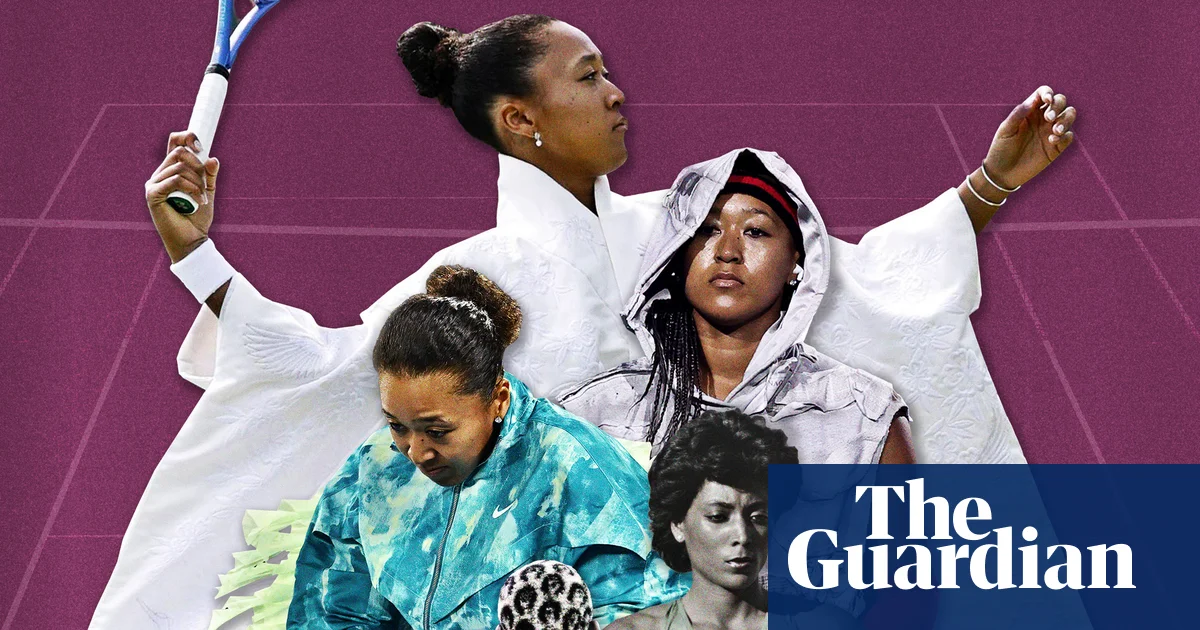
When Long Wave lead writer Nesrine Malik asked me if I’d seen Japanese-Haitian tennis star Naomi Osaka’s incredible pre-match look, I began to wax lyrical about the kimono she donned at Wimbledon a couple of months ago. No, not that look – Nesrine was talking about the NBA-inspired hoodie she wore at the US Open, taking to the court head bowed and hands in pockets, with the theatre of a WWE wrestler. By the time I sat down to write, Osaka had worn another viral walk-on outfit.
The star isn’t the first to acquire as many headlines for her clothes as for her performance. Osaka draws on a long tradition of Black athletes giving crowds their money’s worth through playful and provocative fashion statements. I delved into the history of why so many Black communities have a culture of “presenting”, and how defiance through fashion has found a natural home in sport.
The fashion game
Growing up, were you told you had to “present”? I’m talking about having elbows and knees moisturised, neat hair, a colour-coordinated outfit and matching underwear, just in case you had to go into hospital unexpectedly. In many Black cultures across the diaspora, it is far better to be overdressed than underdressed, and “extra” is more a term of endearment than an accusation. A considered, extravagant or playful outfit enters into a kind of shared visual language, and there is a culture of “turning out”, of giving the people a bit of a spectacle.
Throughout this eventful year of international sport, the Long Wave team has been hatching a theory. We saw Naomi Osaka wear creative jellyfish- and basketball-inspired outfits, and the DR Congo’s football team land in Texas in leopard print sashes and sunglasses. Meanwhile, Cabo Verde took to the pitch in intricate cornrows and locs, and Frances Tiafoe ripped off his trousers in a flourish. Earlier this year, officials forced a redesign of Haiti’s Winter Olympics kit featuring revolutionary leader Toussaint Louverture after finding it breached dress guidelines. Each of these stylish displays had an element of swag and showmanship that felt distinctly Black.
They also drew on a long tradition established by generations of Black athletes, from US basketballer Dennis Rodman’s punk aesthetics to Jamaican sprinter Shelly-Ann Fraser-Pryce’s neon wigs. Sometimes, these style choices have bumped up against the demands of elite sport, where dress codes are rife, and the tiniest details are optimised for performance. Why did the Williams sisters wear their famous white beads even when they were literally falling on to the court and losing them points? Why have so many Olympians donned two-inch-long acrylics despite them being impractical?
In one conversation with the Long Wave team, I remarked that I know my mother would not let me go on television to represent my people with a hair out of place or a chipped nail. We ventured different ideas about what scrubbing up and turning out a look meant in Black communities across the globe, trying to find a common thread.
Black style breaks rules
For some communities, the culture of “presenting” and“turning out”, is undoubtedly a response to historical attempts to quash our dignity and self-expression. Our clothes have long been a cultural battleground, with histories of suppression paradoxically giving rise to beautiful traditions of innovation and provocation. At the time of the transatlantic slave trade, for example, enslaved people were forced to dress in only the cheapest and coarsest fabrics – a practice that was sometimes enshrined in law, due to fears that free Black people were dressing above their status. Still, Black people found ways to creatively adorn their outfits. Sometimes, they subverted European fads and mixed these with African-inspired fashions, setting new trends. See also: Caribbean carnival costumes and traditions, many of which have their roots in the defiance of oppression.
Part of the fun of Black style has often been how rules have been circumvented. Even in freedom, legislation like the Tignon Laws forced Black women in New Orleans to cover their hair, and to refrain from showing “excessive attention to dress” through embellishments like jewellery and feathers. Enter our tradition of beautiful headwraps. Fashion historian Jonathan Michael Square highlights that in this period we see early precursors to African American “matchy-matchy” fashions. He describes enslaved people of the time and their descendants as “some of the most persistent purveyors of what would become known as ‘camp’”.
Black sportspeople tap into this history of subversion and play – since the sports world is characterised by rules, uniforms, traditions and genuine practical constraints. When Naomi Osaka wore a kimono as her Wimbledon walk-on look, she technically didn’t violate the British tournament’s notoriously stuffy dress code, since all her ruffles and bows were white. In its 2005-06 season, the NBA famously introduced dress codes in a crackdown on the durags, chains and baggy tees that were trickling into the industry via hip-hop culture. The move inadvertently spawned a new competitive culture of “pre-game fits” between Black basketballers.
Nesrine points out that, in some Black cultures, style is an important way of summoning bravado when you’re being called to represent. While testing the French Open dress code, Serena Williams described her all-black bodysuit as making her feel like a “warrior”. Osaka’s kimono also draws a spiritual parallel with battle clothes worn by African Zulu and Maasai Moran fighters. She told the New York Times earlier this week: “I am a pretty private person … Every time I wear a different outfit, it’s like a different character, almost like a video game, where you can select different avatars.”
after newsletter promotion
Is fashion always that deep?
Of course, we can be cynical about these cultures. Top-level tennis players, for example, make most of their earnings from brand partnerships. Our culture of scrubbing up good also can’t be separated from the pressures of a racist society: when a Black person takes the world stage, they are often seen as a representative for all of us. Some might say that this feeds into a pressure to be flawless, and to look flawless. But the culture of expression seen in the sporting world cannot be reduced to any one theory – it is far too complex, and, not to mention, far too camp.
There’s also a sense of collectivity in all of this that reminds me that Black culture is deeply referential, nonlinear, and always finds ways to keep itself alive. With a hood and winding cornrows, Naomi Osaka pays homage to NBA star Allen Iverson. Iverson himself brought Black street style to the court, which many believe prompted the infamous dress code crackdown. In the 2021 Australian Open, Serena Williams wore a one-legged catsuit in a nod to the track star Florence “Flo-Jo” Griffith Joyner, who tore up the tracks in the 1980s with bright self-styled uniforms and six-inch acrylic nails. Flo-Jo didn’t over-intellectualise it: “Dress good to look good. Look good to feel good. And feel good to run fast!”
Tap in
What are the most legendary looks you’ve seen Black athletes wear to compete? Share your favourites by emailing us at thelongwave@theguardian.com or replying to this email and we may include your response in a future issue.
