

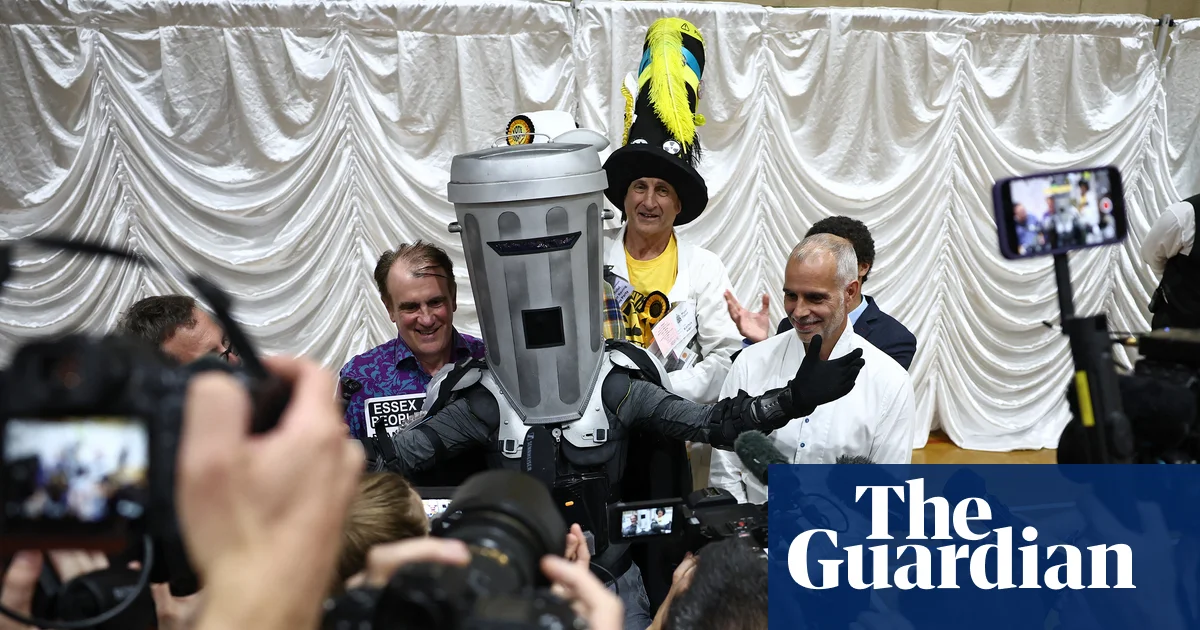
It ended, perhaps fittingly, on a rather baffling note. After 34 days of campaigning to regain the parliamentary seat of Clacton on England’s south coast, Nigel Farage, the leader of the Reform UK party, declined to turn up to the town’s leisure centre to hear himself declared the winner and MP. It was quite the thing. The last high-profile winning candidate to fail to enjoy his moment of victory was Bobby Sands in 1981. The IRA man had his reasons: he was on hunger strike in a prison in Northern Ireland, and went on to die 26 days later.
Instead Farage attended a gathering of his supporters at an airfield on the outskirts of Clacton billed by his party as “Farage Fest”. He told fans he would be damned if he was going to stand on a stage “having won a resounding victory” and “be demeaned and humiliated by nobodies”.
But he also said Essex police had advised him of an “organised campaign to disrupt and degrade the result”. A Reform UK spokesperson went further: “Essex police advised Nigel not to attend the count tonight due to a credible threat against him.”
Not true, suggested the police. No such advice had been given. One of the shoutiest members of Farage’s anti-immigration party, Lee Anderson, had a slightly refreshed explanation by 8.10am when interviewed by the BBC. His leader had not wanted to disrespect those who had flocked to Farage Fest. He was, actually, if you will just listen just for a moment, a man of principle. “It was a great occasion that it is only right that he spends that time with his members, with his activists, with his supporters,” Anderson fumed.
All this left one intergalactic explorer, with his arms raised and a bin on his no doubt sweaty head, to take the starring role at Clacton leisure centre. The candidate who went by the name of Count Binface made a declaration on social media: “I came first in the Clacton byelection! Of the candidates who bothered to turn up for the results.”
Count Binface, for those who have not been following this latest fever dream of a moment in British politics, is the parody figure who declared himself the unity candidate when Farage triggered the byelection by resigning the seat back in July.
Farage had explained his resignation at the time as a challenge to the establishment that would show them that the people did not want him scrutinised and investigated by the parliamentary authorities over an undeclared £5m gift from a crypto billionaire or any of the other financial scandals orbiting Reform UK.
The other major political parties called his bluff. It was a stunt, they said, and none of them stood, leaving Count Binface, a familiar and striking figure at elections, whose real name is Jon Harvey, to harvest the anti-Farage vote. And he could reasonably be said to have done rather well, given that he won just 95 votes at the recent byelection in Makerfield, in Greater Manchester, where Andy Burnham, now the prime minister, won his parliamentary seat.
Binface, who describes himself as an “independent space warrior” from the planet Sigma IX, won 26.93% of the ballot with 9,455 votes, leaving him second to Farage who secured 22,239 votes (63.34%). There was a healthy 44% turnout.
Perhaps – and it is only a theory going round the leisure centre in Clacton – Farage was actually not at the count because he did not fancy the inevitable photograph of him next to his ludicrous competition?
“That means I’ve got – against Nigel Farage – 10,000% more votes than I got against Andy Burnham,” Binface later said of his electoral tally. “What does that tell you? Well it tells you that Nigel, who said that he didn’t want to be humiliated, maybe has been. As for me, I’m over the moon – I’m over your moon, I’m over my moons – and what comes next, well we shall see. But you know what, we know this for a fact: over one in four people in this constituency would rather have Count Binface as their MP than the leader of Reform UK.”
That was the Binface take on an election estimated to have cost the public purse £250,000. Others were available. For the fired-up Anderson, who scolded the BBC presenter Justin Webb for being “very rude” for interrupting him on Friday morning, there was one clear reading of that night’s events.
“[Nigel Farage is] celebrating a stunning victory in Clacton and the people have decided: they’ve stuck two fingers up to people like the BBC, the establishment, the blob, the whole of Westminster,” Anderson said. “There has been a constant witch-hunt by people in the media.
“There’s been a witch-hunt against Nigel Farage and he said: ‘You know what? Enough’s enough. Meet me at the ballot box.’ And when it comes to a crunch, when he does throw the gauntlet down to the other political parties, what happens? They run away like the cowards they are. He challenges them at the ballot box and he wins.”
Naturally enough, that wasn’t how the other main parties saw it. “All Farage can brag about this morning is beating a bloke with a bin on his head,” said a Conservative party spokesperson. “What he should do is answer the serious outstanding questions about why he hid his £5m from the public.”
Bridget Phillipson, the chair of the governing Labour party, said: “There’s no hiding place now and Nigel Farage needs to answer to the public as to exactly what’s going on.”
As election workers sorted through the voting ballots at the leisure centre in the early hours of Friday morning, one moment caught by photographers also tells a story.
Across the 90cm long ballot paper containing all the names of the parody and independent candidates for the seat of Clacton (it was the longest ballot paper in UK electoral history), a disgruntled voter had made their mark: “What a disgraceful waste of money.”
Three hours after Farage’s victory was declared, the suspended parliamentary standards investigation into the Reform UK leader over accusations he failed to declare gifts and donations had resumed.
