

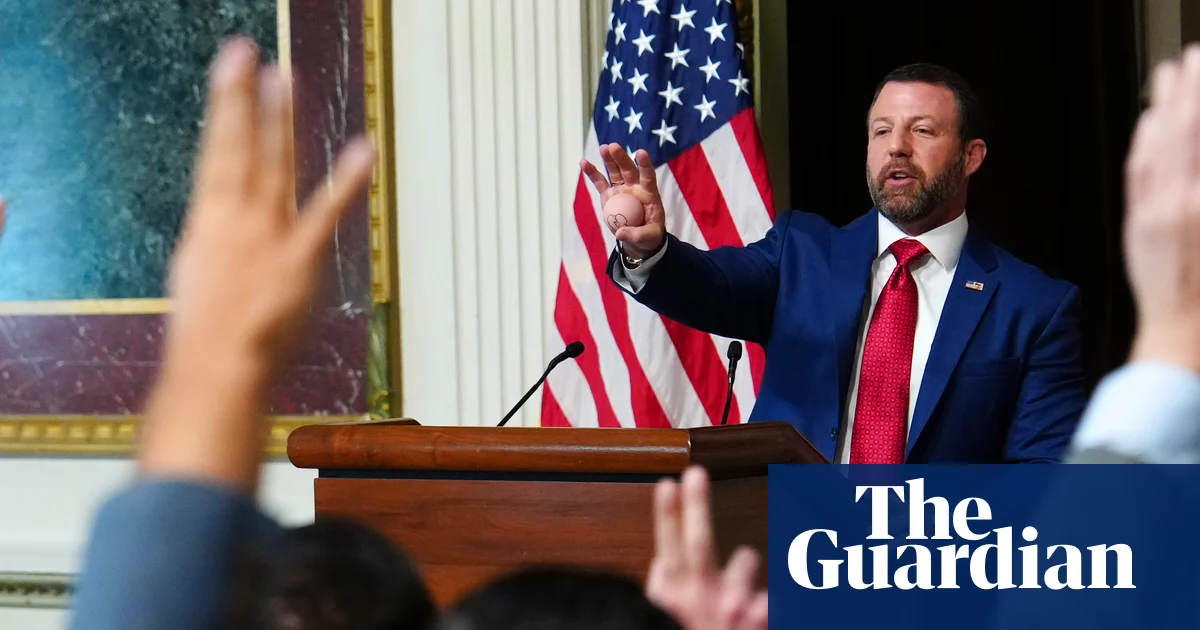
The US homeland security secretary, Markwayne Mullin, doubled down on Donald Trump’s unsubstantiated election claims on Friday amid his agency’s efforts to support the president’s agenda.
Trump used a review compiled by the Department of Homeland Security (DHS) as the basis of many of his unsubstantiated claims on Thursday during his televised primetime address to the nation.
“This isn’t about rehashing the 2020 election. This is just exposing what took place, and to make sure it never happens again,” Mullin said, after the president’s speech was widely criticized for revealing no new information about the safety and security of the US elections, despite claiming that system falls “catastrophically short” of “greatness”.
Mullin claimed that the DHS identified “250,000 noncitizens registered to vote in California, Pennsylvania, New Jersey and Nevada”. However, election experts, including David Becker, the executive director of the non-partisan Center for Election Innovation and Research, said the administration has not been “transparent about the methodology” in reaching that number.
On Thursday, several state officials from the states that Mullin mentioned responded to the administration’s claims. Al Schmidt, Pennsylvania’s Republican secretary of state, said that voters in the Keystone state “must take steps to verify their identity before they cast a ballot, including providing proper identification every time they register to vote, vote by mail, or vote at a new polling place”.
He added: “All evidence has shown that noncitizen voting is extremely rare across the country, including in Pennsylvania.”
On social media, the homeland security secretary shared the letters he penned to the four secretaries of state, outlining his department’s so-called “findings”. In each letter, Mullin writes that his department’s preliminary review found a number of registrants in that state “for whom the name, date of birth, address and social security number match a non-citizen in our files”.
This methodology is problematic for a number of reasons. First, as Mullin notes himself, there hasn’t been any verification yet on the identities of those people the review has supposedly identified. Secondly, being registered to vote and actually voting are two separate things; someone might be registered, but not actually cast a ballot in a given election. And, as citizenship status can change over time, his department would need to prove the individuals were not citizens at the time of actually casting a ballot.
On Friday, Mullin also claimed that 28,000 noncitizens had been identified on the voter rolls of more than 20 states that have “proactively” worked with the administration on the Save program – a tool implemented by the DHS to verify citizenship status.
Becker noted that this number sounds plausible, but it is only 0.04% of the 68 million eligible voters in those states.
“One thing that I love about numbers, and I love about facts is they don’t lie,” Mullin told reporters on Friday. “This isn’t something that I’m trying to tell you to spin a narrative. This is what is going on, and what we are saying is that every state should partner with us to work to secure this.”
Throughout his press conference, Mullin also repeated his threat of withholding federal grant funding to states that don’t work to “secure” elections.
“If they’re not willing to do it, it should raise serious questions. It’s not that hard. This isn’t a partisan issue,” the homeland security secretary said. The federal government has previously sought access to state voter rolls, which contain the personal data of millions of Americans. States have refused to turn the data over, resulting in a number of lawsuits the administration has lost.
Mullin also repeated many of the president’s baseless conspiracy theories that he pushed on Thursday evening – particularly that voting machines are unsafe and insecure. This, despite election officials and cybersecurity experts routinely underscoring that these machines are not connected to the internet and undergo scrupulous testing before each election to make sure they have not been compromised.
“We know for sure that our foreign adversaries, not our allies, foreign adversaries have parts that are vital pieces in our voting machines,” Mullin said, appearing to repeat the president’s claims that the CIA obtained reporting of “a specific plot by the Maduro regime” in Venezuela to “digitally rig their own country’s elections in 2020”.
However, the vulnerability involved voting technology used in Venezuela by Smartmatic and did not extend to the US, according to the CIA analysis. Claims that Venezuela’s leadership controls electronic voting systems worldwide – including those used in the 2020 US election – are part of a long‑running conspiracy theory and are not supported by credible evidence.
On Friday, Mullin said – again without evidence – that rivals can “change voter registration and your vote”.
“There’s not a question. It’s not even for debate,” he said.
