

The bill for the creation of State Police has been passed by the National Assembly, and with the assurance of its passage by the State Assemblies, it only indicates that State Police is an idea whose time has come. However, the desire to ensure that a new problem is not created in the process of solving an old one was the focus of the ARISE News Town Hall Meeting held recently in Abuja. Alex Enumah reports.
The ARISE News Town Hall Meeting, held last Thursday in the nation’s capital, Abuja had in attendance critical stakeholders in the Nigerian project, with one single goal in mind: ensuring that the proposed State Police reduces, if not completely eradicates, the lingering insecurity in the country.
The Town Hall, tagged: Building National Consensus for State Police and National Security was co-chaired by the National Security Adviser, Mallam Nuhu Ribadu, and Governor of Kwara State, AbdulRahman AbdulRazaq, who is also the Chairman of the Nigeria Governors’ Forum (NGF). The Guest Speaker was former Israeli Prime Minister, Ehud Barak. Lead discussants included serving and former governors, federal lawmakers, security chiefs, legal experts, and rights activists, among others.
The consensus among all participants was that State Police is indeed the right way to go if the country must overcome its current security challenges. Although it was observed that the initiative alone cannot resolve insecurity, there is also a need to address the root causes of insecurity.
However, a few participants who did not oppose the idea faulted the timing, arguing that certain things ought to be in place before decentralizing the force.
Setting the stage for the discussion was the Deputy Speaker of the House of Representatives, Rt. Hon. Benjamin Kalu, who pointed out that the size of the Nigeria Police Force as of today cannot cover the 923,768 square kilometers of the country nor serve over 200 million Nigerians. Besides, the Deputy Speaker noted that while the United Nations provides for one policeman to every 400 citizens, in Nigeria, one policeman handles over 600. The current situation, he argued, makes policing distant from the people and also increases response time.
Similarly, the Guest Speaker, former Israeli PM Ehud Barak, in his keynote address, agreed that State Police is a “step in the right direction” when one considers Nigeria’s vast geographical size and complex security challenges. He noted that the centralized policing system works better in his country due to the relatively small size of its territory.
According to him: “In terms of geography, Israel is probably 40 times smaller than Nigeria. Within a two-hour drive, you cover almost 90 per cent of the population.
“Nigeria is a totally different country. I strongly believe the idea of having State Police is a very good start in the right direction.”
While this was the consensus of the gathering, issues such as abuse by state executives, funding, training, good governance, and true federalism were raised. It was believed that with appropriate reforms and legislation, these issues could be easily resolved.
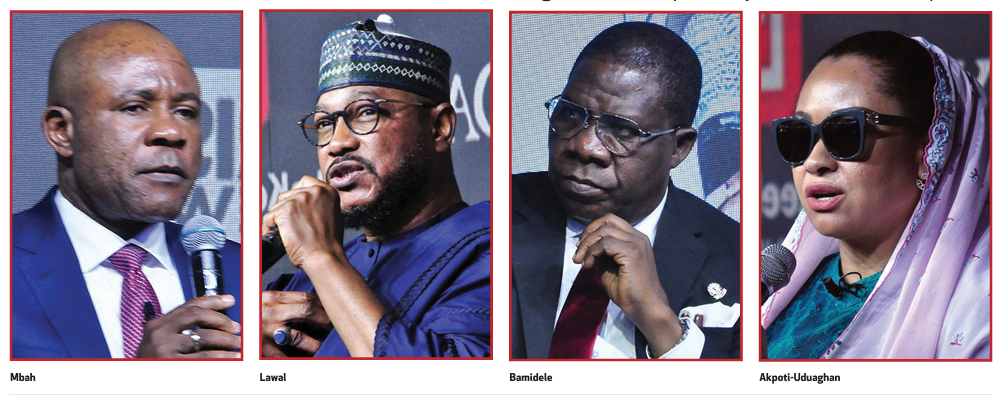
Reacting to the issue of abuse, Governor of Zamfara State, Dauda Lawal, who declared full support for State Police, observed that most states already have one security outfit or another and they have not been used against the opposition. He, however, agreed that there is a need for lawmakers to fine-tune the bill to prevent abuse.
Also speaking on the issue of abuse, the Senator representing Edo North at the National Assembly, Adams Oshiomhole, argued that, “If governors misuse State Police, the electorate should vote them out.”
On her part, the Senator representing Kogi Central, Natasha Akpoti-Uduaghan, believes the issue of abuse can be eliminated if State Policing is fully independent of political interference and control.
On the issue of funding, Senator Oshiomhole recalled his days as Governor of Edo State, claiming that governors spend a huge part of their funds equipping the police in their respective states despite not having control over the police. “The Constitution calls the governor the Chief Security Officer, yet he cannot recruit, deploy, promote, or discipline police officers. It is like calling someone a husband when he has no wife,” he said.
But for Enugu State Governor, Peter Mbah, and Leader of the Senate, Opeyemi Bamidele, for the scheme to succeed, funding should be made a priority and placed on first-line charge to guarantee operational independence. “There must be first-line charge funding similar to the judiciary so that the police will not become subject to the whims and caprices of governors,” Bamidele said.
Acknowledging that security must be placed on a first-line charge just like the judiciary and legislature, Mbah disclosed that his administration prioritized security from the onset and equally invested heavily in technology. “So instead of just having boots on the ground, we can also use technology. We invested heavily in technology. As I mentioned, we have AI-enabled CCTV cameras — both static ones and mobile ones. Even our DRB and response vehicles are all installed with AI-enabled CCTV cameras. That is one of our capabilities,” he said.
While Senator Akpoti-Uduaghan suggested that two-thirds of Internally Generated Revenue should be dedicated to the funding of State Police, her colleague from Edo North, Oshiomhole argued that the issue of funding would be meaningless if citizens fail to track the monies released for police operations. “Let’s look across the country at police barracks over the past 20 years. Let’s do a fact check: how much has been released to the Nigeria Police Force for barracks in the last 20 years? Then go to the barracks and see whether there is any evidence that money was actually put into the system,” he said.
Besides the issues of abuse and funding, discussants observed that State Policing is not the only panacea to insecurity. They called for effective reforms, standardized training, welfare, and synergy with other security agencies.
For former Chief of Defence Staff, General Lucky Irabor (rtd), “We must ensure that training, equipment, logistics, administration, and welfare are done in such a way that the average citizen, when he sees the policeman on the streets, is convinced that he is someone who is out for business.”
Irabor warned that if the above is not heeded, “the sickness that is affecting the federal police currently will also affect the State Police.”
Similarly, a former House of Representatives member from Abia state, Hon. Nnena Ukejie, urged the Federal Government to first and foremost strengthen the capacity of the police to fight crimes before embarking on the decentralization of the force.
According to her, there is no way state police can be effective if the current police force is weak. She explained that the Nigeria Police of today is being confronted with crimes such as terrorism, banditry, kidnapping, and proliferation of small arms, among others, which require a different method to handle. “First thing is to put in place a strong national police,” she said, “We must look at the transition timeline”, and determine whether we have a police force that can quell terrorism, banditry, and other violent crimes. Ukejie also wondered if states really have the kind of money needed to deal with the security threats confronting them.
As part of solutions to the current insecurity in the country, she suggested strengthening institutions, including civil society groups and others expected to hold State Police accountable, as well as the need for good governance. “I think it is important that as we have these conversations, we also have capacity building for the people who are going to hold them to account. We should not personalize the behavior of the society or system as far as this is concerned. And my final point would be: police is not the only panacea to insecurity.”
For Minister of Defence, General Christopher Musa; Anambra Governor, Prof. Charles Soludo; and Senate Leader, Opeyemi Bamidele, State Police may not succeed without the engagement of the grassroots. “For us to succeed, our local governments must be up and doing, our communities must be up and doing, and we must give opportunities to traditional and religious leaders to also contribute to the success of the community,” Musa stated. While he noted that it makes policing activities a lot easier, he appealed to citizens to promptly report to relevant authorities whenever they see or notice anything strange.
Bamidele explained that the success of State Policing would depend on complementary reforms that empower local governments and establish a sustainable funding framework insulated from political interference.
He said, “The whole essence of advocating State Policing is to establish effective community policing, and that is the first step we must take. However, if we fail to address the issue of local government autonomy and strengthen local governments to enable them to discharge their responsibilities effectively, we will have achieved very little, even with the establishment of State Police.
“These reforms must go hand in hand. For us in the National Assembly, we have taken these issues into account in developing a legal framework that aligns with international best practices and national minimum standards, below which we cannot go, to ensure that State Policing succeeds.”
Meanwhile, the Anambra Governor argued that the conversation on State Policing should go beyond the state level and down to the local government in order to ensure a broader security reform agenda. He, however, called for a restructuring of the country’s fiscal framework to ensure that states have the resources needed to discharge their responsibilities effectively.
He maintained that if the Federal Government retained more than 40 per cent of national revenue, some states might only be able to afford a handful of police officers, thereby defeating the purpose of State Policing.
For rights activist and law professor, Chidi Odinkalu, who suspected the motive behind the establishment of State Police in an election year, government should be more interested in strengthening the justice sector’s capacity to discourage crime.
“The governors are not complaining that we should decentralize the DSS. They are complaining that they should own the police.
“These are governors who have never funded their Ministries of Justice. Now they will find money to give to police because police are used for illegal elections. They will not fund the Ministries of Justice, which are essential for putting away the criminals who endanger Nigerians.
“And nobody there is talking about the funding of Ministries of Justice. Ask all of these governors who have gone away: how much have they spent on their Ministries of Justice in the past four years? But they are investing in the police, and they want us to believe that this is about how to protect the citizens,” he said.
The assurance by the Deputy Speaker of the House of Representatives, Benjamin Kalu, that lawmakers would put necessary safeguards in place to prevent abuse, enhance the capacity of the police both at the federal and state levels, and provide adequate funding to give Nigerians a police system with capacity and timely response, suggests that the country is on the right path toward successful State Policing.
