

Unlock the Editor’s Digest for free
Roula Khalaf, Editor of the FT, selects her favourite stories in this weekly newsletter.
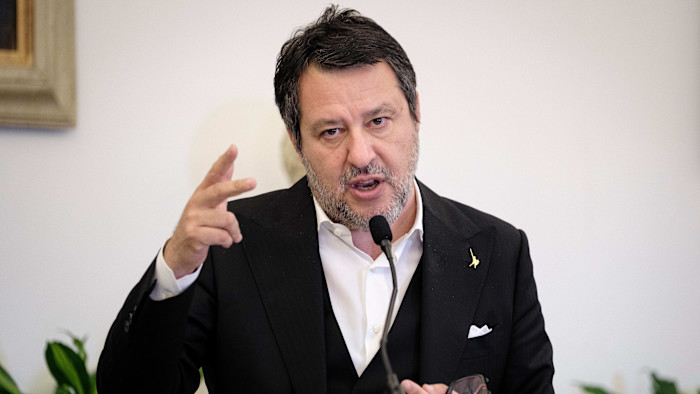
Italy’s deputy prime minister Matteo Salvini plans to introduce a contentious levy on bank profits in next year’s budget, as a looming election and stretched public finances put lenders’ bumper earnings in the spotlight.
The proposal comes while European banks have generated some of their best profits since before the 2008 financial crisis, prompting governments across Europe and the UK to revive discussions about whether to increase their taxes.
Salvini said Italy’s top 10 banks might be asked for a “three-year contribution” and suggested this could be about 5 per cent of profits.
“I’d like to remind those who express doubts that a portion of these profits stems from state guarantees, and therefore from taxpayers, and from costs borne by taxpayers,” he told journalists Tuesday.
Salvini also praised the taxation policies put in place in Spain, where Prime Minister Pedro Sánchez introduced a progressive levy of up to 7 per cent on banks’ net interest and commission income.
A levy on banks has become a recurring theme for Italy’s rightwing coalition as it searches for extra revenues while households grapple with higher living and borrowing costs, and a surge in fuel prices triggered by the Iran war.
The proposal, which comes ahead of next year’s general election, is being spearheaded by the League. Salvini said he was “convinced” it would win the backing of the other coalition parties.
The government is grappling with difficult decisions ahead of its upcoming budget bill, with limited options to reduce its fiscal deficit.
Italy’s economy grew by 0.5 per cent last year — one of the lowest rates in Europe — and is expected to remain largely the same this year.
Meanwhile, its debt-to-GDP ratio rose to more than 137 per cent at the end of 2025. This year Italy is expected to surpass Greece as the most indebted economy in the EU.
Three years ago, a similar measure announced by surprise sent Italian bank share prices tumbling before being hastily retracted.
Italy’s 2026 budget already imposed temporary measures on banks, including a two-percentage-point increase in the regional business tax, Irap, for three years. Salvini’s proposal would be in addition to these measures, his spokesperson said.
Forza Italia, the liberal junior partner, has opposed similar measures in the past, while members of Prime Minister Giorgia Meloni’s Brothers of Italy have defended the government’s approach as a concrete way to bolster public finances and help families struggling with higher mortgage costs.
Italy’s five largest banking groups — Intesa Sanpaolo, UniCredit, Banco BPM, Monte dei Paschi di Siena and BPER — generated more than €15bn in combined net profits in the first half of 2026, up 3.7 per cent from the same period a year earlier, according to an analysis by banking union First Cisl.
Italy’s banking association ABI has opposed previous attempts to tax lenders’ profits.
Last year the banking group argued that the governing coalition’s notion of “windfall profits” was misleading because banks were already subject to higher corporate and regional tax rates than other companies.
