

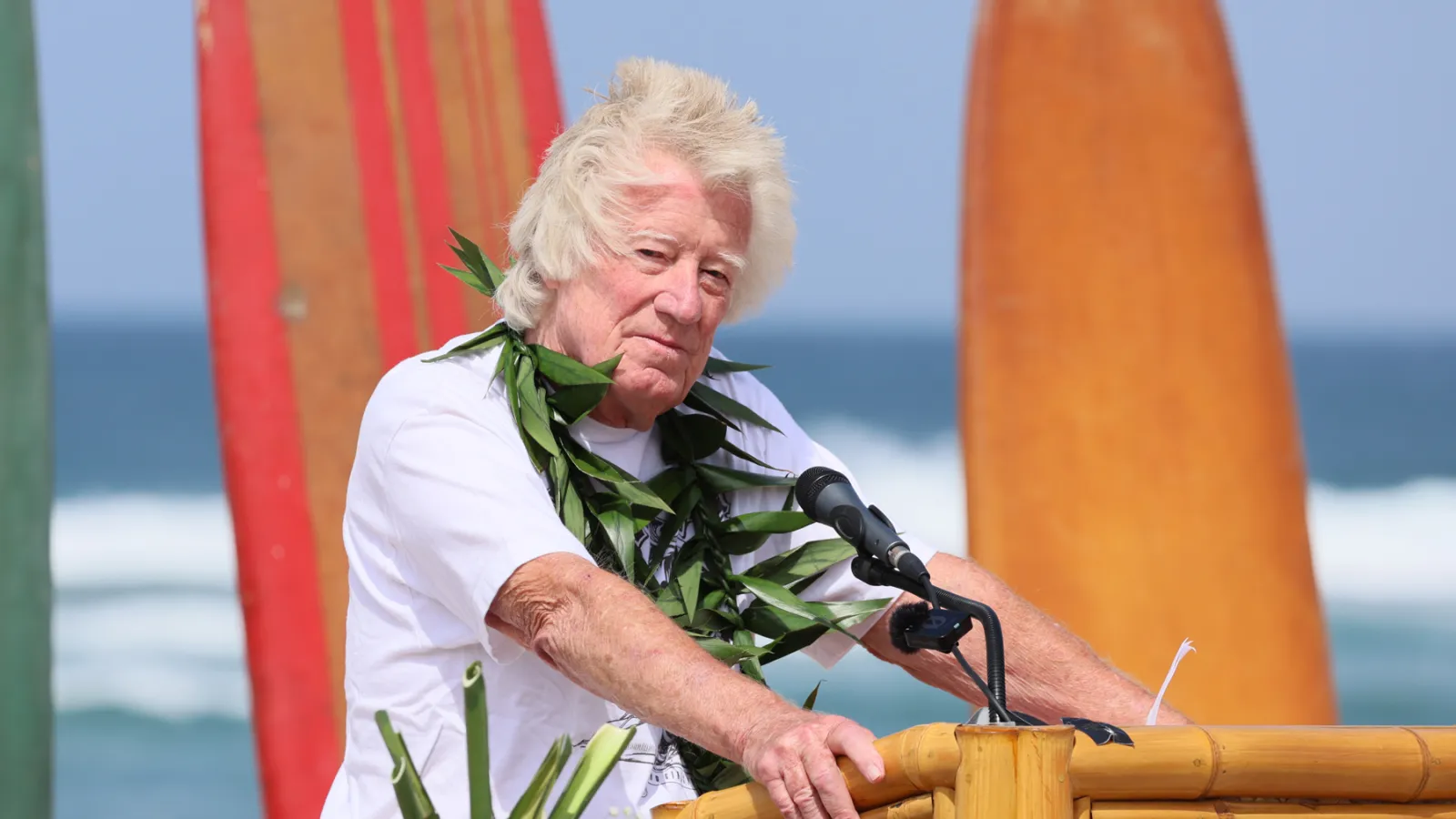
Rolling Stone‘s interview series Last Man Standing features long-form conversations between senior writer Andy Greene and musicians who are the last remaining members of iconic bands. In some cases, they are the only classic-era member in the current touring lineup. In others, they are the only ones still alive. In either case, the task of keeping the torch lit has fallen onto their shoulders, whether they wanted that responsibility or not.
Years before the Beach Boys, the Surfaris, Dick Dale & His Del-Tones, and other surf-rock acts of the early 1960s, there was Jan and Dean. The duo of Jan Berry and Dean Torrence formed in 1957 at Emerson Junior High School in Los Angeles, and bonded over their shared love of doo-wop. With help from future industry moguls Lou Adler and Herb Alpert, and support from Dick Clark on American Bandstand, they landed a series of hits on the charts like “Baby Talk” and “Clementine” while still teenagers.
And even after joining forces with the Beach Boys in the 1960s for massive, global hits like “Surf City” that landed them a gig as emcees of the groundbreaking 1964 concert movie T.A.M.I. Show, featuring performances by the Rolling Stones, James Brown, the Supremes, Marvin Gaye, Chuck Berry, and the Beach Boys, they continued with their studies in college. Torrence majored in advertising design at USC, while Berry went to UCLA, and later California College of Medicine.
This was highly unorthodox for a successful pop group since school took up so much of their time, and it greatly limited their touring, but Torrence has no regrets. “It was actually a good thing,” he says today. “We wouldn’t get burned out by the music industry. We were away from the noise. And school was more fun because you didn’t have to be someplace at any particular time except class. So in a way, we could recharge our batteries. We could actually think things out a little bit more clearly when the offers came in to do this, to do that, and take our time with it.”
Berry had a genius-level IQ and was indisputably the leader of the group. He also played a crucial role in the creation of Jan and Dean classics like “Dead Man’s Curve.” But in one of the cruelest ironies in rock history, Berry suffered a devastating car crash not far from the actual Dead Man’s Curve in Los Angeles on April 12, 1966. It left him with severe brain damage and partial paralysis that plagued him for the rest of his life.
Torrence would eventually reunite with an impaired Berry after the 1978 TV movie Deadman’s Curve introduced their saga to a new generation. But a dozen years before that, Torrence put his college degree to work by starting the graphic design firm Kittyhawk, and creating iconic album covers for Chicago, the Beach Boys, Steve Martin, the Supremes, Michael Nesmith, and way too many others to mention.
Berry died in 2004 following years of health issues stemming from the car accident. But Torrence continues to gig with his group the Surf City All-Stars, but only sporadically. He spends most of his time at his Southern California house.
He logged onto Zoom with Rolling Stone in his lush California backyard. “It’s always 72 degrees here,” he says with a smile, “no matter what time of year it is. And I planted all of these trees myself.”
Torrence may be 86, but he’s still got a full head of blonde hair, and a stunning ability to recall events that took place nearly 70 years ago. He chatted with us for over two hours to go over the glory days of Jan and Dean, the hysterical story of how he wound up singing lead on “Barbara Ann” with the Beach Boys, the difficult aftermath of Berry’s accident, and his hopes that Jan and Dean will one day be recognized by the Rock and Roll Hall of Fame.
What’s the first music you heard as a kid that really spoke to you?
My parents’ music. We only had one radio in the house. I was listening to a lot of Dean Martin and Frank Sinatra, which I appreciated. I was never really motivated to think that I should do something like that, because I really wasn’t interested until doo-wop. And then once I heard doo-wop, heard background vocals and all of that, I became immediately interested.
When did you start surfing?
Probably 15 or 16 when I first got a car, because then I could have a surfboard. So I actually bought a truck, and that way I could take my board to the beach. I was more interested in the beach culture on a whole. Surfing, I sort of enjoyed, but California water is cold. We didn’t have wetsuits like we would nowadays. I probably spent more time bodysurfing if I happened to be in the water. I had a paddleboard, and those were really big boards since you could paddle out, and then lay on it and get some sun.
What’s your first memory of ever seeing Jan Berry?
Jan was quite a character. I had heard of him. He was one of the most interesting characters in school. One day I was sitting in a class. I have ADD, which I didn’t know about at the time, so it was hard to pay any attention to a teacher for very long, and I would sit there and probably look out the window more than I would be listening to a teacher lecturing.
I just happened to be looking out a window this one day and I see some guy. I knew he was a high school kid. He was walking on the other side of the fence, which wasn’t allowed, towards Fosters Freeze ice cream, which was like Dairy Queen for us. He was blonde. He had a gray jacket on, so I knew that meant he was a Baron, and the Barons were a group that was very popular with the girls: “I think that’s Jan Berry.” And about that time I see his hand comes up, and he’s smoking a cigar.
I’m going, “How does a person do that?” And then a few beats later, once he was out of sight, I thought that would be a nice character to meet someday.
When did you meet him?
I’d say maybe a couple of months later. Football season started and I was on the football team. I knew Jan was on the team the year before, but he was on the team for a couple of weeks and then he just disappeared. So new season, I go to my locker that I was assigned. I open it up and somebody comes next to me, opens up a locker and I thought, “Oh, man, this is that guy Jan Berry.” I said hello and he said hello back, and then within minutes he’s offering me candy. He said, “Oh, you want some Milk Duds?”
I didn’t really eat much before football practice and I’m certainly not going to eat some sweets, so I said, “Maybe after practice.” And then the next day, practice again, he offers me Red Hots. I said, “No, thank you.” And he said, “Are you sure?” Then he sticks his hand out with the Red Hots in it, saying, “Well, here,” like, “I eat ’em and you need to eat ’em.” I hit his hand and they spilled all over the floor, and then he goes about picking them up and putting them back in the little package. I went, “This is a very interesting guy. I think I’m liking being around him.”
Within a couple of weeks, in the shower room, somebody spontaneously was singing a doo-wop song. I suppose it was all really just in the moment that somebody else chimed in another part and then somebody else found another part to sing, and pretty soon we found ourselves just, a cappella, singing.
Prior to that, did you see yourself as a singer?
No. In the shower room, I noticed that nobody picked up the falsetto part. Now, I didn’t even know the word falsetto, but I realized, “Hey, man, I can sing,” because I’d sing along in the car. That’s where we got our music. I filled in the high part, and everybody went, “Oh, good, man, we got all the vocal parts.” Then we’d double them. Some other people wanted to sing along, and they just picked up whatever vocal part they wanted to double or triple. It was like a choir at one point.
When did you realize Jan was musically gifted?
Probably after the football season. Because once you finished practice, we went to the shower rooms, and most of the kids went home to do homework. And so that was the extent of us singing together. Well, the football season ended and now we all went, “We’re not singing anymore. Singing was fun.” So Jan said, “You can come up to my house in Bel Air. I’ll give you the directions,” and he invited me over.
Most of the guys that were singing were in Jan’s little social group, and they already knew where his house was, so I was one of the outsiders that was given his address and how to get there.
Once I walked in his house and into his music room… it was a pretty big room. He had a piano. He had a microphone. He had two tape recorders that were given to his dad by Howard Hughes.
We had never heard ourselves on tape before, and it was quite a big deal. And having two tape recorders, he’d figured out how to create an echo. So now it sounded relatively like what we sang in the shower room, because we realized later that most echo chambers were made out of the same tile that happened to be in the shower room, which created a really wonderful echo.
To flash forward a bit, you joined the Army Reserves. Jan forms Jan and Arnie with Arnie Ginsberg. What was it like to be at the army base and hear their song “Jennie Lee” on the radio?
It was a gut punch, to be sure, because Jan did try and talk me out of going in the Army, but I’d already signed up. I follow the rules. He doesn’t. He can smoke a cigar on the other side of that fence, and I couldn’t do that. So he called me the night before I was leaving to go to Fort Ord and said, “Well, you can’t go. We’re going to get a record deal.” And I thought, “Man, how are we getting a record deal? And whatever we’re doing can wait six months. I’m only in for six months and back out again.”
I didn’t know how to get out of it, and he said, “Well, call General So-and-so,” that he thought he knew, “I have his number.” And I went, “Look, I’ll try and I’ll see what I can do.” He said, “You better do that.” I didn’t, because I didn’t know how to get out of it, but in our lives, six months really went by pretty quickly, and so I’m thinking, “I’ll get back in time to rejoin the group and then we’ll go from there.”
I was getting ready one morning when I heard the song. One of my buddies happened to have a little radio. He said, “Listen, isn’t this that song you were working on?” I’m hearing it going, “Damn, yes.” Now it had instruments on it. We only had a piano because Jan could play chords. Now this had real instruments, drums and bass and guitars, and I went, “Holy shit, what happened?” I was blown away. I just didn’t know what to think. I thought I’d missed it, screwed it up.
Were you in touch with Jan?
I did come home a couple of times in that six months, and I did of course go up to Jan’s house. He and Arnie were working on the next single, and it just looked stressful to me. They had a record producer guy, an older guy, an adult in the room, who was, well, being a record producer. He was putting his opinion in on things, and not liking certain things and liking other things, and they did not appear to be all that happy.
I finally excused myself, got out of there and went to the beach, and I thought about it. I said, “That’s the difference of when it becomes real and it becomes a job, more or less. And you show up and you have to do some music, because the company needs to take that piece of music that you made and make a record out of it and send those records to the DJs. It’s business now.” I wasn’t sure if that was that much fun.
What happened to Arnie?
I saw him every day at USC. We were both in the School of Architecture together. I actually saw Arnie more than I would see Jan.
How did he feel about the group taking off without him?
He didn’t care. He really disliked the business, truly. He was a smart kid too. And as much as he didn’t like the industry, he probably didn’t like taking Jan’s orders either, and so it’s a little bit of conflict there. I thought if I had that opportunity, I would just let Jan be Jan, and I would certainly like that better than not participating at all. So I figured, well, Arnie, that’s his choice and good for him.
Tell me your initial impressions of Lou Adler and of Herb Alpert. It’s pretty incredible that you worked with both of these future titans when they were so young.
No kidding. Jan met both Lou and Herb when he and Arnie just happened to be doing a show on the same lineup as Sam Cooke. They looked very professional, and they were maybe about six years older than we were. We were still boys. So Jan met them. They explained to Jan what they did for Sam Cooke, but Sam Cooke had a whole kind of entourage around him at all times.
And Herb and Lou, they were the lowest on the totem pole, so they knew instinctively that Sam Cooke is a great artist, but all these other handlers will be the ones that’ll be part of Sam’s career. And, yes, they got to write a song that became a hit for Sam Cooke, “Wonderful World.” They were talented, but they weren’t going to probably get any further along with Sam, so Jan thought of them.
Jan said one night, “Look, we’re stuck, but I know these guys, I’m going to give them a call.” We called them up, and the next day I met up at his house after school. These two guys show up dressed like pros. They had matching ties and had pinky rings and all this stuff you needed to look like you were successful, and we were in shorts and in old t-shirts and we weren’t wearing shoes. That was one of the things they told us later, the first thing they recognized about us, that we didn’t like wearing shoes.
Jan told them, “Yes, that guy that you met before with me is gone, but Dean’s my new partner. We’re looking for material. Are you interested in coming aboard with us and finding a song that we can record,” and then we’ll give it to the record company that Jan and Arnie were still part of. Lou and Herb go out and they come up with this nice doo-wop song and we recorded it. Herb did all the music arrangements for the studio. Next thing we know, we have an actual record.
They said, “Don’t go back to that old company that you signed as Jan & Arnie. This is a new entity. We will search for a better label to be on.”
You guys get songs on the radio and the group takes off, but you both stay in college. Why? Most people in your position would have dropped out to focus on music full time.
We didn’t trust the music industry at all, but we enjoyed singing. We enjoyed creating records.
Did you ever feel as if you were almost leading two separate lives? There was the college student life and the music life, and there were almost two distinct things?
Yeah, and in a way we also realized that that was a good thing. Our managers couldn’t reach us for most of the day, so they weren’t always calling us trying to get us to do things. See, the managers don’t get paid unless we’re doing something. If we did a show or two, they obviously got their cut. Now, if we’re spending five days, six days not doing anything, no income comes from any of that. So they would always push for, “You’re going to have to pick one or the other,” subtly.
But you couldn’t really tour or promote the records as much as you could have if you weren’t in school. Did you worry being in school would limit the growth of the band?
As long as we had Dick Clark, we didn’t need any of that. Because you’d get on The Dick Clark Show, lip-sync to your song once on a Tuesday or Wednesday, or Thursday, and the next day there would be 250,000 orders for your record. The next day there would be another 150,000. And the next day, even though it’s only been played once, you could probably count on a half a million records being sold just by singing that song once.
So why go out and beat yourself up, lugging a bunch of instruments around with other guys? You’re going to need other guys to sing the background vocals. That’s too complicated. We’ll just get on The Dick Clark Show and sell as many records as we want.
Do you recall first hearing “Surfin’” by the Beach Boys on the radio?
Yes. It was doo-wop, pure doo-wop, just like what we were doing, and yet the subject-matter was a lot different. Most of the other people that were on American Bandstand were all those Italian dudes with great voices singing songs for girls, basically. And they were crooners. They were singing middle of the road songs, and the subject-matter was either a new love or a broken-up love. Whatever the situation was, it was all about relationships with girls.
We kind of did that in the beginning because that’s what everybody else was doing. And then we heard these other guys. “Oh my God, they’re talking about beach culture,” and we went, “God, that opens up a whole new theme about what we need to write songs about.” We’d much rather sing about cars or surf culture than be crooning to the women.
It’s pretty clear they were very inspired by you two in the beginning.
Yeah. And on the East Coast, all those guys competed with each other. And it was something that was pretty intense, the things that these guys would do and say to one another, and they wouldn’t want to work with other artists.
We liked the idea of working with other artists. And this was the first time we realized that there was a singing group close to us in proximity, and they were in Hawthorne, we were in West Los Angeles, and that’s not that far apart, that we could work with these guys, and like working with these guys, not be like Italian dudes that would never want to work with each other, but they’d be forced to sometimes. We loved the idea.
We looked at it like there’s a hundred spots on that top 100 Billboard. We can all compete for it. So what? It makes it interesting. And we didn’t feel threatened at all.
Tell me about first meeting the Beach Boys. What were your initial impressions?
We’d already heard at least their first and second recordings. And we knew that technically they were doing what we had always wanted to be, in a vocal band.
We didn’t like being a duo, and the first chance we got on multi-tracks, we filled those tracks with vocal parts. We wanted to be in Dion and the Belmonts. And we just ended up being a duo. But now we meet these guys. We go, “This could be the band we always wanted to be in. So if we work together, and they’d become our opening act and just stay on stage, we’ll be able to do a lot of stuff together.”
That’s what we did. We just happened to be on the same bill. When we would get offered a certain date to do, our requirements were that there would be a self-contained backup band, because we didn’t really have one. We would work occasionally with the Wrecking Crew, which is about the best band in the world you could ever have…. So we met [the Beach Boys]. They had learned our songs. The buyer said, “You’re going to get this date. It’s a Jan and Dean date. They’re the headliners, but you must learn their three hits.” That’s all they had to do. And then we just filled the rest of the music with stuff we liked.
Did you suss out quickly that Brian Wilson was the leader, and he was brilliant?
Yeah, we figured that out pretty quickly. Our newest hit when we met them was a song called “Linda.” It was our first breakthrough with doing our own background vocal parts. And we were inspired to cut a track that sounded like the Four Seasons. The Beach Boys had to learn it. And then when we sang it live with them onstage, we went, “This sounds really, really, really good.”
And so, with “Linda” being a hit, after we did the first show, we exchanged phone numbers. And then, the record company gave us a budget to cut an LP. Well, hell, we didn’t have enough songs. We’re not sitting around writing 12 songs. So we thought this whole surfing thing is pretty cool.
Jan called Brian, and said, “Look, we’re doing an LP, and it’s based around the ‘Linda’ hit that we had currently on the charts, and we want to invite you to come to the recording studio when we start working on this album. Since there aren’t any other surf songs, you only have two, we’ll take your two songs, and we’ll re-record them with you. You can get paid as musicians,” because they were in the union. “You also get paid because, especially for Brian, you wrote the songs. And plus, Brian, you have a publishing company. And actually, your publishing company will get paid on the sales of the song. Are you in?” And of course, he said, “Holy cow, yes.” To be on the Jan and Dean album, he was thrilled.
So how did “Surf City” happen?
“Surf City” happened because of recording together in the studio. They did all the background vocals with us, and then we put on the leads. I think we even doubled leads with them. And we said, “Based on these surfing songs that we did, we want to really shift everything that we’re doing in terms of writing and persona and all of that to the beach culture.”
We said, “We’re even naming the album Jan and Dean Take Linda Surfin’. That way we’re announcing to our fans that we’re heading in this new direction. We only have two surf songs because that’s all that have ever been written. So Brian, you better get busy.”
He said, “I know what the next single’s going to be.” And he sits at the piano and plays “Surfin’ U.S.A.” And I went, “Holy shit, that is really, really, really good.”
But we pointed out to Brian, “That’s not your song. You changed the words to a Chuck Berry song.” And then Brian said, “Well, my dad said it was okay.” We said, “Brian, your dad works in a machine shop. I’m not sure he knows the rules, but that’s them. You can’t change somebody’s song by just writing the words. He owns the melody.
I said, “What else you got?” He said, “Surf City,” and give us a little rough demo, and we recorded it on the piano. We said we still want to do “Surfin’ U.S.A.” And he said, “Well, so do I.” “Okay, well go ahead, but you’ll get sued.” He said, “Okay.” Which he did.
Of course.
But both of them were in the top 10, anyway. So we finished it, and we invited him once we cut the tracks: “We’re in studio at Western Recorders, and we’re about to start the vocals on ‘Surf City.’” He didn’t even know we finished it. We said, “Would you like to come up and hear the track and stuff? And if you want to sing, you’re welcome to sing.” He said, “I’ll be right up.”
He showed up. We played on the track. And I think the track was one of the best tracks Jan had cut at this particular time. And it’s all the best guys in the Wrecking Crew. We had two drummers. People weren’t recording two drummers. I don’t think it had ever happened before.
The talent in that room for the “Surf City” session was unreal. You have Leon Russell, Glen Campbell, Hal Blaine, the two of you, Brian Wilson, Tommy Tedesco…
No kidding. And then you have Herb Alpert and Lou Adler looking over your shoulder. Think about that.
So Brian heard a track and I swear to God, he said, “How did you do that?” “What do you mean?” He knew we weren’t musicians particularly. We said, “Brian, this is studio musicians, and you too can have that group if you call this one number; Hal Blaine. It’s his home number. He lives about 10 minutes from the studio. And you tell Hal, I want all the guys that played on ‘Surf City.’” And he went ahead and did that.
It changed everything for the band. I said, “Look, it’s good for your guys too because they’re going to get off the road.” He didn’t like being on the road, and that’s why he was always around. We could call him because he wasn’t out on the road. Now, as you pointed out, it’s pretty much the road work that you do also supports the music that you’re doing. And yes, you are spot on with that. He had the best of both worlds. He had the band out there. Mike [Love] was singing all the leads, and they were all good singers. So pulling him out really was no big deal.
It was good for the [Beach Boys]. They realized they didn’t have to spend their time playing instruments when you had the best guys in the world. Now they can totally work on just vocals, which was absolutely perfect. It was brilliant.
In 1963 and 1964, there were surf songs all over the radio. Movie theaters were full of surf movies starring Annette Funicello and Frankie Avalon. Why did all of America become obsessed with this little subculture confined mostly to one state?
Because it was Southern California. Even Dick Clark moved here with his whole company. And he was intrigued by it too. He let us skateboard on one of his American Bandstand shows, never been done before, where somebody did something other than music.
I was at USC, and I’d go to all the Bowl Games. I’d see license plates all over from places like Michigan and Ohio, and they all came to California. They made that drive to come see this game. Then, if you think about it on TV, the weather’s probably bad on the East Coast. So you watch all the Bowl games, you’re probably still in the house with warm clothes, and poof, up comes this picture of the Rose Bowl. And then, of course, you have the blimp taking all the pictures of beach areas. I mean, they were selling California big time. And so what do you think those young people are going to think watching that bowl game?
That it’s paradise.
It looks like so much fun. These people are in short sleeve shirts, and the girls are half-dressed dancing and doing their thing. And some people aren’t wearing shirts at all for God’s sake. And where would you want to be?
California.
There you go.
So “Surf City” is this huge, huge single. You guys are at the peak of your career, but you still stay in school. I think people are always surprised that even in this period, many years after the first singles, you guys are both still in school.
Sometimes I think that just the fact that we weren’t bowing to the altar of the music industry, that we’re not in the Rock and Roll Hall of Fame. I mean, if you think about it in terms of metrics, I think we checked all those off and sales and all of that kind of crap, and Jan being a pioneer for God’s sake, making our first two Top 10 records are made in a damn garage by this teenager. For sure, he should have gotten a lifetime achievement award or something like that. It got nothing. It got nothing because we didn’t give a shit. We were just comfortable doing it that way.
“Dead Man’s Curve” really showed his growth as a songwriter and arranger.
He minored in music at UCLA, and got grades for writing these parts because the professors realized that writing these parts, he couldn’t be studying. I think some of the professors were probably impressed and some probably weren’t. But he would bring the record in and give it to the professor to hear as a recording.
One time he was told to write something from Bach, like a Bach chorale. And so he did. And then he said, “I’m going to make a song out of this, a pop song,” which he did. And it made it on an album, but it was really fascinating because when I heard it, I said, “Jan, you’re doing your Bach chorale thing.” And then when we get it in the studio, and we start working on the verses, it became Bach and Beach Boys. It was kind of “I Get Around” mixed with a Bach chorale.
How did you wind up singing lead on “Barbara Ann” on the Beach Boys’ Party! album?
A lot of the battles that we had, that we hated, were legal issues. And in that day, there was no crossing over of groups and doing each other’s music except for us. And we were always told we can’t do it. They would forbid us to do it, and we would do it anyway. And then they never knew. Everybody’s voice kind of sounded alike to them. So they could never really catch us doing it. And so we would just keep doing it anyway.
This was one of the first times we wanted to get legal clearances to work on a Beach Boy record, because Brian was working on Pet Sounds. Brian told us he was getting calls every day, “Where’s this record? You haven’t given us a record in four or five months.” They were on schedule to keep putting out these records. And this was obviously a very complicated project he was working on, that they had no idea what he was doing. At this point, he was so successful he didn’t have to report into the record company anything.
He’s working on his own. He had a studio at home. He kept complaining to us that he’s getting these calls from these guys. They say, “How hard is it to make another ‘Little Deuce Coupe’ song?” And he’d say, “Well…” He didn’t probably tell them the truth that he’s writing crap that doesn’t even come close to sounding like ‘Little Deuce Coupe.’”
So I think it was kind of my idea. I said, “Brian, if you keep these guys busy with something, give them something, and you’ll buy yourself three months or four months of them not calling you and pressuring you about the Pet Sounds thing that you’re doing.” And I said, “Look, you can record a live record in two days. Just do it live, like a live show, where you’re not re-recording things and stacking vocals. It’s very raw, but make it fun. You can do that in two to three days. Give it to the record company and say, this is my project, take it or leave it, and they’ll take it.”
So, he came up with a concept of doing something live. He said, “We’re going to take pictures of us sitting around strumming guitars and all analog stuff and make it look like it’s just spontaneous. You guys should be in the pictures too.”
Now you got to go to the lawyers. We told our lawyers what we intended to do, and they said, “You must get an actual contract with the Beach Boys that they will do the same for you, so that our company will have something also with a crossover.” And we said, “We don’t do stuff like that. It’s all by a handshake and verbal.” So, we were flat-out told you can’t be on that Party record.
Jan just bought a nice new house in Bel Air, and so he didn’t want to get sued by the record company, or hold up royalties because that’s what they would do, I’m still living at home with my parents, so I didn’t care. I had a new Stingray, and if they hold up our royalties, hell, it wouldn’t bother me. So we said, “Sorry, we can’t do it.” And they just went ahead and had to make it because they needed to fulfill that thing and get their company off their backs.
What happened from there?
We just happened to be in the studio at the same time. We were in Studio A, they were in Studio B at Western Recorders. We were working on something, our engineer wanted to take a break and then Jan said he needed to make some phone calls. And I said, “I’m going to go down to the Beach Boys studio and just hear what they were doing.” And Jan said, “Okay, but do not sing on anything. Do not sing, right? Got it?” I said, “Sure, I got it. Yeah, sure.”
So he went off and the engineer went off and I went down, opened up their door. They were just in the middle of something trying to figure out what song they were going to do next. And I walked in and they said, “You want to sing something?” I said, “Sure. It has to be simple. Whatever it is, it has to be fast.”
I said, “Everybody knows ‘Barbara Ann.’ This would be a perfect album filler.” Brian didn’t know what key to do it in. We just made up something that was comfortable for everybody and counted it off and sang it.
We got halfway through. Brian stopped it, didn’t like it, changed something. So take two. I’m looking at my watch, “Let’s finish it.” So take two gets halfway through. He stops it again. We’re all grouped around one microphone. Now on the third take, Brian goes, “I want Dean, you come over and sing with me like we did on ‘Surf City.’” We sang the falsetto parts together on “Surf City.” So he said, “Come over and sing with me.” And then Mike and the other guys go, “No, he’s good over here. We need him over here.”
And then Brian says, “No, I want him over here.” And I said, “Guys, I don’t care. I got about 10 minutes, so whatever we do.” And then I pointed out, “Well, Brian’s the producer, right?” And he said, “Yeah.” “So okay, that’s what he wants.” So I got on Brian’s mic to sing with him. This time we finish it all the way to the end. We knew it was great and it was fun. It needed to have happiness in it, which it did. And spontaneity, perfect.
Then they get to the end and we didn’t want to stop. And somebody said, “One more time,” just on the ending. So we do, “You got me rolling, you got me rocking, Barbara Ann. Bop bop, Barbara Ann.” Then I said, “One more. Come on, one more,” or something like that. And then they do it in halftime. And a big ending. And with that, I head out the door and Carl says, “Thanks, Dean.” I said, “You’re welcome.” I go back to the studio. Jan’s there waiting. He said, “So what are they doing down there?” And I said, “Oh, they just sang ‘Barbara Ann.’”
“Did you sing?” I said, “No.” Then I find out months later the song comes out. They left the long ending and you can hear Carl saying, “Thanks, Dean,” as I’m going out the door.
So what was your favorite memory of T.A.M.I. Show? Was it seeing the Stones, James Brown, Chuck Berry, the Supremes?
I have no idea. We were busy. We had parts to read. So we were kind of always in another room, but we played with most of these people. We knew how good they were. When we saw the final thing, it was spot on. It was absolutely perfect. But we were in the middle of a lot of redressing for different bits because we were introducing everybody.
But I mean, the Supremes and Diana Ross. The camera loved her. She looked so great. And then when they would cut to the band for shortcuts to see the whole stage and stuff, there’s a guy at the piano with a pompadour. That’s Leon Russell.
How did you hear about Jan’s car accident?
At this particular time I’d moved into his house because his girlfriend broke up with him. So he was lonely. I was probably in that house about a year or more. We would have our morning meetings before we went to school. And we’d pick out where we wanted to play over the next couple of weeks. And we’d always pick places where we had some girlfriends, that dominated the reason for us. We would be in our bathing suits because we didn’t take showers before school, so we’d get in the pool.
And then the Helms Bakery Truck would come by, and we’d buy chocolate donuts and glazed donuts. So we’ve had some drinks and we would sit by the pool, have our breakfast off the truck and then get in our Stingrays and go off in different directions.
So Jan, there’s a whole other story about that particular summer before this event. He had his automobile accident in April. The previous summer we were to be in our first movie [Easy Come, Easy Go], which was mostly comedy. And it was so funny that we ended up in a train wreck, a real train wreck. We were supposed to be pretending to be in a train wreck and we got in a real train wreck. Jan compound-fractured his leg. Half of the crew were all injured. The director was injured and the cameraman, all that. I was the only one because I had gotten off this flat car because I was hungry and I wanted to eat. And Jan said, “Wait 10 minutes, 15, you get a free meal over there at catering.” I said, “Nah, I’m going to go to that A&W Root Beer up the street. I’ll see you later.” I got off the train, the trains went on, did what they were supposed to do, and they had a big, huge crash.
Seventeen people went to the hospital. Jan, being a med student, looked at his leg, knew it was pretty badly broken and that the main blood vessel went down his leg, if he stayed too long, he’d bleed out. So he grabbed the blood vessel and then had some guy off the train who was one of the crew to help put him in a car that happened to be parked waiting for the train to go by. Put him in his kid’s car. Jan said, “I’m bleeding. I’ll pay for your interior. Just get me to the hospital.” And he was in the hospital before the ambulances arrived to get everybody else.
But the compound fracture was so bad he was not able to go back to school. And he had a deferment from the draft board because he was in med school. Well, he had to drop out until his leg healed. And somehow the draft board found out that he was out of school and they drafted him. So this particular morning he said he was pissed off. He was going to go to a meeting in Beverly Hills, but he was going to go by the draft board, show them his leg. And he had a letter from school saying you’ll be readmitted for the fall and he’d be back in school and get his deferment. Plus, he couldn’t walk very well.
So I said, “Good luck with that.” And I got in my Stingray and went to school and he got in his Stingray and went to the draft board. The draft board told him he still didn’t have a deferment, so he was going to have to go in the army even if he couldn’t walk. And then off he went and he was pissed, so I hear. And he crashed his car into the back of a big gardening truck in Beverly Hills. So I knew nothing about that and I’m at school. I was just passing people going from class to class, and some classmate came up to me and said, “Hey, how’s Jan?” I said, “What do you mean?” He said, “Oh, I heard on the radio coming to school that he was in a bad accident.”
So three hours ago I just saw him, he was fine. And I did know that he was going to be driving. So I found a payphone, called Lou Adler’s office and he told me it’s pretty serious. He’s going to have brain surgery that particular day because he had hit his head very bad. He didn’t really hit anything else except his head. So he had head trauma and he was in a coma for 20 some odd days. Never the same. So that’s how I found out about it at school.
I can’t imagine.
So basically it was over in one day. We had planned for the future and we knew that the music someday the records are going to stop selling. And so then we would see it coming and make our next plan because that’s why we were in school in the first place and just go onto the next thing. Well, ending it all in one day. We didn’t see that coming at all.
Did you know his brother Bruce?
I didn’t know his brothers well, but I knew them because they would be at the house whenever I’d go up to Jan’s house because all of them lived at home at one time or another. Bruce, I did not know as well. Yeah, and I know what you’re talking about.
He was immortalized in Neil Young’s Tonight’s The Night. He suffered an even worse tragedy. That poor family.
Yeah. And all the kids were super bright. All blondes and very pretty mom. The dad was brilliant. And so all the kids had looks and really were bright, super bright.
Ken Berry founded SIR studios. That’s still going to this day.
I designed his first logo. He came to me and said he was going to start this business. Well, I helped him design it. I mean, he stole the A&M logo part of it. And I said, “Yeah, I don’t think you can do that.” So we borrowed part of A&M.
When Jan got out of the coma and was learning to walk and talk again, did you think maybe in a year or two you could somehow reconvene, or did he simply suffer too much damage?
Too badly damaged, I was sure of it.
Did you see him much in the years that followed? I know his family was taking care of him.
I didn’t see him that much, but I didn’t realize starting your own business was as hard as it was. And pretty much was six and a half days a week I was in my office.
Did you think about doing solo records right after the breakup?
Right after. Lou Adler, of course, his mind was working. He thought, “Yeah, I could slip you off into one of these other projects,” that he was working on. And he had some guy that was in some band that he was producing at the time, a blonde guy. He said, “Yeah, maybe I can put you together with this other really good-looking blonde guy who’s a very talented singer.” And I thought about it. Everything up until the accident, it was absolutely perfect. And I didn’t see the point starting all over again. I said, “I’m going to do something else.”
Starting a design business was very smart. The record label art departments were hopelessly trapped in the past.
I absolutely knew that in most cases, the artist should be involved one way or another. Every time we would put out something and I would go up to the art department and say, “I want to be involved.” And they would literally kick me out of the art department and just say, “We make the art, you do the music.” Which was old school, as you said. They were so used to taking a headshot of somebody and then just putting their name on it. They wouldn’t think conceptually that all of this stuff should have some continuity to it.
There are so many album covers you made that I love. The first Chicago album, the Dennis Wilson one, The Beach Boys Love You.
That was kind of cool. I didn’t like the title “Love You.” I thought that was kind of corny. I wanted Cowabunga, which was more Native American because that’s supposed to look like a Native American thing too.
Pacific Ocean Blue is just a masterpiece. Dennis was so talented, even though his brothers overshadowed him his entire life.
Plus he had that whole thing going on where he always needed to be in love. So he had all of that going on, all that energy going on to drive his perspective of the kind of music that he wanted to write.
Did the 1974 Rolling Stone article about Jan and Dean play a role in reviving interest in the group?
It had everything to do with it. If we hadn’t had that Rolling Stone article, I don’t think we would ever have done any music after that.
Wow. I didn’t realize it played quite that big a role.
I knew it was an interesting story, and it was musical. The guy that wrote the article [Paul Morantz] went to USC and he was in USC Law School and we didn’t really ever cross paths, but he knew about us and thought it was interesting enough to write about.
The 1978 CBS TV movie Deadman’s Curve aired at a time when an absurd number of people watched anything that aired on the networks.
It was huge. Luckily, we didn’t have all the channels we have today. You had three to pick out of 100 million people watching TV.
Was Jan excited to get back on the road after that?
Oh, he loved it. He lived for it. But he still had his demons, and he had his problems, and he had to overcome realizing that it’s gone full circle here, and that now I’m in charge. That was a tough one.
I’m sure it was painful for you to see somebody who was so intelligent, so capable, be damaged in that way.
It was, but it did give me joy when you were on stage and watch the people react to him. I mean, he wasn’t as good as he was before the accident, both mentally and physically. But because of the article first, and then reproducing that in film, 30 to 40 million people knew the story. So it wasn’t a shock to most of them to see him. They were prepared for it and they wanted to support him no matter what. And he only had maybe five leads out of the 25 songs or 30 songs that we would do. And the rest of the time he could just look at the audience and wave at them. The audiences loved it.
I’d imagine the drugs he was taking at that time were a form of self-medication. He must have been hurting mentally and physically. The drugs must have numbed that pain.
Yeah, I suppose so. He had powerful drugs anyway just because of his brain damage. There was some stuff that he would have to take to make sure he didn’t have a seizure because he would have seizures. And I saw at least 10 of those over the years, and they were not pleasant.
Cocaine is a horrible drug. He must have been in hell.
I mean, he was very animated. I didn’t realize he was doing cocaine. And then when I did, I was so naive. I just thought, “Well, we’ll scare him and tell him that we’re going to send him home.” None of that worked. I even had a fake drug bust, and I thought that was brilliant. It worked for about two hours, I think, two or three.
How were the shows you did in the early 1980s with Mike Love as a duo?
Those were so cool. God, those were fun. Jan was in rehab, and I had Mike join me. I mean, he’s been the face of the Beach Boys, basically. He had some corporate things that he wanted to do and the Beach Boys didn’t like corporate stuff. They thought that was selling out. And pretty much it was the Wilsons against Mike in a lot of things. And Mike loved corporate things and thought that was a way to go. You could do songs in commercials and then that entity, whatever it is, will support your tour. It makes sense.
But the Beach Boys just didn’t want to do it. I knew of that just because Mike and I were close and we’d talk anyway. And then when this opportunity came where we could work for Budweiser, which Jan and Dean had done the year before.
I knew if Budweiser found out about the cocaine, we would not get to ever do any more Budweiser stuff. So I called Mike to see if he was interested, and he had his problems with Dennis. Dennis at one point, right about that time, had pushed him off the stage, and he took quite a fall down into the orchestra pit, and it was dangerous.
So Mike would be out there trying to keep track of Dennis and make sure Dennis wasn’t coming to get him for whatever Dennis’s reasons were. So he said, “Oh man, this would be a way of me showing the other guys that I don’t need them. And I can go out now and I make 50/50 with Dean. With you guys, I split the pie up six or eight ways. And so, you either get Dennis into rehab and get him help or I’m not coming back.”
I did exactly the same thing with Jan. I ended up firing Jan at the end of that run that we did, because I needed to complete those dates, because we did sign contracts saying we’re going to do them. And then, the very last date in October, I fired him. And he said, “You can’t fire me,” and all that shit. And he went home and started calling a new band, because he didn’t like the band that we had. So I said, “Fine, you go do whichever you want to do, but I’m not going to be a piece of it.” Mike came aboard. We had a really good time.
Mike has such a crazy work ethic. The Beach Boys were doing something insane like 250 shows a year in that time.
He’s a Viking. He’s struggling now. He’s not well, and he’s struggling, but he’s not going to stop until it’s really over. And I think he wants to probably even die on the road. He’s comfortable on the road, done it all these years. He loves the fans, the fans love him. I mean, Beach Boys, their catalog is right up there with the Beatles.
When is the last time you saw Brian Wilson?
Oh, I went to see his show maybe two years before he passed. I had wanted to go visit him, and I knew two or three of the guys in his band, and one of them [Gary Griffin] was one of my keyboard players that I hired in the ’80s. So I had a direct line to him, and I wanted to come visit him, and I just wasn’t allowed to do that for some reason. I don’t know. Brian had his own demons, obviously, and then whoever was handling him probably didn’t want him to be with very many people from the past, as if I were going to give him drugs.
The last few years of Jan and Dean looked rough. It must have been upsetting to see Jan in such a diminished state. He couldn’t even stand onstage.
Yeah. I was stuck, and the fans were starting to… Once they seen it, they didn’t really want to see it again particularly, because it was hard enough to see it for the first time. I had hoped that he just physically wouldn’t be able to do shows, and admit that he needs to pull the plug on it. That wasn’t Jan. I swear to God, at one point I visualized him in an iron lung onstage with a beer, because he would take it that far.
And to him, he needed to be there. It was all he had. If I pulled the plug on it before he actually would say, “I’ve had enough,” I would be blamed for it because he would go home and probably die. “You’re the guy that pulled the plug and you’re out here playing with your band and not cutting him in, and he has to have a part of it.” So I was really stuck, and I went two years longer than I should have just for legacy. And it was hard to overcome that after he passed, to bring people back, because they seen it and didn’t want to even be reminded of it.
Do you remember the last time you saw Jan?
We were playing at a performing arts in El Cajon, down close to San Diego, as I remember. Anyway, he did his normal show, sat in a chair most of it, and sometimes did get up and do a little dance. And at the end of the show, he got a standing ovation. And then we came back on. I must have done an encore thing, and then we got another standing ovation. So people really liked it, once. So as long as you could play in towns that you hadn’t played in before, it all worked out pretty well.
We helped him out to the car. His wife was driving the car and said, “See you down the road,” because we had stuff booked in another three or four weeks. And off he went, and he had yet another seizure, and seizures eventually led to a heart attack. So the seizure caused him a heart attack, and that was it.
His story is such a tragedy. That car accident just reverberated for decades.
No kidding. But then you look at it without that car wreck, would Rolling Stone have been interested in me?
You play in the Surf City All Stars now.
Yeah. I guess I came up with the name. So they’re basically my bandmates. And I don’t mind when my bandmates go out and hustle their own stuff. It’s okay with me. And then I can be added in, but I’m expensive.
How often do you play in a typical month?
At least once a month.
Al Jardine and David Marks sometimes play with the group.
During the year, we probably worked with Al maybe two or three times. I went to his Love You show, matter of fact, that he did, where he did the whole album, downtown L.A., because I helped do all the ads for it, because I had the graphics and still had all of the pieces to that album cover, so I could create all of this advertising. He said, “How much do I owe you?” And I said, “Give me free tickets and a backstage pass for two.” We’re all friends.
Jan and Dean really need to be inducted into the Rock and Roll Hall of Fame. It’s crazy that it hasn’t happened.
Yeah. I have mixed feelings about that. If a new group of people that are making those choices come up with it, I’d be fine with it, except it should have been done in Jan’s lifetime.
Lou Adler called me up, around 15 years ago probably. I would visit him two or three times a year, and we’d just sit and talk about all the things we did and how much fun it was. He always said, “Working with Jan and Dean was the most fun I ever had, because you were no problem at all. The other groups were very successful, but they’re all moving. They’re breaking up all the time. You guys were just kind of straightforward.” And I told him, “Well, without you, I don’t think we would have ever made it.” And then he pondered about that, and he said, “Without you guys, maybe I would have never had a career.” “Oh,” I said, “So we’re even, I guess.”
Do you think you’ll ever retire?
I don’t know. I just put together a new band, at 86, with a new name, with two other guys that have a lot of hits. And we are going to be the Part-Time Legends. Now, because of lawyering and all of that, I can’t tell you who these people are. The two main characters in my band were Beach Boys at one time, Beach Boy band members. So that kind of gives you a hint of what’s to come. I don’t know if it’ll work. We’ve already got offers, but we have some legal stuff to get through.
How often do you think about Jan? What do you miss most about him?
I don’t miss the brain-damaged Jan. He was a handful. But we always had something that would never be fixed, because he would want to run the whole thing and he was not capable of doing that. But the old Jan, I think about him often.
