

…IPO opens today
The Dangote Petroleum Refinery, the world’s largest single-train refinery, opens its books to public investors today, seeking to raise $1.6 billion in an initial public offering that will test whether investors see Africa’s newest energy giant as a durable, cash-generating business or a one-off beneficiary of a chaotic year for global oil.
Owned by billionaire Aliko Dangote, the refinery posted revenue of $13.9 billion in the first half of the year, with earnings before interest, tax, depreciation and amortisation of $2.6 billion and net income of $1.82 billion, a reversal from a $475.8 million loss in 2025.
The listing is Nigeria’s largest in years and a test case for whether the country’s capital market can absorb a transaction of global scale.
“The significance of this transaction goes beyond its scale; it demonstrates the depth, capacity and investability of Nigeria’s capital market, as well as our readiness to support businesses of global ambition,” Temi Popoola, group managing director and chief executive officer of Nigerian Exchange Group, said.
He added, “Our objective is to use landmark transactions to build a market where many more Nigerian businesses can access long-term capital and where more investors can participate in Nigeria’s growth.”
Now, as shares in the refinery go on offer to investors, Africa’s biggest refinery is positioning itself as a large-scale merchant refiner capable of supplying West Africa while competing for customers in Europe and other international markets.
“Dangote Refinery’s scale-up should deepen economies of scale, lower fixed costs per barrel, strengthen operating leverage, and reinforce the refinery’s structural cost advantage relative to regional and several global peers,” analysts at Cardinal Stone said in a note sent to BusinessDay.
BusinessDay’s findings showed Dangote is entering the stock market just as the economics of global refining are being reshaped by geopolitical disruptions, refinery closures in mature markets, new capacity in Asia and the Middle East, and the gradual shift away from gasoline as electric vehicles gain ground.
Analysts argued that the refinery has moved beyond its difficult commissioning period and into a phase where utilisation, operating efficiency and cash generation can begin to justify its enormous capital cost.
“Dangote Petroleum Refinery has moved beyond its initial commissioning and ramp-up phase into a period of materially higher utilisation and operating stability,” Harrison Osagiede and Charles Njoku, analysts at Zedcrest Research, said in a note seen by BusinessDay.
Dangote Refinery recorded a gross refining margin of $33.70 a barrel in the first quarter, before it moderated in the second quarter. Its first-half average was still $24.50 a barrel, well above the $13.70 recorded in 2025 and $10.70 in 2024.
But the analysts cautioned against treating that profit surge as a permanent feature of the business.
“The key question is therefore not whether the refinery can reproduce a $33.7/bbl Q1 margin, but whether it can sustain a structurally higher margin and utilisation profile than it achieved during its initial ramp-up period,” Osagiede and Njoku wrote.
That distinction may prove crucial for investors buying into the IPO.
Global refining benefited from a series of disruptions in 2026, including attacks on Russian refining infrastructure and outages in the Middle East that tightened gasoline, diesel and jet-fuel markets.
Analysts said those conditions are set to ease as disrupted capacity returns and product inventories recover. Yet Dangote’s investment case does not rest entirely on a temporary refining boom.
Its core advantage is scale combined with integration.
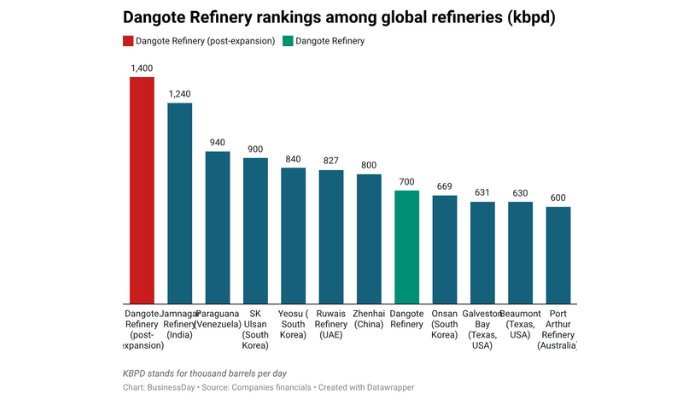
The Lagos facility has about 700,000 barrels a day of crude-processing capability, making it the world’s largest single-train refinery, according to Zedcrest. It also includes an 830,000-tonne-a-year polypropylene operation, storage facilities, marine infrastructure and a deep-sea jetty.
That configuration gives Dangote several ways to make money from the same crude barrel.
Instead of relying solely on petrol, the refinery can produce diesel, aviation fuel, LPG, naphtha, fuel oil and petrochemical feedstocks.
That flexibility matters at a time when demand for different petroleum products is moving in different directions.
The International Energy Agency estimates showed that electric vehicles displaced about 1.7 million barrels a day of oil demand in 2025, and that displacement could rise to about 5 million barrels a day by 2030 under current policies.
Petrol refining is likely to face the greatest pressure, while aviation fuel and middle distillates are expected to prove more resilient.
For Dangote, that creates an incentive to optimise its product slate rather than simply maximise petrol output.
The geography of demand also works in its favour.
Advanced economies are already seeing stagnant or declining oil consumption, while emerging economies, particularly in Asia and Africa, are expected to account for a larger share of incremental demand as populations grow, cities expand, and vehicle ownership increases.
Africa remains particularly attractive because refining capacity is low relative to its population and petroleum-product requirements.
That is where Dangote’s ambitions stretch beyond Nigeria.
The refinery is increasingly behaving less like an import-substitution plant and more like a regional merchant refinery. Nigerian seaborne petroleum-product shipments averaged about 561,000 barrels a day in the second quarter, with roughly 350,000 barrels a day exported, according to Zedcrest.
The planned expansion could amplify that role.
Dangote has announced a $14.3 billion expansion that would take processing capacity from about 700,000 barrels a day to 1.4 million barrels a day by 2029. Zedcrest said the project could put the refinery on a scale comparable to some of the world’s largest refining complexes.
But bigger is not automatically better.
The refinery already requires enormous quantities of crude. Nigeria’s production recovery, although encouraging, remains insufficient to comfortably supply a future 1.4 million-barrel-a-day facility while meeting exports and the requirements of other domestic refiners.
The refinery therefore cannot rely exclusively on Nigerian crude. It has increasingly operated as a merchant buyer, sourcing barrels internationally when domestic supplies are insufficient or commercial terms are unattractive.
That flexibility is itself a competitive advantage, according to experts.
Analysts at Zedcrest Research said over time, the key competitive advantage should therefore be viewed as logistics flexibility rather than simply lower freight costs.
“A large, modern refinery capable of combining domestic crude with international feedstocks and supplying both Nigeria and export markets is better positioned to optimise its delivered crude cost and product netbacks across different market conditions,” Zedcrest Research said.
It added, “This flexibility should become increasingly valuable as Dangote expands toward 1.4 mbpd and competes for crude and product-market share across the wider Atlantic Basin”.
Beyond the balance sheet, analysts are framing the IPO as a test of Nigeria’s retail investment culture.
Bismarck Rewane, managing director and chief executive officer of Financial Derivatives Company Limited, urged Nigerians to weigh the offer against the temptation to sell their Permanent Voter Cards for quick cash ahead of elections, a practice he said trades long-term value for short-term consumption.
“You are better off with your N5,000 share than selling your PVC for N10,000 or N15,000 and consuming it,” Rewane said.
He called the offer’s ambition to reach 10 million investors a milestone in itself.
“The reality is that targeting 10 million investors is also a milestone,” he said, adding that if the company reached that mark, “the Dangote Refinery will have the largest number of shareholders in the world.”
Fiona Ahimie, president of the Chartered Institute of Stockbrokers, said the listing gives Nigerians a stake in a strategically important asset.
“The refinery combines a strong integrated business model with the scale and strategic importance required to contribute meaningfully to the country’s energy security and industrial growth,” Ahimie said. “It also gives Nigerians an opportunity to participate in the ownership of an important national enterprise. Investors with a long-term outlook should consider being part of this opportunity.”
She said the offer could deepen public understanding of how Nigerian savings connect to productive enterprise, and that the country’s network of licensed stockbrokers stands ready to help investors through the process.
Sehinde Adenagbe, chairman of the Association of Securities Dealing Houses of Nigeria, said the offer adds depth to the market.
“Bringing an enterprise of this scale to the public market broadens participation, supports wealth creation and adds depth to Nigeria’s investment landscape,” Adenagbe said. “The stockbroking community welcomes the offer and is ready to support a seamless process so that investors across the country can take part.”


