

You have full access to this article via your institution.
Hello Nature readers, would you like to get this Briefing in your inbox free every day? Sign up here.
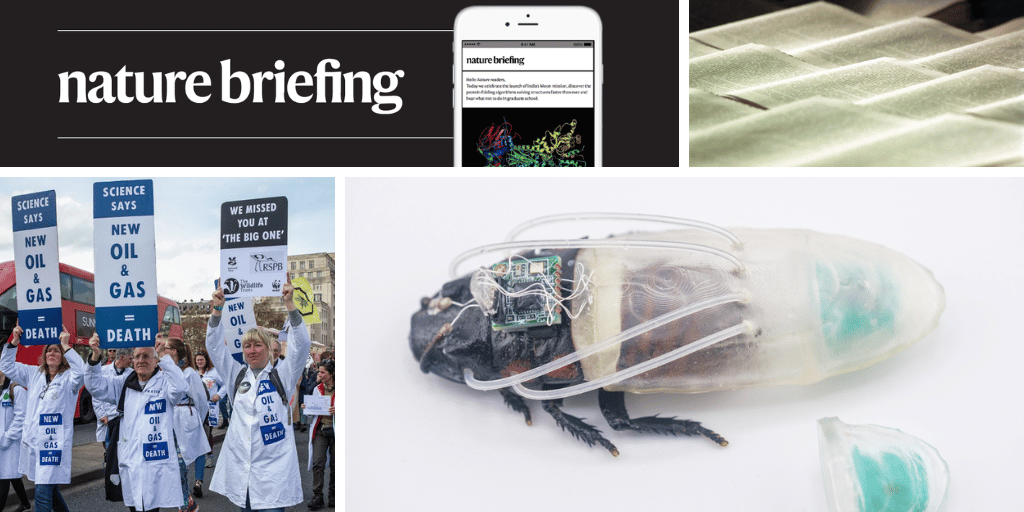
Remote-controlled insects could be used in search and rescue missions to explore dangerous areas or rubble that humans can’t access, researchers hope. (NTU Singapore)
Researchers have equipped ‘cyborg’ cockroaches with diving suits that enable the insects to breathe underwater. These Madagascar hissing cockroaches (Gromphadorhina portentosa) have electrodes attached to their brains and sensory organs that allow researchers to remotely control their movements. The new 3D-printed suits attach tubes to the insects’ breathing holes, called spiracles, that connect to a chemical oxygen generator. In underwater tests, the roaches could explore a variety of underwater terrain and traverse obstacles for up to three hours at speeds similar to those they could move at on land.
Reference: Nature Communications paper
Researchers have created an entirely synthetic cell that can feed, grow and reproduce. Dubbed ‘SpudCells’, the tiny blobs aren’t technically alive, but can perform some of the chemical reactions seen in living cells. “It’s a cell that was built, not born. It’s constructed, but it does what cells do,” says synthetic biologist Drew Endy. Scientists hope that humanmade cells like these can reveal secrets such as how many genes a cell needs to survive, or be engineered to produce compounds that natural cells can’t make.
The New York Times | 8 min read
Reference: biotic preprint (not peer reviewed)
Cancer research papers that appear to have been produced by paper mills — businesses that produce and sell low-quality or fraudulent manuscripts — garner double the citations than do genuine articles in the field. The problem appears to be self-propagating: in an analysis of tens of thousands of papers, researchers found that papers that were probably produced by paper mills frequently cite, or are cited by, other potentially fraudulent articles. This distortion of citations might also inflate the impact metrics of journals in molecular oncology, says statistician and study co-author Adrian Barnett.
Nature | 6 min read
Reference: bioRxiv preprint (not peer reviewed)
Features & opinion
Scientists need to acknowledge their own political biases to avoid eroding public trust in science, argues Mark Henderson, director of corporate affairs at the charitable foundation Wellcome. The scientific community can’t assume public support for their positions and should take care to ensure that science isn’t equated with membership in a wider liberal or progressive project. “If respect for science is bundled with wider political identity, people with more conservative values might feel pushed to reject science along with the politics,” Henderson writes.
Nature | 6 min read
In the waters of the Port of Miami, Florida, a community of coral is thriving — seemingly against all odds. Growing on hard materials such as concrete blocks and dumped shopping trolleys, the coral have stood strong in the face of disease, drastic swings in temperature and pollution that have caused bleaching in other Florida coral populations. The coral in the busy waters of the port are only a few decades old, and scientists think that human activity in the area could be what’s equipping these species with their unusual survival mechanisms. Now researchers are trying to work out how.
In The Political Economy of Rwanda’s Rise, economist Pritish Behuria details Rwanda’s bold attempt to transform its economy after the 1994 genocide. The nation has made impressive gains in health systems, technology and governance, but that has yet to translate into an industrial economy, Behuria writes. The book “is about much more than Rwanda”, says science writer Abdullahi Tsanni in his review. It “offers an important lesson: growth is not the same as transformation, and technological capability remains extremely difficult for nations to build”.
Nature | 7 min read
Today my skin is crawling as I watch ‘superworms’ (Zophobas morio) make quick work of the carcass of a little bittern (Botaurus minutus). The flesh-eating beetle larvae can clean the meat right off of animal bones in just a few hours, which could give museums a new way of preparing animal skeletons for display without damaging them.
Let us know if we need to clean up any areas of this newsletter at briefing@nature.com.
Thanks for reading,
Jacob Smith, associate editor, Nature Briefing
• Nature Briefing: Careers — insights, advice and award-winning journalism to help you optimize your working life
• Nature Briefing: Microbiology — the most abundant living entities on our planet — microorganisms — and the role they play in health, the environment and food systems
• Nature Briefing: Anthropocene — climate change, biodiversity, sustainability and geoengineering
• Nature Briefing: AI & Robotics — 100% written by humans, of course
• Nature Briefing: Cancer — a weekly newsletter written with cancer researchers in mind
• Nature Briefing: Translational Research — covers biotechnology, drug discovery and pharma
