

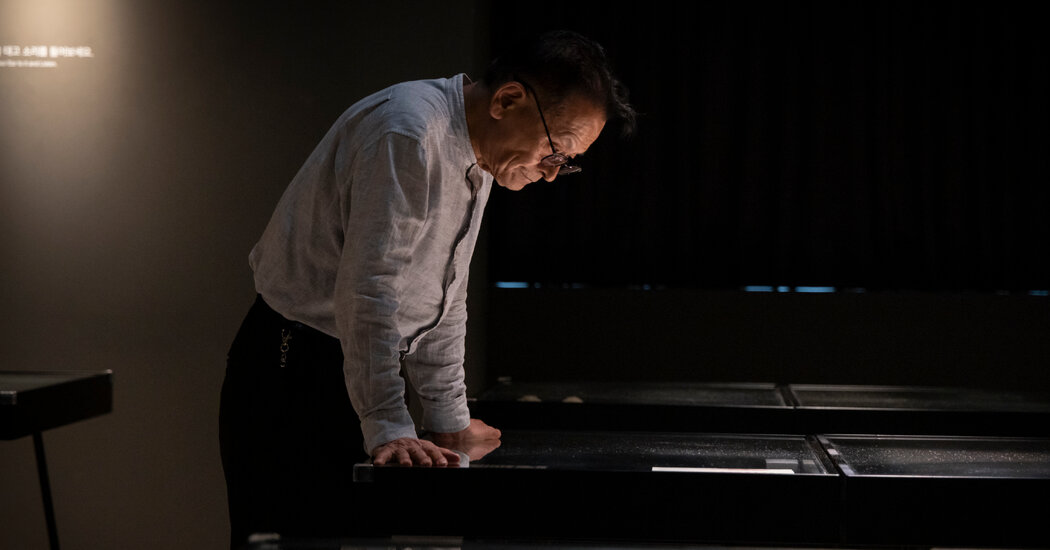
The matte black brick building has stood in the heart of Seoul for 50 years. It is also unusual for the slit-like windows that run across its fifth floor. Each looked out of small cells, some of which were painted blood red to evoke fear.
There, in 1981, South Korea’s military dictatorship tortured Yoo Dong-woo, a former factory worker, for organizing labor protests. His ribs were broken, some of his teeth were knocked out, and blood constantly pooled in his mouth.
“So, this is how a person dies,” he recalled thinking at the time.
Mr. Yoo and his cause survived. South Korea is now a raucous democracy. And, as of last summer, the site where he was beaten mercilessly, as were hundreds of others, is part of the National Museum of Korean Democracy. The exhibits — one describing the torture meted out to detainees is so gruesome that it is off-limits to young children — remind visitors of a past that must not be repeated.
But six months before the museum opened, South Koreans got a shocking echo of that period: President Yoon Suk Yeol declared martial law. The crisis was quickly averted, and Mr. Yoon is serving a life sentence in prison for insurrection. The museum is still deciding on how to acknowledge that episode, but in recent months South Koreans have gotten alarming reminders of the country’s dark history.
In May, a Starbucks promotion appeared to mock a massacre in the city of Gwangju in 1980, when the dictator Chun Doo-hwan deployed tanks and paratroopers to crush pro-democracy protesters. Shortly after, a high school baseball team from Seoul made headlines for taunting its opponents from Gwangju by chanting “Let’s go to Starbucks!” and “Tank Day!” Both episodes struck a nerve.
“I can’t help but feel that our past is still unfolding,” said Na Ji-hyun, who was visiting the museum last month. She had been detained at the building, known as the Namyeong-dong Anti-Communist Interrogation Office (dong means neighborhood in Korean) for more than a week in 1983.
Then 22, she got caught in the dictatorship’s dragnet because she was part of a group that gave night classes on literacy, math and social sciences to factory workers and housekeepers, and was seen by officials as a possible breeding ground of dissent. Interrogators coerced her cooperation by pointing to officers who were notorious for torture and recounting stories of past detainees who had died in their hands. She heard the screams of other prisoners who were being tortured down the hall.
“I didn’t know what was happening, and I couldn’t dare to ask,” Ms. Na said. While she was not beaten, she was questioned for hours on end and forced to write statements about her political ideology, education and social circle.
Even today on the fifth floor, sunlight seeps in thin slivers through windows that are barely a foot wide. They were designed to prevent inmates from jumping to their deaths or escaping. A circular staircase winds up, built in a way to disorient detainees as they were blindfolded and marched up the stairs to interrogation rooms.
Some of those cells have been recreated, and part of the grounds have been revamped; a tennis court where guards would enjoy their leisure time is now a courtyard.
But one cell has been preserved as a tribute to one of its former occupants, Park Jong-cheol, a student activist who died after being waterboarded at the building in 1987. His killing, which the authorities tried to cover up, helped catalyze mass protests that forced the government to agree to a free and direct presidential election.
The Starbucks promotion, for a tumbler, included a phrase — “Thump it on the desk” — that some critics said evoked Mr. Park’s death. The authorities had initially claimed that Mr. Park gasped and died after an interrogator slammed a desk in his cell. The company apologized and fired its chief executive in South Korea. In the other episode, the high school apologized and its baseball team was barred from nationwide competition for a month. The players went to the Gwangju school to apologize and 12 of them were punished by the school, though it did not disclose how.
“They are not matters that can simply be apologized away,” said Kim Chanho, a manager at the Korea Democracy Foundation, which operates the museum.
Many in South Korea have blamed the episodes on a lack of understanding of the country’s history. The museum can help fill this void, Mr. Kim said, but added that he believed society as a whole — civic groups, private companies and schools — had not fulfilled its collective duty in making sure that the country’s history is not forgotten.
“It’s great that we have a space like this to educate people and raise awareness,” Ms. Na said. “But doesn’t it feel like only people who already care or are experts come here? Shouldn’t people who don’t care also come?”
When Mr. Yoo was hauled in, guards demanded to know whether he was a communist or a socialist. He said he was neither, drawing their wrath. “They punched my face from both sides and kicked me so hard in the ribs I collapsed,” he said. “They hit me without mercy.” Accused of being a communist and anti-state agitator, he faced a trial for organizing an association of democratic workers and was released on probation after more than a month in detention at Namyeong and several more in another prison.
The trauma haunted him for years. He said that he suffered hallucinations and nightmares of being arrested again. Being at home induced panic, and he often wandered the streets and slept in public spaces for long stretches of time.
After military rule ended in 1987, the building was still used in secret by the police for interrogations targeting labor and left-leaning organizations, according to the museum. It was officially shut down in 2004 and renamed the National Police Agency Human Rights Center in 2005. But the continued police ownership prompted backlash from civic groups and victims, who argued that the agency that had carried out state torture should not have control over its memory. In 2018, President Moon Jae-in approved its conversion into a museum and the grounds were handed over to the Democracy Foundation.
Still, many South Koreans across the political spectrum hold conflicting views on their country’s turbulent modern history, with some far-right conservatives baselessly claiming that the Gwangju uprising was instigated by North Korean Communist agents.
“In such a polarized society like Korea how do you build an edifice that’s supposed to memorialize democracy when, in fact, a lot of the stuff hasn’t even been resolved by historians?” said Theodore Jun Yoo, a professor of cultural studies and history at Yonsei University in Seoul. “The public hasn’t agreed on all these issues,” he said.
Mr. Yoo, who is now in his late 70s, has worked as a docent at the museum, showing visitors the very places he was tortured.
“At first, even catching a glimpse of this building would make me shiver with dread,” he said. “But one day a thought struck me: Why should I be the one to be scared? It’s the perpetrators who should be scared.”
