

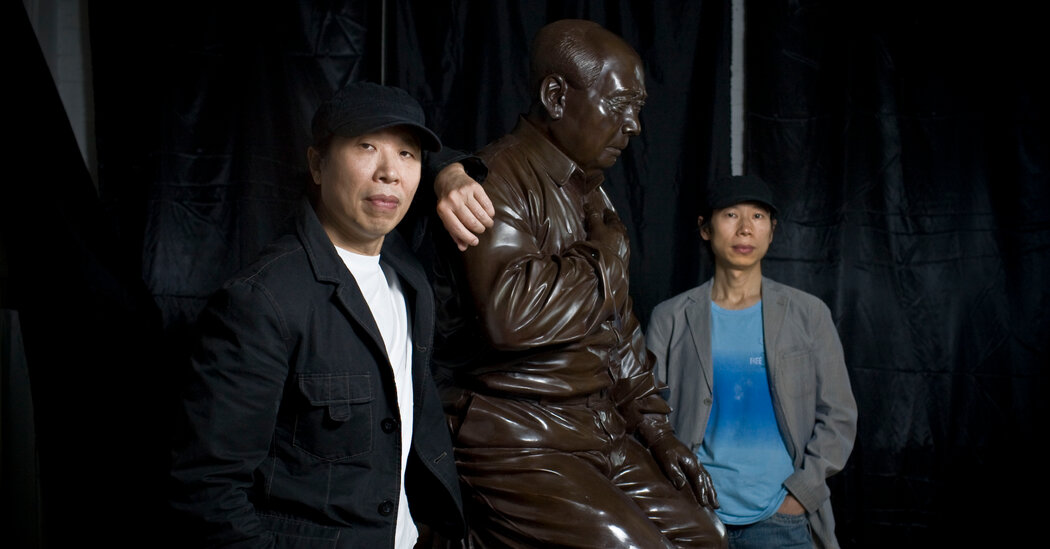
A Chinese court on Tuesday sentenced a prominent New York-based artist, Gao Zhen, to three years in prison for making irreverent sculptures of Mao Zedong more than 15 years ago, according to his wife.
The Sanhe City People’s Court in Hebei Province found Mr. Gao guilty of slandering one of the country’s heroes, highlighting the shrinking space for expression under China’s leader, Xi Jinping.
The case of Mr. Gao, who had emigrated to the United States and was detained in Beijing two years ago while visiting family, underlined the opacity of China’s legal system. The 70-year-old artist was tried during a one-day secret hearing in March that his family and U.S. diplomats were barred from attending. He was found guilty and sentenced during Tuesday’s hearing, which two of Mr. Gao’s other brothers were able to attend.
Mr. Gao is the elder of the artistic duo known as the Gao Brothers, who became famous during the early 2000s for their satirical and provocative takes on politically sensitive topics such as the Cultural Revolution, a decade of political turmoil unleashed by Mao, as well as the 1989 Tiananmen Square massacre.
The three-year sentence, the maximum Mr. Gao could have received, means that he will serve one more year in prison after two years’ detention. The artist plans to appeal the court’s decision.
Gao Qiang, Mr. Gao’s younger brother, who lives in New York and who worked with him on the Mao sculptures, said in a Facebook post before the sentencing that whatever the court decides, “history will ultimately judge the larger question: Whether an artist can be imprisoned for confronting history through art.”
“Gao Zhen has already lost nearly two years of freedom. He should go home,” Gao Qiang added.
Gao Zhen was arrested at his art studio on the outskirts of Beijing while visiting China in 2024. When his wife, Zhao Yaliang, tried to take the couple’s 7-year-old son, a U.S. citizen, back to the United States, she was barred from leaving. The two have remained in China, waiting for Mr. Gao’s release. Mr. Gao has refused to confess or plead guilty, according to Ms. Zhao.
The Gao brothers rose to prominence at a time of relative openness in China. While the police shut down their exhibitions, the two were able to continue working and became known for their creative antics while evading the authorities. They held underground art exhibitions and in the case of one especially provocative sculpture — a bronze statue of Mao kneeling in repentance, called “Mao’s Guilt” — they kept the head of the sculpture separate, bringing it out only for special viewings.
According to Ms. Zhao, that piece is one of three that prosecutors named in their evidence against Mr. Gao. The other two included a sculpture of Mao with breasts and a Pinocchio nose, and another that depicts a group of Mao likenesses with guns, preparing to execute Jesus.
Criticism of Mao, the former Chinese leader whose legacy is considered central to the legitimacy of the Chinese Communist Party, is strictly controlled. As part of a campaign to enforce the Party’s version of history, China has made it illegal to tarnish the reputation of historical figures or to question official narratives.
Mr. Gao was charged under that slander law, which was passed in 2018, years after he produced the sculptures of Mao. Journalists, stand-up comedians and regular citizens have been punished under the same law, but Mr. Gao’s case is one of the first times that it has been used retroactively.
People familiar with the case said Mr. Gao had been accused of disseminating images of the Mao sculptures online as recently as 2024, including on the cover of a biography of the former leader by a Chinese journalist who emigrated to the United States in the 1980s.
Shane Yi, a researcher at the nonprofit Chinese Human Rights Defenders, said that by targeting Mr. Gao, the Chinese authorities were able to remind overseas Chinese citizens that the state still had power over them whether they are abroad or back in China.
“But no matter which motive carries the most weight: A person has been locked up for two years over his art, and his wife and young son, a U.S. citizen, have been barred from leaving China this entire time,” he said.
Ms. Zhao said that her husband had been punished while in prison, including being deprived of food, and being barred from reading books and getting letters from his family.
Still, Mr. Gao has continued to make art, tearing pieces of plain paper to make portraits of his family. In a recent letter to his wife, Mr. Gao enclosed a poem: “Sleepless nights, tossing and turning, memories drift like clouds and smoke/Once a dragon slayer, now imprisoned, he has no regrets for mocking the wicked.”
Pei-Lin Wu contributed reporting.
