

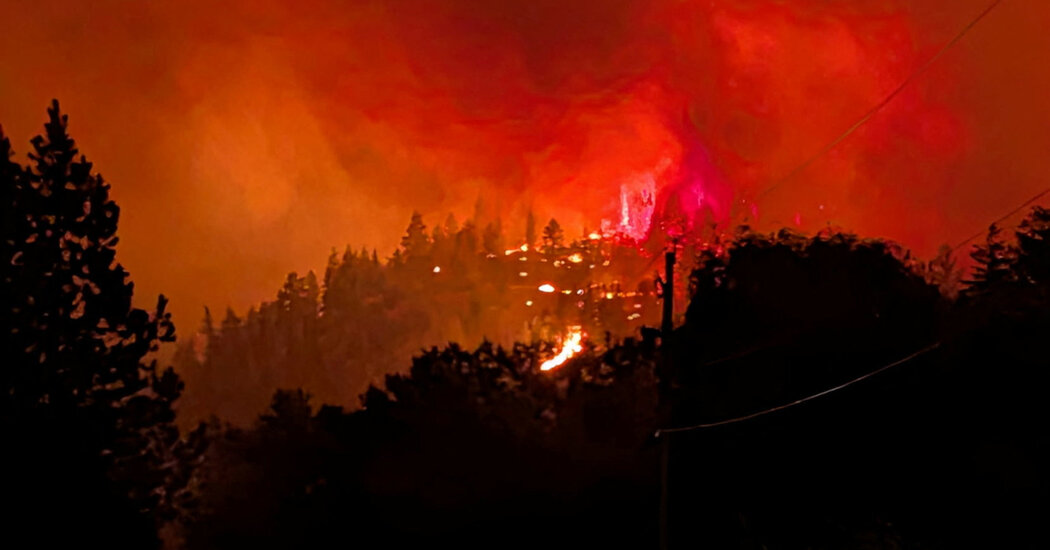
As August begins, Canada’s wildfire crisis has shifted increasingly westward, where spreading flames have triggered evacuations and a provincial state of emergency in British Columbia weeks after smoke from Ontario fires choked cities to the south.
An explosive wildfire forced the evacuation of roughly 20,000 people from several Okanagan Lake communities on Saturday. The Bald Range fire was discovered around 5:30 p.m. Pacific time on Friday, about 10 miles northwest of Summerland, burning just 20 acres. Four hours later it had erupted to nearly 12,400 acres, said Erick Thompson, spokesman for the Regional District of Okanagan-Similkameen emergency operations. The fire is considered out of control.
“This being like a bomb going off,” British Columbia Premier David Eby said Saturday at a news conference. “A remarkable escalation of fire activity.”
About 12,000 residents of Summerland were ordered out shortly after midnight, followed by an additional 8,000 in nearby Peachland. Both communities sit on the lake’s western edge, about 240 miles east of Vancouver.
In July, nearly 200 wildfires burning in northwestern Ontario sent smoke across a large swath of Canada and the United States, fouling the air for millions and forcing hundreds of evacuations near the fire zones.
Rain and lower temperatures since then in many parts of the country helped Canadian firefighters bring hundreds of blazes under control, but days of darkened skies and unhealthy air raised tensions with the United States. A group of Republican lawmakers last month criticized Ottawa’s handling of the fires, and President Trump threatened to impose tariffs on Canada to pay for harm caused by the smoke.
Prime Minister Mark Carney did not directly respond to the complaints by Republican lawmakers, but he suggested the United States should do more to combat climate change, which scientists say is a significant factor in creating bigger, longer and fiercer wildfires.
What is the status of the fires?
As of Aug. 8, nearly 630 wildfires were burning across Canada, and have razed the most forest acres in the Northwest Territories, Ontario and Quebec.
On Saturday afternoon, 105 wildfires were burning in British Columbia, according to the B.C. Wildfire Service. Erratic winds, lightning storms and hot temperatures have stoked the blazes and more than 20,000 people had evacuated in the Okanagan region.
Videos posted on social media showed homes in Summerland in flames and fire burning on both sides of local roads. At least 55 people were airlifted to safety, Mr. Thompson said in a video broadcast. The province’s wildfire service has warned boaters to stay off Okanagan Lake, in the interior region, so as not to obstruct water bombers refilling their loads.
As of Aug. 8, 110 fires were burning in northwestern Ontario, down considerably from July, when the blazes spread aggressively across the remote, northwest part of the province, sending acrid smoke across several major cities. About a dozen rural and Indigenous communities were forced to evacuate.
The smoke darkened skies from northern Ontario to the East Coast of the United States, leaving New York, Toronto and Washington at times with the worst air quality in the world.
Roughly 9.5 million acres have burned in Canada, according to the Canadian Interagency Forest Fire Center.
The wildfire season in Canada typically runs from April to October, with August the last peak month.
What is Canada doing?
Crews from Mexico have been dispatched to Canada to support hundreds of local firefighters, under an agreement between the countries, including the United States, to share fire resources in times of need.
About 100 Mexican firefighters arrived in British Columbia on Aug. 3, with another 200 landing a few days later. Ontario also received the help of 100 firefighters from Mexico,
Some evacuees in northwestern Ontario blamed local authorities for slow communication on the direction and danger of the fires. Officials, including Eleanor Olszewski, Canada’s minister of emergency management, have defended Canada’s forestry practices. “Warmer, drier weather is becoming more common, increasing wildfire risk in Canada and around the world,” Ms. Olszewski said in a statement in July.
Why is it so hard to control fires in Canada?
Most wildfires in Canada spread across such vast, remote areas that they cannot be fought effectively and are often left to burn, experts say.
Half of Canada’s wildfires, like the blazes in northern Ontario, burn in sparsely populated areas, said Michael Flannigan, an expert on fire management at Thompson Rivers University in British Columbia. They are most often accessible only by plane.
Even if it were possible to to deploy firefighters to such remote areas, there is rarely enough time to react. Ignited mostly by lightning, wildfires often spread widely in the highly combustible boreal forest before firefighters can respond within the first critical 30 minutes.
In the long run, wildfires are considered beneficial because they remove the most flammable material in forests, promoting regeneration. Extinguishing every fire increases risk, as Canadian officials have learned in managing national parks.
What is happening with the smoke?
Summer weather, like thunderstorms, can help clear smoke, but the smoke itself complicates the forecast. It can block sunlight, keeping temperatures lower at the surface and preventing storms from rising and intensifying.
As of early August, the smoke in Canada was concentrated in southern British Columbia and parts of northwestern Ontario.
Scientists estimate that wildfire smoke is linked to tens of thousands of deaths a year, and that human-caused climate change is responsible for a growing share of them.
