

From the comfort of his bed, Jonathan Rinaldi, a political candidate for a city council seat in Queens, New York, tinkered away on his iPhone, prompting an artificial intelligence chatbot to mock up fake news hits and endorsements he had never received.
During the campaign last October, Rinaldi shared one of those stories, made to appear real with a CNN logo, on his Facebook and Instagram. It stated that Lynn Schulman, his opponent and an incumbent Democrat, had been “forced to drop out of the race due to a series of critical mistakes”. But Schulman had not quit her campaign, and in November, won by a landslide.
Rinaldi felt these posts were “art” – and definitely protected political speech. “I made memes and political satire; nothing I did is fake,” he said. But local officials accused the 47-year-old vaccine skeptic and serial sperm donor of defrauding voters. On 24 June, he was arrested on misdemeanor forgery charges, in what appears to be one of the first times a candidate for office could face criminal penalties after using AI in their political messaging.
“Campaigns are full of lies, OK, ” Rinaldi told the Guardian in an interview. “What I’m saying is that I’m not doing anything different than anybody else.”
While this kind of enforcement is rare, and the laws used to level charges against Rinaldi predate and do not require the use of AI, the alleged deception at the heart of the case is emblematic of a fraught national debate about regulating AI in political communications.
Rinaldi disputes he violated any laws and worries about the free speech implications of being arrested for online activity. “It is very important for the police to not be able to arrest you on complaints for social media posts that are created by AI,” he said.
AI-generated ads are everywhere this election season. They mostly hype up candidates, or mock their opponents – often paid for by outside groups unaffiliated with the candidates. But their widespread use – and the occasional bad actor – are fueling concerns that deceptive political content could manipulate voters and amplify misinformation ahead of the November midterms.
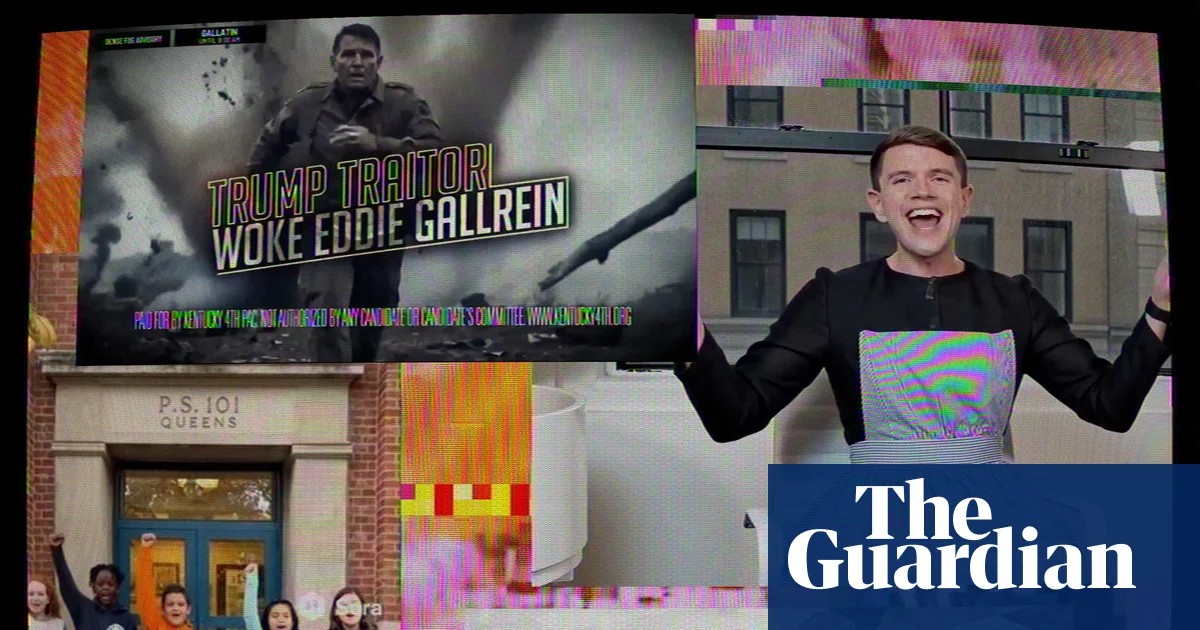
In congressional primary races across the country, attention-grabbing AI-generated ads are already sparking controversy. One video depicted James Talarico, a Texas Democratic Senate candidate, dressed as Maria from the Sound of Music and singing a version of My Favorite Things about trans kids. Another suggested Thomas Massie, a conservative Kentucky congressman, was “in a throuple” with progressive “Squad members”: showing the lawmakers holding hands as they checked into a hotel room. Spencer Pratt, a Los Angeles mayoral candidate, took on the role of Batman and portrayed his opponent Karen Bass, as the Joker in a bizarre digital spectacle that garnered millions of views and helped propel him from fringe outsider to serious contender.
“Most of these ads aren’t trying to convince people,” said Bruce Schneier, a fellow and lecturer at Harvard Kennedy School. “They’re about social signaling. What’s important is: my team gets to dunk on your team.”
Even the president is a fan. Donald Trump has leaned heavily into AI “slopaganda” – portraying himself as a king gracing the cover of Time magazine, a pope and a light-saber wielding Jedi. He also shared a racist video depicting former president Barack Obama and his wife Michelle as apes, fueling intense backlash. Trump later removed the post. During the 2024 presidential election, both he and Elon Musk shared AI-generated images of Kamala Harris at communist rallies. Just last week, Trump posted an AI video of himself posing as a doctor, with a stethoscope around his neck–claiming to have cured some of his most famous critics of “Trump derangement syndrome”.
Some uses of AI have been more deceptive. In the 2023 presidential primary, Ron DeSantis, the Florida governor, posted what looked like an AI-generated image of Trump hugging Dr Anthony Fauci – who had become a target of Republicans’ anger over his pandemic response strategy. In January 2024, a political consultant sent AI-generated robocalls mimicking Joe Biden to thousands of voters two days before the state’s presidential primary; the fake Biden suggested people vote in the November election instead, and that their ballot wouldn’t make a difference in January.
Experts warn that sophisticated new AI tools have made it far easier to manufacture and amplify misinformation at a mass scale. The public shares those concerns, too. A March 2026 poll from PBS News, NPR and Maris found that 85% of Americans say it is likely that AI-generated political content will spread misinformation about November’s elections. The scale of distrust held up across Democrats, Republicans and independents.
The Brennan Center for Justice is pushing the Federal Election Commission to act decisively on “deliberately deceptive AI-produced content” for fear that deepfakes impersonating candidates “are likely to become an increasingly effective tool for defrauding donors”. US law bans federal candidates and their agents from fraudulently misrepresenting themselves to be “speaking or writing or otherwise acting” on behalf of another candidate or political party “on a matter which is damaging” to the one being misrepresented. But that doesn’t always translate into enforcement.
While there’s generally a high bar to protect political speech, more than 30 states have enacted laws regulating the use of deepfakes in political messaging. Most are focused on disclosures, such as stating the inclusion of deepfakes and AI, or highlighting who paid for the ad. Minnesota and Texas ban the use of deepfakes for a certain number of days leading up to an election. California and Hawaii’s deepfake bans were struck down by federal courts for being overly broad and infringing on the first amendment.
“All the existing regulatory framework we have around political communication is quite muddled and there’s a long history of that muddle leading to confusion and very poor and non-rigorous enforcement of the rules,” said Nathan Sanders, a data scientist at Harvard.
Old problem, new challenges
In his bid for city council, Rinaldi, according to the prosecutor’s complaint, prompted AI to dress up his opponent in a “Hot Girls for Zohran” T-shirt. He also posted images and videos falsely stating he had the backing of many local groups, including a police precinct, students at an elementary school and a Jewish interest group. Made-up children – some with their fists raised – chanted outside of a building labeled PS 101 Queens: “Make it real. Make it Rinaldi. Let our voices shine.”
According to the filing, Heather Bennett-Idels, founder of the Queens Jewish Alliance, confronted Rinaldi after he shared an image promoting the group’s endorsement of him. The group had, in fact, endorsed his opponent. “It’s dishonest to have a fake thing up,” she told him.
after newsletter promotion
“It’s politics,” Rinaldi responded.
Experts agree with the idea that candidates lying is as old as politics itself. “The things we’re afraid of with AI are things that have been part of politics since the beginning of politics,” said Peter Loge, director of George Washington University’s project on ethics in political communication. In the 18th century, Benjamin Franklin published a fake supplement to a Boston newspaper with false news about the British – “compelling nonsense for political goals – nothing to do with AI”, Loge says. Still, the new technology poses unique challenges. “AI makes it easier to lie at scale more than ever before. But the problem isn’t the tech, it’s the lie,” he adds.
Politicians who want to mislead voters already have many ways to do so without AI: they can film an actor in a wig, or turn to photoshop or computer-generated imagery (CGI).
Many political consultants recognize the risks of bad actors using AI but argue the tools can have a democratizing effect. Advertising and media are traditionally the most expensive part of a political campaign. Now, access to free or low-cost AI tools means candidates with less money can create content that is on par with opponents who have much larger budgets, they say.
“AI is a tool for producing truthful content. It can also be a tool for producing not truthful content,” said Julie Sweet, who leads the American Association of Political Consultants’ (AAPC) work on AI and modern political communication.
The AAPC produced a “meaningful disclosure framework” that advises members not to publish content in which synthetic audio or video that’s realistic enough to be mistaken for a genuine recording, generates words the opponent never said, or depicts them at a meeting or location they never attended. For cases in which AI re-creates a specific documented public event from news reports, or enhances an opponent’s photo to look unflattering, it’s worth disclosing, they say. For more innocuous uses of AI, such as translating a candidate’s English speech into Spanish, or a voice clone reading the candidate’s own approved script, the group says that disclosure may not be necessary.
Although members’ views on regulation vary, Sweet says state-mandated disclaimers – particularly ones that require the words “fake” or “manipulated” for AI use in political communications, can reduce trust with the audience, even in cases that don’t have anything to do with deception.
The group instead advises the use of terms such as “dramatization”, “simulation”, “re-enactment”, “synthetic voice”, “translated” and “image enhanced or altered”.
Amid constantly changing regulations, at least one AI tool has baked state laws into their user interface. BattlegroundAI helps users build video, image and text ads for political candidates that complies with current regulations. (That includes the number of seconds a disclaimer needs to run, and particular font sizes).
“Maybe this technology is giving bad actors a slightly lower bar to entry into lying but that is absolutely not a representation of the collective,” said Maya Hutchinson, BattlegroundAI’s founder.
Political researchers and experts expect an explosion of AI-generated political content. As free tools have dramatically lowered financial and technical barriers, candidates can now pump out polished, hyper-personalized campaign materials – in Rinaldi’s case, from his bed in Queens. Undeterred by his loss, he’s now focused on a new campaign: running for state assembly.
“I’m utilizing tools at my disposal to go against the power structure,” Rinaldi said. “And I have to do things that they do not expect because if I just did the same thing that everybody else did, I don’t have a shot.”
