

Unlock the Editor’s Digest for free
Roula Khalaf, Editor of the FT, selects her favourite stories in this weekly newsletter.
Andy Burnham has warned that Britain is a “tinderbox” after a summer of intense heat and drought, but he faced criticism after confirming his government would look at watering down targets for electric vehicle sales.
The prime minister said Britain had to “face up” to the changing climate, as he visited the scene of one of 37 fires across England and Wales, and the nation’s water and transport infrastructure felt the strain.
Burnham announced 100 military personnel had been deployed to a wildfire in South Wales to offer “critically needed” support to firefighters.
He also unveiled a time-limited ban on the sale of disposable barbecues, telling the BBC: “We’re going into a difficult weekend, please just think about the situation that we’re in.
“Britain is a tinderbox right now. Setting a fire in any outdoor setting of any kind is a risk to other people’s homes, it’s a risk to other people’s lives, don’t do it, please don’t do it.”
Millions of people in England and Wales received an emergency government alert on their mobiles around 7pm on Friday, warning them against lighting anything that could spark a wildfire, including barbecues, campfires and fireworks.
The National Fire Chiefs Council on Friday said there had been 1,085 wildfires across the UK so far this year, already surpassing the record 1,017 set in 2025.
NFCC chair Phil Garrigan said the events of the last 24 hours should be a “wake-up call”.
But Burnham has also come into government with a promise to take jobs and growth into account when framing policies to tackle climate change, including over the mandate for EV sales.
The government said it would look at watering down EV sales targets, in proposals campaign groups warned could add millions of tonnes to the UK’s CO₂ emissions in the coming decade.
Under current rules, some 80 per cent of new cars sold in 2030 have to be zero-emission vehicles such as battery EVs. The government is exploring dropping this to as low as 50 per cent — though an outright ban on the sale of new petrol and diesel cars by 2035 will remain in place.
Heidi Alexander, transport secretary, said: “It’s right we keep targets under review to ensure they’re practical and back British industry. The end goal hasn’t changed — but we need to take business with us on the journey.”
Ami McCarthy, Greenpeace UK’s head of politics, said weakening the rules would be “a wrong turn for drivers, energy security, our climate and the economy”.
Burnham has also promised to take a “pragmatic” approach to drilling for oil and gas in the UK North Sea, with a big decision looming on whether to approve the Jackdaw and Rosebank projects.
However, he has vowed to stick to Labour’s promise not to approve licences for exploration in new fields in the North Sea basin.
As the UK sweltered through its fifth heatwave in recent months, a temperature of 38.1C was recorded at Kew Gardens in west London on Thursday, making it officially the hottest day of the year so far.
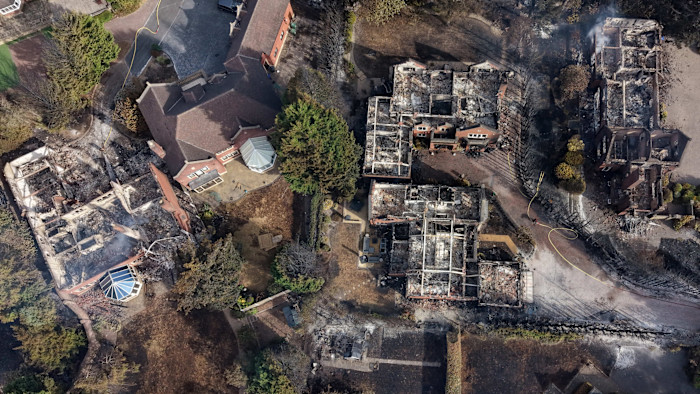
On Friday Burnham visited Stourbridge in the West Midlands, where a fire that started on grass had spread to nearby houses, destroying 19 homes.
He said he planned to commission firefighting planes to combat the spread of wildfires, such as the blaze in the New Forest this week.
The Cabinet Office said the 100 military personnel deployed to South Wales — from the Queen’s Own Gurkha Logistic Regiment and 22 Royal Engineers — will focus on logistical support and water distribution to enable firefighters to concentrate on “frontline firefighting”. A further 100 personnel are due in the area later, following a request for help from the South Wales Fire and Rescue Service.
The latest heatwave has added to pressure on the nation’s water supplies and played havoc with the railways, with trains cancelled due to speed restrictions and several rail lines affected by nearby fires.
A second passenger train derailed on Friday, less than 24 hours after an incident that injured 20 people.
A Greater Anglia service from Southend to London Liverpool Street came off the track at Wickford in Essex, though the train remained upright. British Transport Police said there were no reported injuries.
But it comes after the derailment on Thursday of a Southern Railway service from London Victoria to Eastbourne, in which the last three carriages overturned close to Lewes in East Sussex.
Police said two people were seriously injured and another 18 suffered less serious injuries in the incident.
While the causes of both derailments have not yet been determined, Network Rail, which manages UK rail infrastructure, has warned that track can buckle in extreme heat.
“The unprecedented hot and dry weather that we have experienced this summer has presented exceptional challenges to the railway,” said Network Rail’s safety and engineering director Martin Frobisher.

