

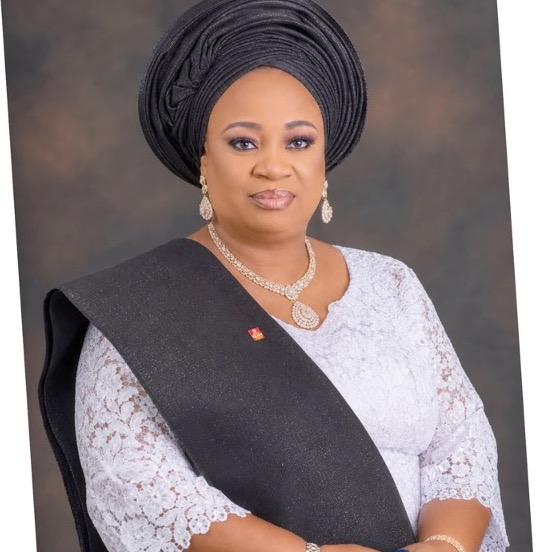
Whether steering a security company in a male-dominated industry or rising through the ranks of Rotary, Bukola Bakare has consistently chosen service over status. Now, as the first woman to serve as District Governor of Rotary District 9111, she is determined to leave behind more than a historic milestone, writes Vanessa Obioha
On July 1, 2026, Bukola Bakare officially began her tenure as the first female district governor for Rotary District 9111. In her welcome letter to members, she outlined her vision and mission, pledging accessible leadership through collaboration, transparency, and support for every club in the district.
At her installation ceremony, she reiterated that commitment. Only a few women have served as district governors in the Rotary Club in Nigeria. For Bakare, whose life’s journey is dotted with resilience and valiance, her investiture is more about responsibilities than titles. Having occupied different positions in the Rotary Club since she joined in 2013 – from Club Secretary to Club President to Assistant Governor – her new position, as she puts it, is a call to serve at a higher level.
“Looking back now, I can see that every assignment, every challenge and every opportunity was preparing me for this moment,” she said.
The significance of her historic milestone is not lost on her, particularly at a time when women remain underrepresented in sectors such as security, where men dominate executive positions. But Bakare has never viewed barriers as reasons to retreat. It is a landscape that she is well familiar with.
From an early age, she evinced the traits of a fearless and compassionate leader.
“I was very much a tomboy growing up,” she recounted, laughing. “I was adventurous, energetic, curious and never afraid to ask questions. I climbed trees, played with the boys, challenged opinions and sometimes got into trouble because I refused to accept that certain things could not be done.”
Her adventurous spirit was matched by a deep sense of justice.
“If I saw someone being bullied or treated unfairly, I found it difficult to look away. Even as a little girl, I felt compelled to speak up for people who could not defend themselves. At the time, I don’t think anyone imagined those traits would one day become leadership qualities. Looking back now, however, I realise they were preparing me for the responsibilities I carry today.”
Those childhood experiences shaped her understanding of leadership as an exercise in courage, difficult decision-making and conviction, even when standing alone.
Her curiosity is equally seen in her academic background spanning media, marketing, management and criminology.
“I’ve always been fascinated by people,” she said, explaining her interest in these fields. “Why people think the way they do, why organisations succeed or fail, why societies develop differently, how communication shapes perception, how leadership influences behaviour.”
While Mass Communication, her first diploma, taught her that communication is more about connecting, influencing and inspiring, her postgraduate diploma in Marketing taught her that every organisation must understand people before it can serve them effectively.
“Whether you are selling a product, leading a business or mobilising volunteers for Rotary, understanding people remains essential,” she added.
Her interest in Criminology emerged through her career in private security.
“I wanted to understand crime beyond what we see on the surface. Too often, society focuses only on the criminal act. I wanted to understand why crime happens in the first place. What social conditions produce crime? What role do poverty, unemployment, poor education, substance abuse and weak institutions play? How can prevention become more effective than reaction?”
Even today, those questions continue to fascinate her and influence how she approaches leadership.
“Good leaders do not simply solve problems; they try to understand why the problems exist. Once you understand root causes, your solutions become more sustainable. That philosophy guides me both in business and in Rotary.”
Her years in security have convinced her that crime is often rooted in poverty, unemployment, poor education, substance abuse, weak institutions and social exclusion.
“Of course, there will always be individuals who deliberately choose criminal behaviour despite having opportunities, but when large numbers of young people become vulnerable to crime, society must ask deeper questions. Why are they vulnerable? What opportunities were missing? What support systems failed?”
“As someone who has worked in security management for many years,” she added. “I have learned that security is not simply about guards, gates, surveillance systems or patrol vehicles. Real security begins long before those measures become necessary. It begins with strong families, quality education, meaningful employment, responsible leadership, functional institutions and communities where people feel included rather than abandoned.”
That philosophy aligns naturally with Rotary’s emphasis on community development.
“Rotary’s strength lies in prevention rather than reaction. We may not carry arms or enforce the law, but we help create the kind of communities where crime is less likely to thrive.”
Few women head security outfits in Nigeria. Bakare belongs to that rarefied world. As the CEO of Around ‘D’ Clock Security Company Limited, she has built the company as one of the top security firms in Nigeria, handling complex tasks and operations in an industry that is perceived as a man’s world.
“There was a widespread assumption that security was a man’s job. Many people believed women were better suited to administrative or supportive roles rather than operational leadership,” she recalled.
Rather than allowing stereotypes to define her career, she relied on competence.
“There were times when people walked into meetings expecting to see a man as the Managing Director or Chief Executive. Some were visibly surprised when I introduced myself. Occasionally, I could sense the initial doubt in their minds. But I also learned that people change their opinions very quickly when they encounter professionalism, knowledge and results.”
One of the lessons she learnt during that period is that confidence is extremely important.
“If you do not believe in your own abilities, it becomes difficult to convince others to believe in you. At the same time, confidence must be supported by preparation. You cannot rely on confidence alone. You must know your work, continue learning and constantly improve yourself.”
As she takes on the baton of leadership in Rotary District 9111, Bakare is reminded of why she joined the club in the first place. It was on November 14, 2013, that the then-President of the Rotary Club of Ikeja GRA, Rotarian Ade Akinfolurin, invited her to attend a meeting.
“Interestingly, my husband had been a Rotarian years earlier while he lived in Kano, so Rotary was not entirely unfamiliar to me. I had heard about it, but I had never really experienced it. I accepted the invitation out of curiosity, thinking I would simply attend one meeting and leave.”
That meeting, she revealed, changed the course of her life.
“What struck me immediately was not the formality of the meeting or the calibre of professionals in the room. It was the sincerity of their commitment to service. These were accomplished men and women who had demanding careers and businesses, yet they willingly devoted their time, resources and expertise to solving problems in their communities. People simply wanted to make life better for others, and that touched me deeply.”
Bakare was already an accomplished professional and entrepreneur at this stage, but found joy in using her success to impact lives. The values of integrity, friendship, diversity, leadership and service that have always been the bedrock of the club still exist today, but in a world with more complex challenges, Bakare is taking things a step further.
She wants Rotary District 9111 to respond boldly to today’s challenges by focusing on mental health, youth unemployment, climate change, peacebuilding, education, disease prevention and economic empowerment. She also hopes to raise at least $700,000 for The Rotary Foundation, deepen collaboration among clubs, strengthen mentorship and forge new partnerships.
Perhaps most importantly, she wants Rotary to tell its own story better.
“Rotary has one of the greatest stories in the world, yet we are sometimes too modest about telling it. We have almost eradicated polio, we build schools, we provide clean water, we restore sight, support education, promote peace and empower women and young people. Yet many people still ask, ‘What exactly is Rotary?’ That tells me we have not told our story well enough.”
For Bakare, success will not be measured by the distinction of being the district’s first female governor, but by the lives transformed under her watch.
“If, at the end of my tenure, more people have hope, more communities have been transformed, our clubs are stronger, our membership has grown, our contribution to The Rotary Foundation has increased, and District 9111 has become even more impactful, then I will consider my tenure successful.”
