

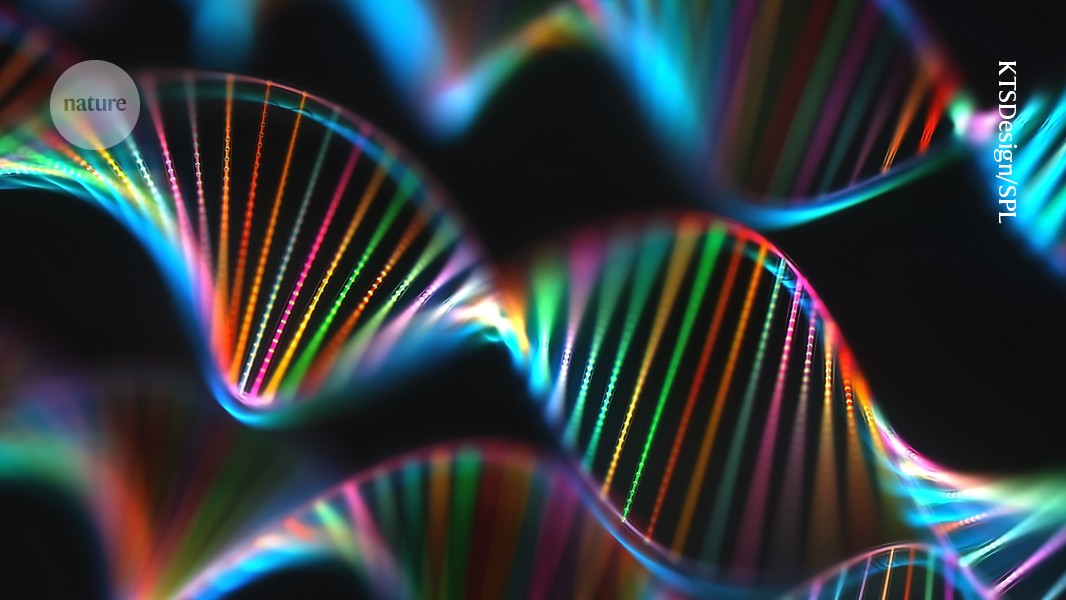
A bacterial enzyme that indiscriminately slashes DNA (artist’s illustration) has been harnessed to kill cancer cells. Credit: KTSDesign/Science Photo Library
Scientists have exploited a peculiar CRISPR enzyme so that it fights cancer by shredding the DNA in cancer cells, causing them to self-destruct.
The enzyme can be programmed to recognize a specific messenger RNA, such as one made by a cancer cell. Once the enzyme finds its partner, it slashes the cell’s genome to pieces.
The DNA-shredding approach, reported in two papers in Nature1,2, could provide a way for researchers to kill cancer cells that express ‘undruggable’ mutant proteins that have been difficult to target using conventional medicines.
CRISPR’s next act: the companies editing the epigenome to treat disease
“It’s a molecular kill switch that recognizes a particular RNA,” says Yang Liu, a molecular biologist at the University of Utah School of Medicine in Salt Lake City, and an author of one of the papers. “This is basically a programmable chemotherapy.”
A therapy that uses this approach to target head and neck cancers caused by human papillomavirus (HPV) is already in early development at Akribion Therapeutics, a biotechnology company in Zwingenberg, Germany. The goal is to produce the first clinical-trial data by 2030, says company co-founder Paul Scholz, who is head of research and development at Akribion and a co-author of one of the papers.
Bacterial defenders
CRISPR systems occur naturally in bacteria and other microorganisms, in which they act as a protective immune mechanism. Some CRISPR systems use RNAs that direct CRISPR-associated (Cas) enzymes to target stretches of DNA in viruses and other invaders. The Cas enzyme then cuts the DNA, destroying the interloper. For more than a decade, researchers have harnessed and modified such systems to edit genomes, creating their own guide RNAs to direct the Cas enzymes to a desired site for editing.
But not all Cas enzymes are equal. Nearly ten years ago, Ryan Jackson, a biochemist at Utah State University in Logan, and his colleagues set about trying to work out the mechanism of a Cas protein, called Cas12a2. Their assumption, he says, was that the enzyme would function much like other Cas proteins used for gene editing.
Landmark cancer trial shows success against ‘undruggable’ cancer — raising hopes for future treatments
But assay after assay in the laboratory failed. “We said, ‘Well this is not behaving the way we want,’” Jackson says. “I accused my students of contaminating the protein.”
Eventually, he and his colleagues, as well as another team, realized that Cas12a2 was different. After recognizing RNA sequences that matched its guide RNA, it went wild and indiscriminately chewed up DNA, causing the infected cell to stop growing3,4. In nature, this could then limit the spread of an infection through the population.
“How the hell does nature come up with a trick like that?” says Rene Bernards, a cancer geneticist at the Netherlands Cancer Institute in Amsterdam. “But, whatever. We can make good use of it.”
Targeted killer
Now, two teams of researchers have done just that. Both turned their attention to cancer, and specifically to tumours driven by mutant proteins that scientists have struggled to target using conventional means. One group pointed its Cas12a2 towards RNA made by cells, including those with a mutation in the TP53 gene, which is altered in up to half of all cancers. The other group targeted RNA made from a mutated version of the KRAS gene. Mutant KRAS proteins can cause cells to grow out of control and are responsible for some of the deadliest cancers.
