

Los Lunas, New Mexico
A company has started to build a fusion machine that it hopes will be the first to generate more energy than it consumes, thanks to the use of immense pulses of electricity to squeeze capsules of hydrogen fuel. The billion-dollar facility, which will sit down the road from a major US nuclear-weapons laboratory, could also be used for research on the country’s ageing stockpile of nuclear warheads.
“It is going to be transformative for both fusion energy and defence applications,” says physicist Keith LeChien, who is chief technology officer and co-founder at the firm, Pacific Fusion.
How the world’s biggest laser smashed a nuclear-fusion record
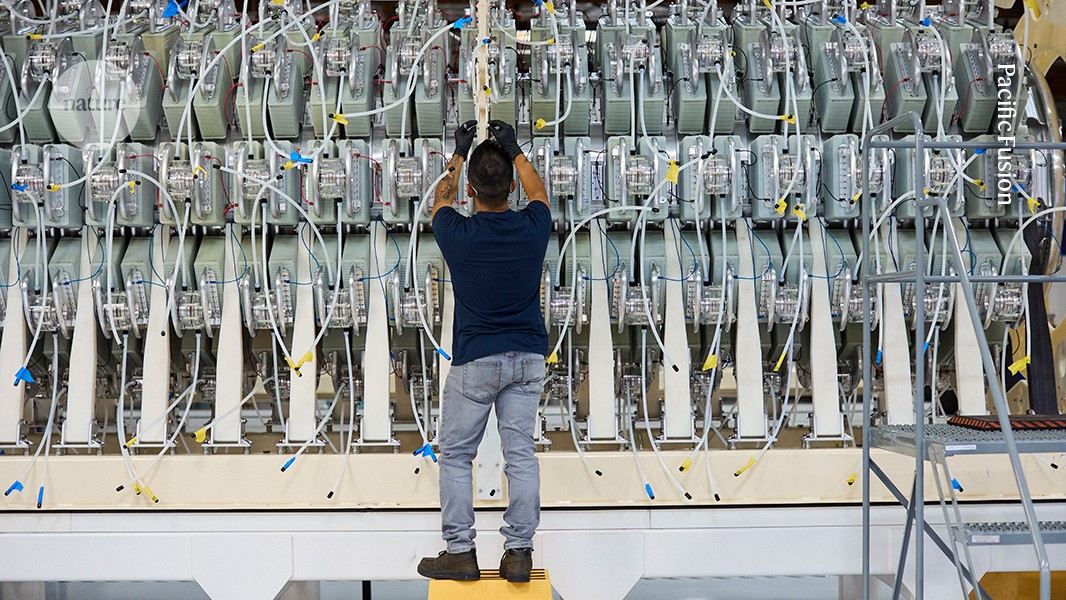
Earlier this month, Nature visited the warehouse in Los Lunas, New Mexico, where Pacific Fusion is assembling key components of its machine. Beneath a wall-sized American flag, workers and a few industrial robots pieced together the first two of more than 150 truck-sized modules called impedance-matched Marx generators. These cylindrical banks of capacitors will be arranged around a central reaction chamber, a bit like the legs of a giant metal crab. The modules are intended to fire in parallel to generate an electrical pulse that packs a punch thousands of times greater than a lightning bolt, and direct it to a pea-sized fuel capsule at the machine’s centre.
The idea is that the enormous current will generate a powerful magnetic field around the fuel capsule, compressing it. With sufficient heating and pressure, the nuclei of the hydrogen isotopes will meld to form helium, releasing energy.
Pacific Fusion is ramping up production rapidly. The company’s goal is to achieve ‘net facility gain’ — the point at which the machine generates more energy than it uses — by the end of the decade. This benchmark is an important step towards the dream of a fusion power plant that supplies virtually limitless clean energy.
Several fusion researchers told Nature that this ‘pulsed power’ technique for initiating fusion is promising. But “there’s still a long ways to go”, says Michael Campbell, a fusion engineer at the University of California, San Diego.
Fusion euphoria
Pacific Fusion, headquartered in Fremont, California, is one of dozens of fusion start-ups that have collectively raised more than US$14 billion of investment in the past five years. Pacific Fusion alone has raised more than $1 billion since it was founded in 2023, contingent on reaching certain technological milestones.
The surge in investment has been spurred in part by the success of the US National Ignition Facility (NIF) in Livermore, California. In 2022, researchers there aimed 192 lasers at a pellet of hydrogen fuel and achieved ‘ignition’ for the first time, generating more energy from the fusion reaction than what hit the target. But NIF has not achieved net facility gain, because the amount of energy released in the fusion reaction was much less than the amount used by the entire facility.

Nature visited a warehouse on the outskirts of Albuquerque, New Mexico, where Pacific Fusion is assembling pieces of its fusion machine. Credit: James Dinneen/Nature
This was widely seen as a demonstration that researchers were on the right track to a fusion-powered future. The trouble has been translating that experiment into a practical power plant that operates around the clock.
“One of the reasons you see so many companies with different approaches is that the answer isn’t obvious,” says Kyle Peterson, a plasma physicist at Sandia National Laboratories in Albuquerque, New Mexico. Sandia, which focuses on national security research, is working cooperatively with Pacific Fusion to optimize the pulsed-power fusion technique for both energy and weapons applications.
Lasers versus lightning
A handful of start-ups, including Pacific Fusion and First Light Fusion in Yarnton, UK, are working to replicate NIF’s success — but by using huge pulses of electricity instead of a multitude of lasers.
The main advantage of pulsed power is that it is more energy efficient than lasers are, LeChien says. At NIF, less than 1% of the energy used to fire the lasers reaches the hydrogen-fuel capsule at the centre of the machine. That’s because the initial electrical charge used to power the lasers is converted to several other forms of energy — light, X-rays, kinetic energy — before it reaches the target, with losses at each stage.
Nuclear-fusion firm says plant will deliver electricity to grid — but big questions remain
Pulsed power offers a more direct route from electrical charge to compression of the target. In Pacific Fusion’s design, around 12% of the energy in the initial charge should reach the target, according to LeChien. He expects the demonstration facility to use about 80 megajoules of electrical energy to charge the capacitors for each pulse. Each ‘shot’ would then yield about 100 megajoules of fusion energy, representing a net facility gain.
If the machine in New Mexico could do that, “it would be a very good achievement”, Campbell says. “If you ever want to produce electricity, you have to produce more energy from every shot than you take” from the power grid.
Even if Pacific Fusion’s design works as expected, however, the initial energy gain from each pulse would be about one-fifth of what is needed to operate a power plant, requiring more basic physics research to improve yields, LeChien says. Working out how to operate the facility continuously to generate sustained fusion energy will involve other substantial engineering challenges.
