

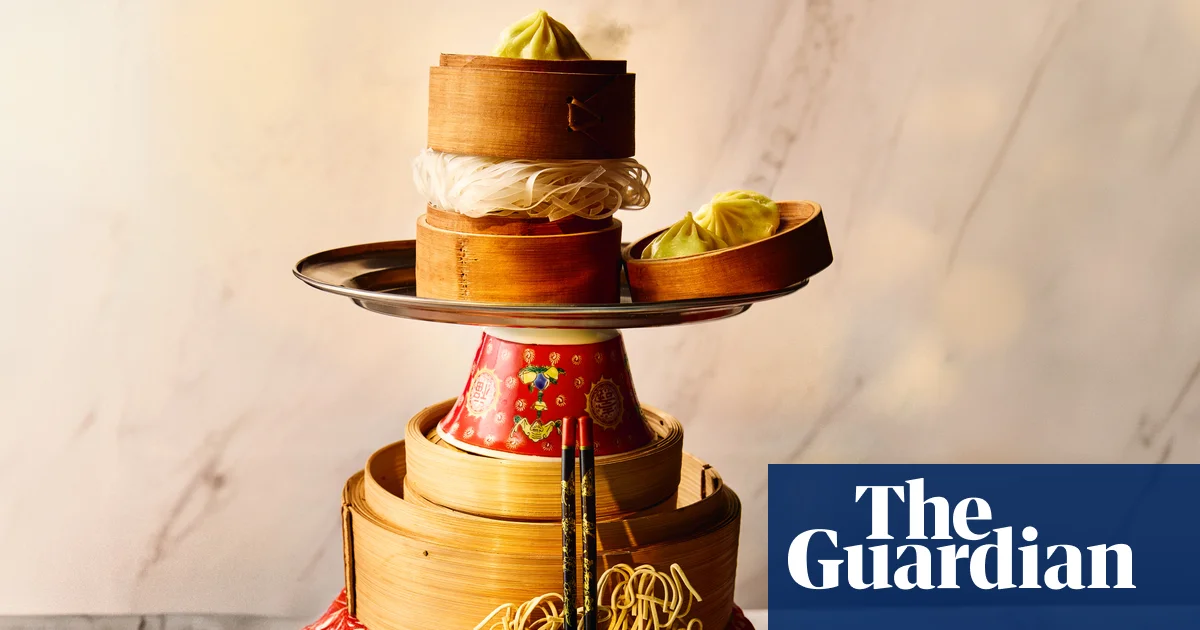
Whenever someone asks what my death row meal would be, I say dim sum without fail. It’s cheating, I know; a loophole where you don’t have to choose. I’ve spent more time thinking about it than I’d like to admit, but what I love most about dim sum is that you never have the same experience twice – a bit like snowflakes, no two are ever the same.
Dim sum covers all bases – there’s no settling on one thing: it’s a chance to sample everything as you work your way through the menu. It doesn’t fit neatly into starters, mains and desserts, but exists as its own genre, borderless and all-encompassing. It’s overwhelming, loud and chaotic for first-timers; an assault on all the senses, but in the best way.
I grew up eating like this, Sunday after Sunday, with my family, extended family, family friends, and aunties and uncles who weren’t really relatives but felt like blood. It often felt as though the entire Welsh Chinese population descended en masse on Happy Gathering, one of the few and oldest-running Chinese restaurants in Cardiff. Most of the Hui clan held their wedding receptions here; in a way, it became our restaurant and a kind of rite of passage. We picked at food, the adults gossiped, children doodled on the paper tablecloths between bites, and drank pots of refillable pu’erh tea at a leisurely pace for hours on end. Westerners have Sunday roasts; we have dim sum.
Every week, we returned to the same round table and gathered at the altar of bamboo baskets, thudded down one after another until they crowded every inch of space. We lifted the lids and steam rushed out in soft clouds, revealing small, intricate dishes inside. The stacks grew higher and higher, wobbling, until the person opposite disappeared from view. We shuffled plates, nudged baskets, and squeezed everything in, playing a game of Tetris to make room for more.
When it comes to dim sum, there are no half measures. I turn into No-Face from Spirited Away, feasting, demanding more and hoovering everything up: crispy, chewy ham sui gok meat croquettes; charred XO stir-fried turnip cake with frilly edges and a fudgy centre; juicy braised chicken feet, tender and rich from soaking up the sauce. I’ve decided heaven isn’t somewhere above the clouds, and it certainly doesn’t sit behind pearly gates. Heaven arrives at the round table before me in dainty portions, tucked inside steamer baskets.
It’s the lid lifting off the har gau, steam rising so quickly it fogs your glasses, before you bite through the crystal, delicately pleated skin and hit the snap of prawn inside. It’s the slow peel of a lotus leaf from the lo mai gai, damp and fragrant, revealing a tightly packed sticky rice studded with shiitake mushrooms, lap cheong sausage and chicken. It’s tearing into a char siu bao, the soft, cloud-like bun giving way as the sweet barbecue pork spills out like a volcano before you’ve even had time to think about it. Then the larger plates arrive: glossy Cantonese roast meats, duck, siu yuk and soy chicken on a bed of rice and a tangle of crispy stir-fried seafood noodles land in the middle to share, then disappear just as quickly.
I pour Dad’s tea, and he taps two fingers on the table to say thank you without breaking the conversation; a gesture said to have come from the Qianlong emperor, who poured tea for his servants while travelling in disguise (a tradition still widely used today). My brother reaches for the last dumpling. The lazy Susan groans under the weight, struggling to turn, then lurches back as my other brother tries to fight for control to be closer to the siu mai.
Dim sum might’ve been my parents’ attempt to bribe my brothers and me into going to Chinese school on Sundays. I’d spend two hours every week learning how to read, write and speak Chinese characters for dim sum, but eating the dishes was the best education. It taught me how to eat, how to savour, how to appreciate the formalities of dining, respect my culture, heritage, history and elders. More importantly, it broadened my horizons and helped me understand textures, smells and contrasts in food like no other meal.
The word “dim sum” comprises two Chinese characters: 点心, which translates as “touch the heart”. Dim sum originated during the Tang dynasty (618–907 AD) in tea houses in southern China along the Silk Road, where small dishes were served alongside tea for travellers passing through. In Guangdong, it became yum cha, meaning to “drink tea”, which eventually expanded to include food. Paired with delicate dishes, sharing food and conversation stretched over hours, laying the foundation for dim sum culture.
In many ways, dim sum has touched my heart more than I expected, to the point where I am devoted enough to have permanently marked my arms with two dim sum tattoos of my favourite dishes. A pair of chopsticks holding cheung fun, because I constantly crave that slippery, chewy texture that demands you slow down, chew properly and work those molars to grind down the ribbon folds of rice noodle. The bamboo basket on the back of my arm holds a trio of har gau and reminds me of how I used to squeeze the prawn filling into my brother’s bowl so I could eat the translucent, chewy skin. “What are you doing?” my aunt would say, pointing her chopsticks at me and shaking her head in disapproval. “That’s the best bit!”
I clearly have a penchant for QQ texture (similar to al dente, but with more elasticity and bounce), or what in Chinese is called “rebound teeth” (daan ngaa). There’s a real cultural difference when it comes to the subtle joys of texture. It’s something that Westerners often find surprising; they don’t usually think about the pleasures of texture beyond taste in the same detailed, attentive way. In my experience, learning to appreciate texture has expanded the possibilities of eating, and especially the enjoyment of Chinese food.
There is an art to ordering dim sum. It’s all about balance: something fried, something steamed, something filling like noodles or rice, sometimes both, and a plate of greens for health. It’s always better when someone else takes charge: sit back, wear your stretchiest trousers and enjoy the ride. There’s the paper slip where you tick off dishes; or in older places, staff weave metal trolleys between tables, calling out what they’ve got, lids lifting as they pass: spare ribs in black bean sauce, taro puffs and egg tarts. Each choice earns a small stamp of approval. The aim is to try as much as possible to collect inky conquests and get a full house on the card. These days, the carts are harder to find, replaced by pre-ordered menus and QR codes. It’s quicker and probably more efficient, but I miss the theatre of it. The moment a trolley would appear beside your table, steam drifting up as one of the seasoned dim sum ladies lifted a lid to show what’s on offer.
Over years of code-switching between my birthplace in south Wales and my parents’ motherland, Hong Kong, it is always dim sum that reunites my extended family after long stretches without seeing each other. Whether at our favourite Happy Gathering, New World Dim Sum in Cardiff, above a casino), or at Wing Wo or Cheun Kee Seafood in Hong Kong, I cherish Sunday dim sum trips like no other. Not because of nostalgia or the idea that those were simpler times, but because they felt like a release, like we all needed that weekly escape. They were moments that pulled us out of the confines of our daily Chinese takeaway life in a small, sleepy ex-coal mining Welsh valley town, and gave us an excuse to meet up in the city, to get out of the house, to congregate with other Chinese people. It was a third space in a predominantly white area that felt like it was ours.
Dim sum is my father and uncle arguing over the bill, each insisting it’s their turn to pay, then quietly heading to the toilet only to settle the receipt. It’s my family stretching a meal far longer than it should last and letting time slip. It’s “a small touch of the heart”, each basket arriving with something made masterfully as it’s passed around the table. And it’s the unspoken promise that we’ll be back next Sunday, doing it all over again.
