

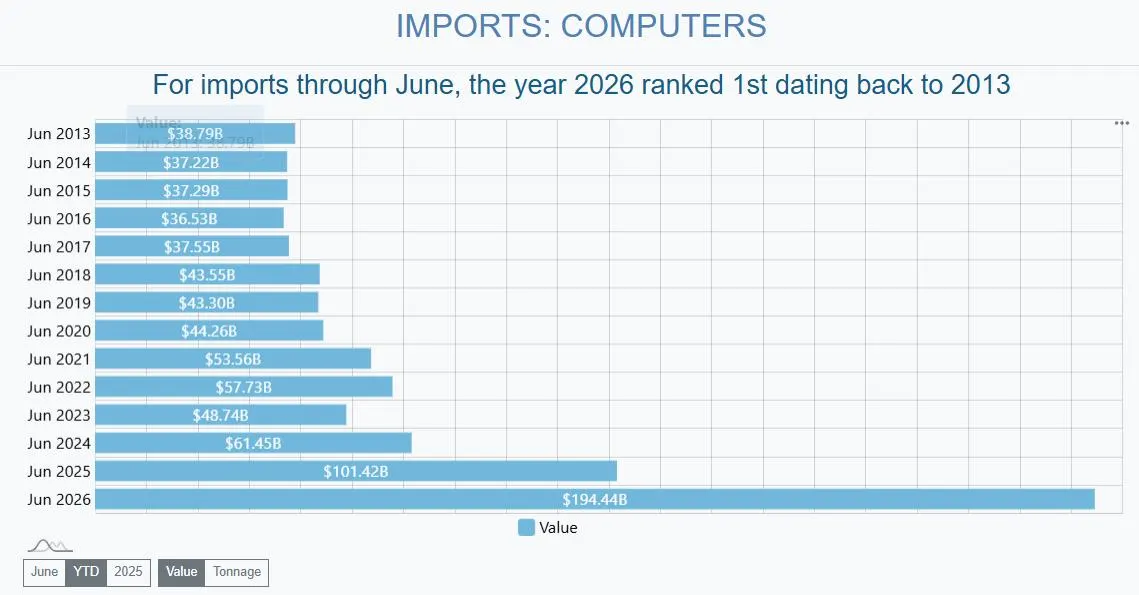
Imports in the broad computer category, which includes servers for AI-related data centers, grew rapdily in the first six months of 2026, helping propel the U.S. deficit past $100 billion for the second straight month.
ustradenumbers.com
The United States’ trade deficit grew for the fourth consecutive month, topping $100 billion in June, according to the latest U.S. Census Bureau data.
President Trump holds up a chart at a White Hous cerermony on April 2, 2025, “Liberation Day,” when he announced his ttade war with the world. The Supreme Court later declared those tariffs unconstitutional.
Getty Images
That is not what President Trump would like to hear. He has taken numerous bold steps to bring the longstanding U.S. trade deficit to heel. That includes a tariff on almost all U.S. imports from China midway through his first term to his April 2, 2025 Liberation Day tariffs against the world. The latter tariffs the Supreme Court ultimately declared unconstitutional.
One factor is the continuing multibillion-dollar investment in imports of computers, servers and other equipment for artificial intelligence data centers for Google parent Alphabet, Facebook parent Meta, Microsoft, Amazon, Oracle and others. Computer imports are more valuable than cars or oil.
Trade deficits have, of course, bedeviled his predecessors as well, but few have made reducing them as central to their economic agenda as Trump has.
The $109.26 billion total for June was the second consecutive month the U.S. deficit topped $100 billion this year and was 87% higher than in February, which now appears to be something of an aberration and the lowest month total in years.
The June total marked the greatest deficit since last July, when the total was $117.13 billion.
For the year, the U.S. deficit remains lower than that registered in the first six months of 2025, $508.83 billion compared to $692.15 billion.
Those unsettled by deficits should take little solace in that not-unsubstantial difference. That’s because for the first time in 2025, the U.S. deficit topped $100 billion in the first three months of a year as shippers front-loaded imports, trying to get ahead of the trade war Trump had said he was planning to announce in early April. It slowed somewhat the remainder of the year.
The deficit in the first six months of this year, while lower than last year, is only slightly lower than the deficits in the first half year in 2023 and 2024. And it appears to be gathering steam.
So, despite a robust 15.19% increase in exports to a record $1.24 trillion and a 1.14% decrease in U.S. imports to the second-highest total on record of $1.75 trillion, the deficit still increased.
Taming the trade deficit is always difficult, since it ultimately represents the exceptional buying power of U.S. consumers and businesses, which outpaces the nation’s workers’ and companies’ ability to produce and find sufficient export demand. The United States remains the world’s third-largest manufacturer, behind China and Germany.
Reducing the deficit is more difficult this year, given that pointing at one country – China, in the past – no longer works.
Through June, the value of U.S. imports from Mexico, Canada and Taiwan were larger than the total from China. Before the trade war with China, the U.S. deficit was five times that of any other country.
ustradenumbers.com
In June, three other countries registered larger U.S. trade deficits: Vietnam, Mexico and Taiwan, in that order. The U.S. deficit with China, which was once five times larger than the U.S. deficit with any other country, now ranks fourth. China, which once ranked as the nation’s No. 1-ranked trade partner, now ranks a distant third behind Mexico and Canada and briefly fell behind Taiwan one month earlier this year.
Those U.S. deficits with Taiwan, Mexico and Vietnam are largely due to increases in the broad category of computer imports. Were it not for the AI-focused multinationals’ massive investments in data centers, you would not see the continuing enormous increase in the computer servers and parts.
The computer import category is dominated by Taiwan and Mexico.
ustradenumbers.com
That increase in computer imports is from $101.42 billion in the first six months of 2025 to $194.44 billion in the first six months of this year, a staggering 91.72% increase. Those three countries – Taiwan, Mexico and Vietnam – make up 83.03% of the total through June.
Had computer imports in June merely matched the total from a year earlier, the overall U.S. deficit would have been roughly $14 billion lower – below $100 billion and below May’s total.
The big increase in computer imports neutralized the 15.19% increase on the exports side year-to-date, an increase in value brought on by a 155.13% jump in outbound shipments of gold, a 49.66% increase in oil, and a 34.40% increase in gasoline and other refined petroleum products.
The increase in gold exports appears linked to investor uncertainty, including concerns about the trade war, the U.S. war with Iran, and the continuing Russian war in Ukraine and the Israeli war in Gaza. Gold is being shipped to Switzerland, the United Kingdom and other markets perceived as safer havens.
But the massive investment in computer servers and U.S. data centers to build artificial intelligence infrastructure is also a response to worries that China and other countries might overtake the United States’ lead in the development of artificial intelligence, what so many perceive to be the most disruptive technology the world has ever seen.
The June data offers a reminder that the deficit is not simply a China problem, nor is it likely to be solved by targeting one country at a time. As long as U.S. companies race to build the infrastructure for artificial intelligence – and U.S. consumers and businesses continue to buy more from the world than the nation sells abroad – the trade deficit will remain difficult to bring to heel.
