

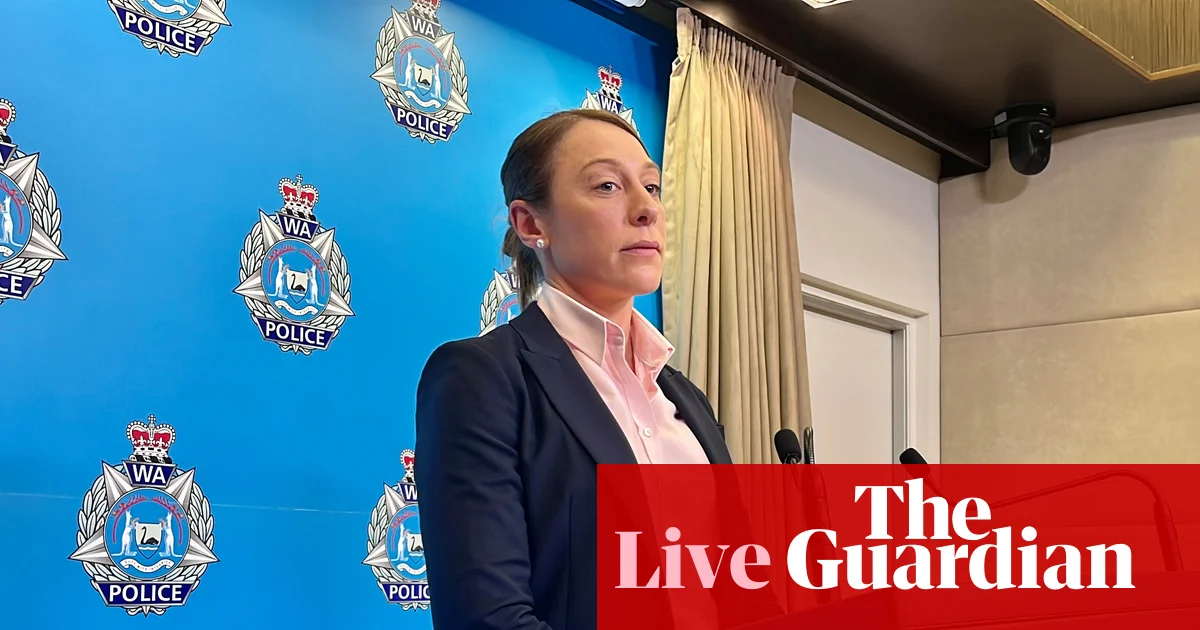
Perth teenager arrested after allegedly stabbing mother to death, injuring sister
A 16-year-old boy has allegedly stabbed his own mother to death and turned the knife on his little sister who managed to flee to get help, AAP reports.
Police attended a home in the suburb of Bentley, in Perth’s south-east, after the incident which authorities say occurred at about 6:15am on Tuesday.
Officers located the body of the 35-year-old mother inside the family’s Mill Street home, Acting Insp Jessica Securo told reporters.
The girl was also stabbed but managed to flee the house, making it to a nearby highway for help. Securo said:
I can confirm there is no ongoing risk to the wider community.
This incident will have a significant impact on the family, friends and loved ones of all those involved as well as the broader community.
Our thoughts are with them all, particularly the 12-year-old girl who remains in hospital receiving treatment. We ask that their privacy be respected during this investigation.
Key events
Family rejects coroner’s newborn death finding
A family whose daughter died hours after her birth from an undiagnosed heart defect has rejected a coroner’s finding that the baby’s death was not preventable, AAP reports.
Thea Flaskett died on the morning of 11 September 2023, a little more than four hours after she was born at a Queensland hospital. Thea’s parents Meg and James Flaskett had fought for an inquest into their daughter’s death, which held hearings in Brisbane in 2025.
Ms Flaskett said the family was “devastated but not surprised by the outcome” in a statement that criticised the inquest’s findings. She disputed that Thea’s heart defect was the only major contributor to her death at Redcliffe hospital, north of Brisbane. She said:
Had Thea’s condition been diagnosed before birth, her labour, delivery and immediate management would have been fundamentally different.
Although these findings bring the coronial process to an end, they do not bring us peace, nor do they answer the questions that have driven us for almost three years.
Luca Ittimani
New KPMG CEO was on executive during ‘botched’ inaction on leaks, Labor inquiry chair says
Labor senator Deb O’Neill has taken aim at KPMG’s new CEO in connection to the firm’s failure to confirm or address leaks in its audit team.
John Sams, today appointed chief executive, is a KPMG lifer who had been the firm’s chief financial officer and a board member since October.
O’Neill, the chair of a parliamentary inquiry, said in a public statement:
Mr Sams’ appointment is the elevation of yet another member of the firm’s leadership which oversaw the series of botched investigations and non-action.
The inquiry has heard KPMG’s board’s subcommittee commissioned legal advice which found no evidence for the leak allegations in December. Only after the allegations were publicly revealed in March did KPMG re-investigate, verify and act on some of the allegations. KPMG declined to comment. Sams did not sit on the subcommittee.
O’Neill previously took aim at KPMG when it replaced its outgoing chair with Michael Ebeid, an internal independent director who had oversight of last year’s investigation. She took another shot at Ebeid in her comments today.
Ebeid is yet to officially become chair but still sat on the selection panel that today appointed Sams. The firm’s 680 partners have to vote on whether to change their partnership agreement so Ebeid can serve as independent chair. O’Neill said:
I note reports of concerns within KPMG about the role Mr Ebeid has played in advancing the path of Mr Sams to CEO, given there has been no formal agreement by partners to allow Mr Ebeid, who is not a partner of KPMG, to assume the role of Chair of the Board.
Contacted on behalf of Ebeid and Sams, KPMG declined to comment. Ebeid today said Sams was also endorsed by the board.

Andrew Messenger
Tamworth sports journalist killed in rural car accident
A well-known sports journalist has been reportedly killed in a car accident while travelling from a football competition.
Tamworth writer Mark Bode, 57, has been named as the driver killed in a three vehicle crash on the Oxley Highway near Somerton at about 6.30pm on Saturday. The small town is about halfway between Gunnedah and Tamworth.
His paper, the Northern Daily Leader, reports that he was travelling home from a rugby league competition in Gunnedah.
A 69-year-old man in the other vehicle was also treated at the scene before being airlifted to John Hunter hospital in a serious condition.
Both occupants of the third vehicle were uninjured.
Bode spent decades in regional journalism after starting his career in Brisbane. He joined the Leader in 2017 and is being remembered as a passionate and hard-working sports reporter, best known for his profiles of local athletes.
Perth teenager arrested after allegedly stabbing mother to death, injuring sister
A 16-year-old boy has allegedly stabbed his own mother to death and turned the knife on his little sister who managed to flee to get help, AAP reports.
Police attended a home in the suburb of Bentley, in Perth’s south-east, after the incident which authorities say occurred at about 6:15am on Tuesday.
Officers located the body of the 35-year-old mother inside the family’s Mill Street home, Acting Insp Jessica Securo told reporters.
The girl was also stabbed but managed to flee the house, making it to a nearby highway for help. Securo said:
I can confirm there is no ongoing risk to the wider community.
This incident will have a significant impact on the family, friends and loved ones of all those involved as well as the broader community.
Our thoughts are with them all, particularly the 12-year-old girl who remains in hospital receiving treatment. We ask that their privacy be respected during this investigation.

Penry Buckley
Jewish schools council says poorer schools using education funding for security
Stephen Rothman, a former NSW supreme court judge who is the co-chair Australian Council of Jewish Schools (ACJS), the representative body for schools throughout the country, has been explaining to the royal commission on antisemitism how Jewish schools are funded, including security costs.
Rothman has said since 2023, “the level of vitriolic antisemitic abuse has been significant, and in my view, normalised to such an extent that members of the community generally feel unwelcome and unprotected”.
ACJS analysis shows the national total for security spending in the four years to 2022 to 2025 is more than $58m. Rothman said be believes every Jewish independent school funds this through levies to parents, but this is “normally significantly lower” than poorer schools needs to spend in relation to security per student, with schools drawing on their own funds or from increased fees to cover costs.
It’s a somewhat tongue-in-cheek line by members of the Jewish community that it’s expensive to be Jewish, and it is, a lot of money is spent on donations and the like, it’s part of the culture, but nevertheless, if you can get the donations, yes, that’s good. If you can’t get the donations … [schools] will use resources that other schools would use for all sorts of other facilities to fund security, including education, unfortunately.
Rothman said the ACJS’s position is “at least the recurrent expenditure on guards and other operational … expenditures” should be funded by the federal government.
Ima Caldwell
Now the wonderful Achol Arok will take you through the rest of today’s breaking news.
Penry Buckley
Jewish school has looked at diverting school funding to meet security needs
The royal commission on antisemitism on social cohesion has been hearing about the security burden on Jewish schools in Sydney and Melbourne following a rise in antisemitic incidents sine October 2023.
Before lunch, it heard from Mount Scopus Memorial College and Bialik College in Melbourne, which like many independent Jewish schools, charge parents security levies in addition to fees, which have increased significantly since October 2023. They described antisemitic incidents directed at students.
This afternoon, Linda Emms, the principal of Emanuel School in Sydney, has said while the majority of its security costs came from levies charged to parents, they did not fully cover increasing costs, meaning “over the last 18 months in my time at the school, it has meant that we’ve had to look at diverting funds from other areas of school operations”.
She said the start of the 2026 school year, had brought an “added layer of complexity” for Emanuel, which is near Bondi beach, with many staff, student and parents impacted by the terror attack in December. Emms said the school has a police presence every day.
Our parents have worked incredibly hard, particularly with some of our younger students, to get their children to see the police as their friends and as being there to protect them.
And I watch some of them come in, and they will fist bump the police as they come in of a morning and say hello to them. And it’s lovely, but it’s really sad that we have parents who actually have to do this, because that’s how they’re actually reassuring their child that it’s OK that there’s actually police at the front gate every morning.
Andrew Messenger
Queensland police ethical standards investigating after man dies in Brisbane city watch house
The Queensland police ethical standards unit is investigating the death of a man at the Brisbane city watch house yesterday.
The 55-year-old Thornlands man had been in the facility since Friday. He was arrested that day, 17 July, at about 10.50am on a return to prison warrant.
He told staff he was feeling unwell on Monday shortly after 3pm and was assessed by nursing staff and other emergency services. He died a short time later. His cause of death is under investigation.
The Queensland police ethical standards command is investigating the death in custody on behalf of the state coroner. The state’s watch houses are operated by Queensland police and are designed for adult detainees to be held for about 48 hours.
There are 72 people currently being held in the Brisbane watch house; eight of them have been there longer than a week, one for 12 days.
Stephanie Convery
I’m going hand this here blog over to my colleague Ima Caldwell now, who will take you through the rest of the afternoon’s news.
The outcome of the vote by Victorian teachers to reject the government’s most recent pay offer and strike on Thursday has sent an undeniable message to the government that change was needed, Australian Education Union’s Victorian president Justin Mullaly has said.
In a statement this afternoon, he said:
Members have been telling the Victorian Labor government for years that the under-resourcing of public schools in Victoria is making their work untenable.
When just three in 10 public school teachers plan to stay working in public schools in Victoria, it is obvious there is a problem.
Victorian school teachers vote to strike on Thursday
Victorian public school teachers will go on strike on Thursday after a majority of Australian Education Union members voted down the state government’s most recent pay offer.
As we reported earlier, voting closed today on the government’s most recent pay offer of of 28.3% over the next four years. Victorian teachers have been locked in the pay dispute with the government for months, with more than 35,000 teachers, principals and education support workers walking off the job in March.
In a statement published just now to AEU Vic’s social media platforms, the union confirmed the strike action will take place on Thursday:
We will be stopping work for 24 hours on Thursday, 23 July right across the state. We will rally in the city and march to Parliament.
The union said 50,677 AEU members voted in the ballot, with 48.82% voting to accept the pay offer, and 51.18% voting against it.
Everyone’s talking about one man – and his dog – today. Guardian political reporter Josh Butler explains the whole situation to Guardian political reporter Krishani Dhanji.
Australian athletes urged to pack extra undies for Commonwealth Games
Australians athletes are being urged to fiercely compete like warriors at the Commonwealth Games, rather than go commando.
With Glasgow being run on a smaller scale, there is no athlete village and its daily laundry service, so Australian team members have been advised to pack extra clothing, especially underwear – just in case.
The Australian HQ at the Glasgow Argyle Hotel will run a laundry service, but on a reduced frequency. Team chef de mission Petria Thomas told AAP:
AUS HQ delivers services aplenty for the Australian Team, with laundry being one.
In a Games village this is often a daily service, but here it will be every three days, so we’ve encouraged athletes to bring spare smalls … just in case.
No one wants to be caught going commando!
Rising robbery risk to Australian cash transfers, inquiry hears
Luca Ittimani
Cash transporters have warned their crews are at rising risk of being robbed as unions say some million-dollar shipments are being driven around by lone workers in small, unmarked, un-armoured cars.
A Senate inquiry into reforms to cash distribution has heard from the chiefs of Armaguard, the cash moving company. Matt Caulfield, its chief executive, told the inquiry the company took more than 8,000 jobs each day, moving millions of dollars between them, and some of its jobs were being done by single, unarmed people in un-armoured vehicles. He said:
Just in this last three months, so we’ve had two armed robberies … We have what’s called a tracking system called Myosh that looks at near misses and red flags. So they’re at the highest they’ve been in my time at Armaguard.
Gavin Webb, from the Transport Workers’ Union, told the inquiry two workers had been robbed and assaulted at a south-east Queensland shopping centre in May, and cash-in-transit workers had historically been killed during cash drops in public places. He said:
We have seen single-crew operators carting millions of dollars of cash in vehicles such as Hyundai i30s … in major cities around Australia, in those unmarked vehicles.
Webb said the limited staff protection was due to banks choosing cheaper cash movers with poor safety standards. Proper protection is costly: Bill Kelty, the director of Armaguard, said its secure vehicles typically cost $300,000 each.
Armaguard and the union are both warning that the reforms being considered by the inquiry are not accounting for the cost of operating safely. Cash distribution has become more expensive and major operators are disagreeing with retailers and banks over how the costs should be covered.
Armaguard’s executive chair, Peter Linfox, said the company’s owners, the Linfox family and Spanish former competitor Prosegur, had paid $125m propping up Armaguard’s cash distribution losses. Its owners did not expect to be paid any profits for years, Linfox said.
Anthropic’s $1.5b copyright lawsuit settlement approved
A US judge has signed off on artificial intelligence company Anthropic’s landmark $US1.5bn settlement of a class action lawsuit brought by a group of authors who accused it of misusing their books to train its AI chatbot Claude.
US district judge Araceli Martinez-Olguin granted final approval of the settlement, the largest known settlement of a US copyright case, rejecting arguments that it was too small.
The case is one of dozens brought by copyright owners including authors and news outlets against tech companies over the training of their large language models, and the first major US case to settle.
A number of prominent Australian writers were involved. A searchable list of books used to train the AI includes six Michelle de Kretser books, Anna Funder’s All That I Am, Hannah Kent’s Burial Rites, and two Gerald Murnanes – to name a few.
Anthropic deputy general counsel Aparna Sridhar said in a statement:
We reached this settlement in 2025, after the court’s landmark ruling that training AI on books is fair use under copyright law – which remains the law today.
We are pleased that more than 91 per cent of authors and publishers covered by the settlement have claimed their share of the payment, and we’re looking forward to bringing this matter to a close.
Penry Buckley
Son of Holocaust survivors describes shock at Sydney Opera House protest
The royal commission on antisemitism has heard from Dr George Foster OAM, a member of the South Sydney synagogue and president of the Australian Association of Jewish Holocaust Survivors.
Foster, who was born in Budapest to two Hungarian Holocaust survivors shortly after the end of the second world war, arriving in Australia in 1947, has described feeling shocked by a protest on the steps of the Sydney Opera House on 9 October 2023:
We heard expletives and you know vilification of Jews to a point which shocked me, and I know much, if not all, of the Jewish community. I never thought that I would see such a thing in this country.
Foster has described an incident in which the South Sydney synagogue was among several firebombed after the first Iraq war. He said it was easier for the South Sydney synagogue to recover from the event during the 1990s.
At that time, again we received many messages of support and assistance, and there wasn’t the overt vilification of the Jewish people then, and I think because of that it was easier for us to come to terms with and move forward after that incident.
Foster has described several subsequents incidents at the South Sydney synagogue, including a petrol bombing in 1993, swastikas being painted and bricks being thrown through windows in 1995, and an arson attack in 2003. In 2025, after the synagogue was allegedly vandalised with swastikas, the synagogue erected a security fence, which was completed four days after the Bondi attack.
Penry Buckley
Interfaith relations after Bondi attack have broken down, royal commission hears
The chief rabbi of Sydney’s Central Synagogue, Levi Wolff, has told the royal commission on antisemitism and social cohesion that interfaith relations renewed following the Bondi attack have broken down.
He said that previously good relations had “chilled” following October 2023. He said while Jewish community leaders had had a constructive meeting with leaders from the Islamic community following the December attack, relations had returned to their previous state following the visit by the president, Isaac Herzog, in February:
Relationships have broken down since. We’ve always tried to reengage that, and we hope that we can in the future.
The royal commissioner, Virginia Bell, has asked Wolff, who was born in the US but came to Sydney in 2001, if conversations with his family in New York show “that even if there’s been a spike in antisemitism there, there hasn’t been the same degree of distress for members of the community?”
Wolff said:
Yes, there seems to be something which stands out about what’s happening here almost more than anywhere else. It could also be to the fact that it is of such a shock. You know, Australia was just, it’s always looked at as this paradise so far away.
Wolff noted that Australia had become home to the highest number per capita of Holocaust survivors outside Israel.
He ended his submission by calling for “three pillars” to respond to antisemitism: “security, legislation and education”. He said education about antisemitism should go beyond the Holocaust, saying it “should encompass how Jews live, not only how Jews died”.
Andrew Messenger
Queensland government to spend similar on CFMEU inquiry as CCC
The Queensland government will spend more on the investigation of a single union as the annual budget for the state’s Crime and Corruption Commission.
The attorney general, Deb Frecklington, and the treasurer, David Janetzki, announced that the state would budget $95m for the state’s CFMEU inquiry, an additional $75m than first budgeted.
The Crime and Corruption Commission is responsible for investigating complaints against all state government bodies including the police; administers the state’s witness protection program; recovers the proceeds of crime; and combats major crime. It has an $82.1m budget this year.
The commission investigates fewer than 1% of complaints referred to it, according to its reporting to parliament. It charged a single person with a corruption offence last year.
Asked whether the lack of investigation was related to budgetary constraints, Frecklington said:
I don’t know whether that’s true. I think I’d like to see your evidence for that one.
Frecklington compared the CFMEU inquiry – Queensland’s version of a royal commission – to the Fitzgerald inquiry, which caused the early resignation and unsuccessful prosecution of the state’s longest-serving premier, four ministers and a police commissioner to be jailed for corruption, led to reforms to the state’s voting system, the creation of the an independent anti-corruption commission and is the subject of several books and films.
The inquiry was initially scheduled to run until October but was extended by another 18 months in May. It will now run about six months longer than Fitzgerald’s inquiry.
