


Brynjolfsson et al
Brynjolfsson et al
Brynjolfsson et al
Brynjolfsson et al
Stay in school, kids
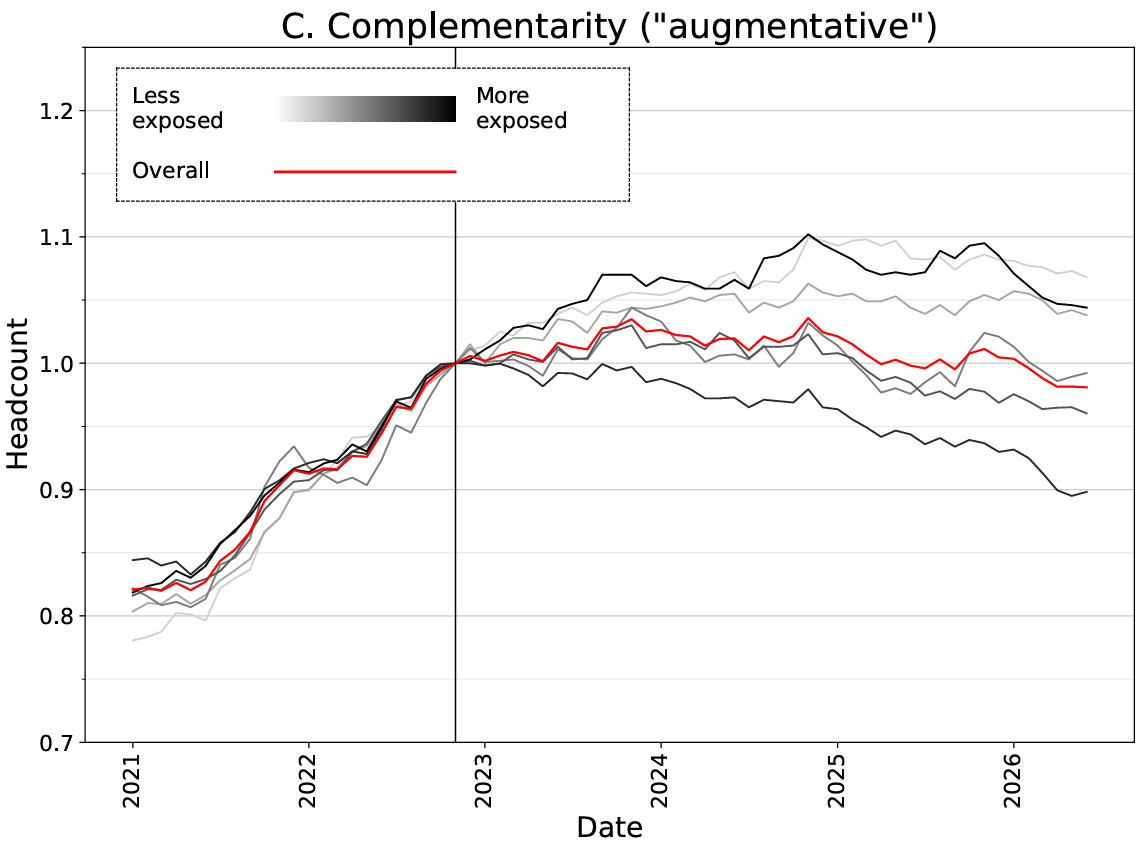
The researchers also theorized that entry-level workers could be especially affected by AI’s impact on jobs requiring heavily “codified” knowledge—the kind of “formal, standardized, documented knowledge that can be taught through education, textbooks, or written procedures.” That would contrast with jobs where AI mainly complements an experienced worker’s more “tacit” knowledge, which is overwhelmingly “acquired through practice, mentorship, and repeated exposure to real situations,” the researchers write.
To test this hypothesis, the researchers used the required level of formal education in O*NET’s extensive occupational database as a proxy for how reliant that job is on codified knowledge. Breaking out the employment data, the researchers found that “occupations with higher codified knowledge have slower entry-level employment growth, while occupations with higher tacit knowledge have faster employment growth for mid-career and senior workers.”
At the same time, the researchers found that higher education might still serve as a buffer against the employment effects the Stanford researchers identified. As they write, occupations with a higher share of college graduates showed more “muted differences between more-exposed and less-exposed occupations” regarding AI. In jobs with few college graduates, on the other hand, “the least AI-exposed occupations [saw jobs] growing and the most exposed occupations [were] declining in employment.”
In a recent interview with The Washington Post, lead researcher Erik Brynjolfsson warns that the current trends suggest a near future in which jobs for those employed in the pre-AI era largely persist while many jobs for the incoming working-age cohort start disappearing. “The entry-level effects we’re measuring are real, persistent and widening,” he said, “and I’m more worried than I was about a labor market that keeps its overall employment level while quietly closing the on-ramp for people starting their careers.”
