

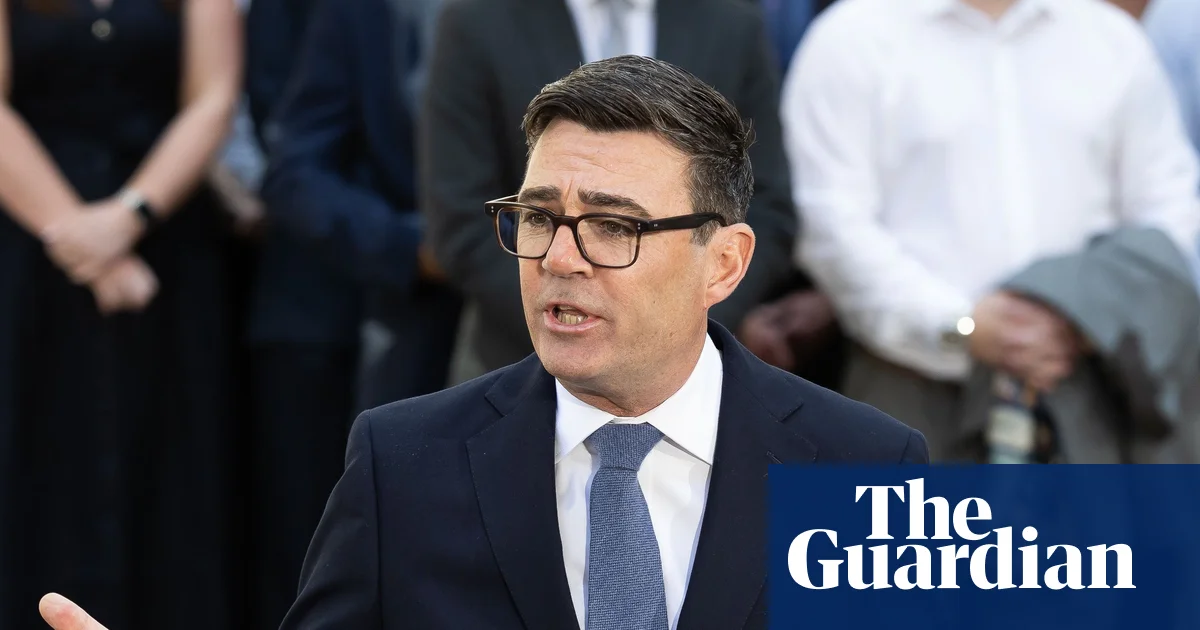
World leaders have warmly congratulated Andy Burnham on his entry into 10 Downing Street as Britain’s seventh prime minister in a decade, but international media largely focused on the scale of the challenges awaiting him.
Emmanuel Macron, France’s president, said he hoped for a deeper relationship “in the service of our peoples, and by giving new momentum to the partnership between the UK and the EU” rekindled by Burnham’s predecessor, Keir Starmer.
The German chancellor, Friedrich Merz, who spoke with Burnham on Monday evening including about continued support for Ukraine, said Germany and the UK were close partners and he looked forward to working together.
The president of the European Commission, Ursula von der Leyen, said she looked forward to “strengthening the EU-UK partnership”. A “very good first discussion” had revealed a common commitment to “bringing the EU and UK closer and closer”, she later added.
Beyond the diplomatic platitudes, however, media coverage focused on Burnham’s regional persona – and the huge task awaiting him. France’s Public Sénat said the new prime minister came from “the working class of the north of England”.
He had managed to “build an image as an ‘everyman’, appearing without a tie, very often in a T-shirt”, the political TV channel said on its website, standing out as “a politician on the ground, close to everyday concerns”.
Italy’s Corriere della Sera said the UK was experiencing “profound unease, instability and social resentment” and “needs a push” forward, but Burnham’s nationalisation, state intervention and reindustrialisation plans suggested he saw the past as a model.
The UK “appears incapable of imagining and planning for the future and prefers to take refuge in a backward-looking Eden”, it argued, even though the pre-Thatcher years were marked by “energy rationing, rubbish in the streets and IMF bailouts”.
The Irish Times noted that Burnham may be “a breath of fresh air” but the challenges that brought down Starmer – “a budget unable to meet desperately needed demand in defence, housing, welfare, care for the aged, and training for the young” – remained.
The new prime minister, the paper said, would be “hamstrung by a commitment to abide by strict fiscal rules. His instinct may be to tack to the left, but he is already trying to prove that … he will govern from the centre” and the job was “immense”.
In an New York Times essay titled The King of the North Won’t Save Britain, Tom Hazeldine said that with his “northern accent, casual attire and everyman persona”, Burnham “trades on his outsider status, a precious commodity in antipolitical times”.
But, Hazeldine added, a UK that had wanted “a bounce” after Starmer had actually ended up with – in the absence of anything better – “a career Blairite with a northern soul and a Whitehall brain. For the country, it looks a lot like more of the same.”
Italy’s prime minister, Giorgia Meloni, wished Burnham “a successful tenure”, adding that Italy and the UK were “bound by a deep friendship and a collaboration that, over the years, has grown ever stronger” and she was sure would continue.
Outside the EU, Donald Trump, who had previously described Burnham as “the mayor of a town” and “extremely liberal”, said on Monday night the two had had a “very good conversation” on topics including North Sea oil.
“The Prime Minister has got a big job ahead of him, but he will be able to do it and, of course, the U.S.A. will be there to help!” Trump posted on Truth Social. “The call was interesting, and went very well. I wished Prime Minister Burnham, GOOD LUCK AND GODSPEED!”
Ukraine’s president, Volodymyr Zelenskyy, described the UK as “one of the global leaders”, adding that the two countries’ relationship was “stronger than ever and Kyiv stood “ready to work together in all possible formats”.
Anthony Albanese, the Australian prime minister, said Australia and the UK were “longstanding friends” bound by “deep ties”. He looked forward to strengthening the partnership and promoting “security, resilience and prosperity in the years ahead”.
