

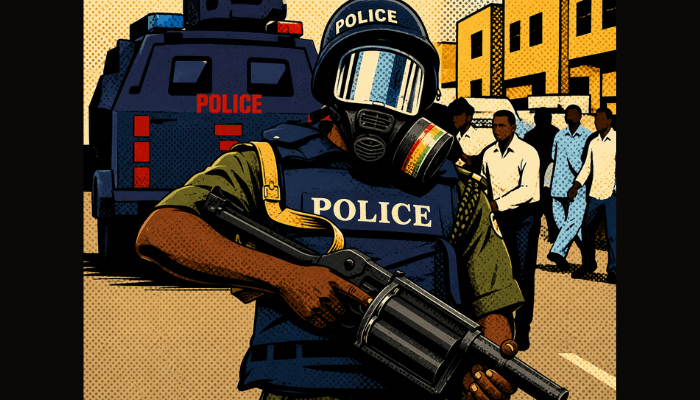
Two events I came across yesterday captured the state of Nigeria’s police-public relations with unsettling clarity. In Port Harcourt, angry youths blocked Agip Road to protest the killing of Anthony Obodo, a 22-year-old University of Port Harcourt graduate murdered by a police officer. The youths’ anger is not hard to understand. The Rivers State police commissioner, who warned that the protest could be “hijacked by hoodlums”, completely missed the point. His response, the unfortunate standard of Nigeria’s security apparatus, is to treat legitimate grievance as a potential security threat. It has been happening since 1929. Meanwhile, Anthony Obodo’s family is left with a dead son and a vague hope of justice.
The pattern is not new, and that is precisely the problem. In 2020, the #EndSARS protests erupted after a video surfaced showing police officers with the SARS unit killing a young man in Delta State. That spark ignited a national protest which was only put down following the brutal events at the Lekki Toll Gate.
The case of ASP Usman Nuhu, the police officer filmed killing musician Oghenemine Ogidi in Delta State, is a textbook illustration of why young Nigerians have lost faith in the police and increasingly resort to self-help. Nuhu and four other officers were arraigned on 30 June. Nuhu pleaded not guilty to murder; the others pleaded not guilty to lesser charges. The court adjourned to 14 July 2026 for trial to begin. That is where the public record ends. No reporting has emerged confirming whether the trial commenced, let alone reached a verdict. It is entirely plausible that the matter remains pending, buried in the court’s docket.
This is the pattern: a young man is killed in plain view, the officer involved is dismissed swiftly, and the prosecution begins with public fanfare, then silence. The system does not deliver justice. It delivers procedural theatre. When the state cannot, or will not, hold its own killers accountable, the message to young people is unmistakable: your life does not matter, and the law will not protect you. The police are not protectors but predators with badges, and when the very institution meant to enforce accountability becomes the perpetrator, the logic of self-help becomes unavoidable.
Every young Nigerian knows this story. They have repeatedly heard the promises of investigation and prosecution, then watched the silence that follows. And they have drawn the only conclusion available: no one is coming to save them. Not the police. Not the courts. Not the government. They are on their own, and so logically, they will turn to self-help. When the state abdicates its monopoly on violence and justice, it creates a vacuum that vigilantes, mobs, and armed groups will fill. That is a failure of governance, and it will not end until the system begins to punish its own. Until then, young Nigerians will keep taking the law into their own hands, because the law has shown them nothing else. The Nuhu case is not an exception. It is the rule, and the rule is that justice is for the powerful, and the rest must fend for themselves.
EndSARS was a spark that caught fire. Ogidi’s killing was a spark that flickered and died. The Port Harcourt protest may well be another spark that does not catch. But one day, one of these will. And God knows, I don’t want to be out on the streets when that day comes. But another incident somewhere else showed that we may not be far off…
In Osogbo, a passerby used a drone to scare off police officers caught on camera extorting motorists. The officers fled. What caught my attention was the laughter of onlookers. That is instructive.
The Osogbo incident is something entirely different from what we saw in EndSARS, Delta, and now Rivers. Osogbo was a moment of pure contempt, where citizens no longer even bother to petition or protest but simply expose and humiliate. The use of a drone to shame police officers reflects a growing frustration with police misconduct. The pattern is clear: citizens are finding creative ways to resist because the formal channels of accountability are broken. Extortion has been a persistent problem, but not much has been done about it, except when it goes viral internationally, like the dismissal of the policeman who extorted that Dutch rider who was going through Nigeria on her motorbike, caught the whole thing on 4K video, and broadcast it to the world.
These incidents matter because they reveal a police force that is simultaneously predatory and weak. Predatory, because officers routinely extort and kill with impunity. Weak, because they flee from a drone. The contradiction is explosive. When the state’s coercive apparatus is both feared and mocked, it has lost its legitimacy, and the more Nigerians see police officers as clowns who can be outsmarted by a drone, the less they will fear them. The less they fear them, the more they will resist.
The greater danger is that this anger is about to collide with something far more combustible: hunger. Nigeria is gripped by a cost-of-living crisis. Protests over economic hardship have already turned deadly. Just yesterday, the police fired tear gas on pensioners protesting harsh living conditions. Over the last year, various reports show that the police have arrested nearly 700 people, but they always deny attacking peaceful demonstrators. The fuel subsidy removal and currency devaluation have pushed food prices out of reach for millions. The Jollof Index, a measure of the cost of a staple meal, has risen by over 600% since 2016.
In this environment, the police are not protectors. They are the face of a state that has failed to provide security, economic opportunity, or justice. Every extrajudicial killing, every extortion, every drone video that goes viral chips away at the legitimacy of the state. The most recent NOIPolls Police Brutality Poll (May 2026) found strong public backing for structural policing reform. But reform has not come. Instead, the police have become an institution that Nigerians have learned to avoid, bribe, or, as in Osogbo, outsmart.
In my not-so-humble opinion, the next large-scale unrest in Nigeria will not be triggered by politicians or ethnic militia. It will be triggered by the police. A single spark, a routine stop that turns fatal, a protest that turns violent, and the accumulated anger of millions will erupt. The Port Harcourt protesters blocked a road while the intrepid Osogbo drone operator shamed a few officers. These are small acts of defiance which are rehearsals for something larger.
When hunger meets a police force that kills with impunity and flees from drones, the result is not stability. It is a powder keg, and the police are like a toddler playing with matches near the keg. It’s not a matter of if; it’s a matter of when.
Nwanze is a partner at SBM Intelligence


