

Unlock the Editor’s Digest for free
Roula Khalaf, Editor of the FT, selects her favourite stories in this weekly newsletter.
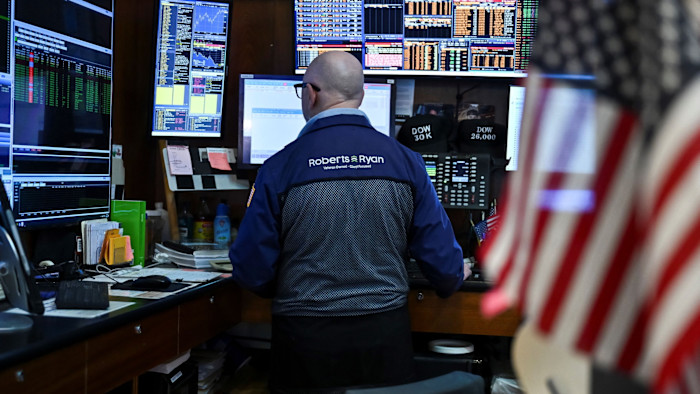
Stock investors were jolted by another bout of AI-related volatility this week, leaving many asking whether this was the first sign of the AI bubble popping.
Wall Street’s tech-heavy Nasdaq Composite index fell 4.6 per cent over the week. In South Korea, where the stock market is heavily weighted towards the memory sector, the Kospi index fell more than 7 per cent and trading was halted twice during the week.
Trevor Greetham, head of multi-asset investing at Royal London Asset Management, said he believes there is a bubble in both valuations and earnings in the tech sector. But this particular sell-off, he said, was a “short-term wobble in terms of rate expectations” after the Federal Reserve hinted this month that its next move could be to raise interest rates. While Greetham said tech earnings “can’t be sustained”, he added that the rally was not over yet.
For Arun Sai, a senior multi-asset strategist at Pictet Asset Management, this is not the start of a big market correction but the resumption of a rotation out of tech stocks towards the rest of the market.
The rotation, which began in early 2026, was being supported by falling oil prices as the Strait of Hormuz reopens, he said.
This “episodic broadening out” and the volatility that comes with it was “going to become part and parcel of equity markets”, Sai said. Emily Herbert
Is the US jobs market holding up?
Jobs data to be released on Thursday will give investors a glimpse of how the world’s biggest economy has held up in the face of higher oil prices and rising inflation.
Economists polled by Reuters expect June’s unemployment rate to come in at 4.3 per cent, unchanged from May, while non-farm payroll gains are forecast to hit 110,000, down from May’s increase of 172,000.
May’s figures had caught many investors by surprise: NFP gains were more than twice what economists had forecast, led by hires across the leisure and hospitality sector ahead of the football World Cup, and there were large upward revisions to March and April data. Total job gains in the first five months of this year are 569,000, almost five times the total additions in 2025.
Many investors say they now worry more about the US economy overheating than about a potential recession, despite oil prices having fallen to pre-Iran war levels and long-run inflation expectations having slipped to their lowest for more than a year.
The Federal Reserve’s new chair Kevin Warsh said earlier this month that “persistently high prices” were a “burden for the American people”. Traders are continuing to bet on at least one quarter-point interest rate increase from the Fed this year, a stark reversal from the series of cuts anticipated before the war began on February 28.
Morgan Stanley economists said in a note that “a move below 4 per cent on the unemployment rate by September would increase cause for concern that the labour market is much stronger than thought”. George Steer
Has the US-Iran peace deal had an impact on euro area inflation?
The US and Iran announced their memorandum of understanding — the first step towards a peace deal — on June 14, three days after the European Central Bank raised interest rates for the first time in almost three years.
Euro area inflation data for June, due on Wednesday, will offer investors an insight into the impact on the region of the dramatic fall in oil prices that followed.
Economists polled by Reuters expect the annual inflation rate to fall for the first time since before the US and Israel launched their war on Iran at the end of February, triggering a global energy shock. They forecast a rate of 3 per cent, down from 3.2 per cent in May, potentially easing concerns that higher energy prices have spilled over into the wider economy.
Those concerns fed into the ECB’s decision to raise its policy rate by a quarter point to 2.25 per cent at its June 11 meeting, its first increase since September 2023.
Core inflation, which excludes volatile energy, food and alcohol and tobacco prices, is expected to remain flat at 2.6 per cent in June, its highest level since April 2025.
If inflation does begin to fall, rather than spilling out into the wider economy, it could prove awkward for ECB president Christine Lagarde, who said after the meeting that it was “pretty obvious” that rates had to move higher to avoid that spillover.
“The recent fall in oil prices has made fears of 4 per cent euro area inflation this year a distant possibility, whereas a couple of weeks ago it was close to our base case,” said George Moran, a euro area macro strategist at RBC Capital Markets.
He said he expects June data to show a big fall of almost 5 per cent in fuel prices, enough to keep inflation hovering at about 3 per cent this year.
RBC expects euro area inflation to fall from 3.2 per cent in May to 3.1 per cent in June and to reach the ECB’s 2 per cent target by early next year, with few signs of second-round inflationary effects beyond services. Ramsay Hodgson
