

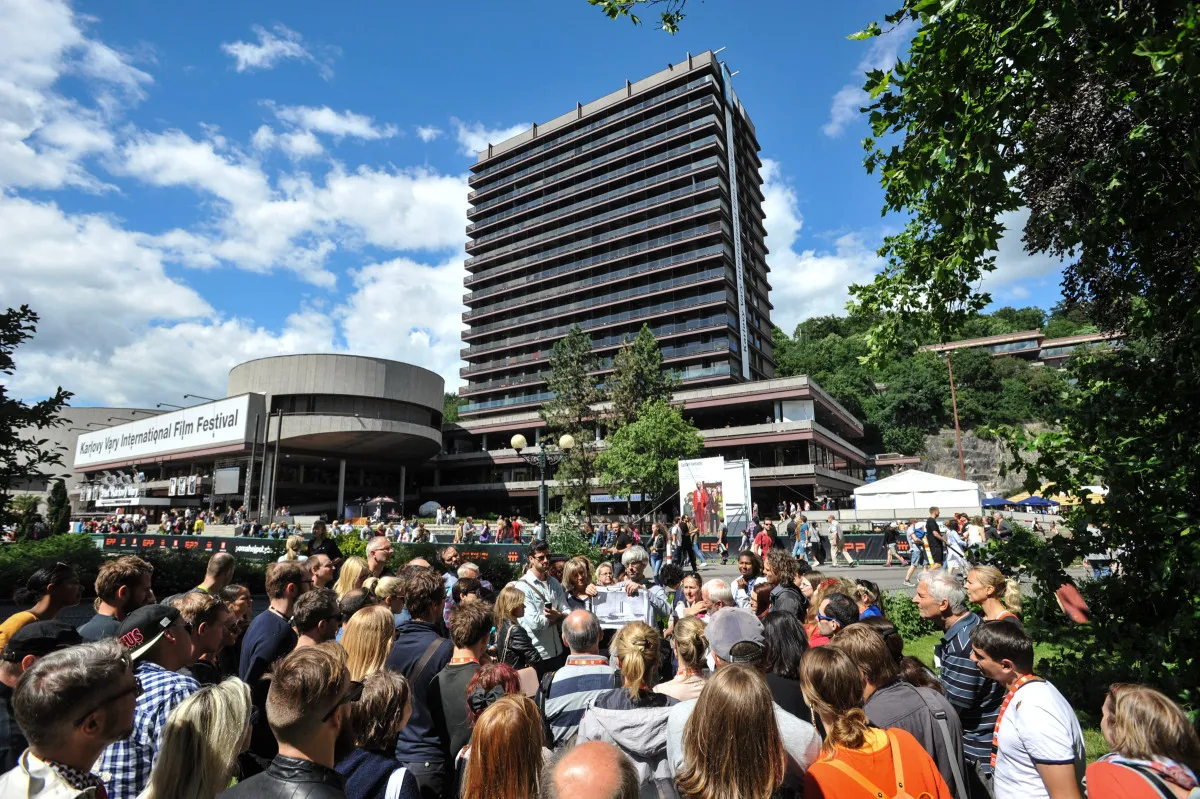
Just like in many parts of life, making a film is a team effort. And so is putting together the lineup of a big film festival. Just ask Karel Och, the artistic director of the Karlovy Vary International Film Festival (KVIFF).
“I don’t think I’ve ever used a singular whenever I talk about the selection, because I would be ashamed to use the singular, because clearly, from day one until the moment we share the movies with the audience, this is teamwork,” he tells THR. “The beauty of this teamwork is that, if you are lucky, you have a team full of strong individuals, just like I do.”
Which means that “the discussions are amazing, because you learn from your colleagues, from the emotionality of your colleagues, from the intelligence of your colleagues,” Och explains. “Sometimes, they convince you that their suggestions are better for the festival and for the program. I’m 52, so I’m the oldest, but the youngest member of our team is not even 30 years old, and it works perfectly.”
For the double anniversary of the fest’s 60th edition in its 80th year of existence, he and his programming team have scoured the globe for new movies from established filmmakers and first features from new voices alike.
While the KVIFF team has a global focus and international experience, it added Italian programmer Lorenzo Esposito last year. “I’m very happy to say that in the history of Karlovy Vary, which is now 80 years old, this is the first time we have a foreign collaborator who is more than a programming consultant,” Och tells THR. “Obviously, we’re really happy about our consultants, but we’re not working with them throughout the year on a daily basis. Lorenzo is the first foreign-language-speaking member of the programming committee in the history of the festival.”
That means that Och and his team added the Italian to their WhatsApp group. “There are seven of us, and we speak English, even though six of us are Czech,” he shares. “That actually makes you think about how you express yourself about the movies. I think it’s a gift to be forced to articulate yourself in English with your colleagues who are Czech to find new ways to express yourself thoroughly.”
Only time will tell which films in the 2026 KVIFF selection will become big surprises, major discoveries or arthouse gems. What THR can, however, already present to you is a look at the worker bees of the big Czech festival who help Och make all the cinema magic happen.
Meet key members of the KVIFF programming team here.
Anna Kořínek
Program Coordinator
Anna Kořínek
Courtesy of Film Servis Festival Karlovy Vary
When did you start working for KVIFF, and how did you get hired?
I started in 2010 in an administrative position in the program department. I was appointed Program Coordinator and a member of the selection committee in 2016.
What did you do before working for the festival?
I was working for the Queer Film Festival Mezipatr in the positions of production coordinator and program coordinator. I was also partly involved in some other Czech film festivals.
Do you have any specialty or focus?
As a programmer, I am focused on the German-speaking countries, the Middle East and Iran. I am also curating the program Future Frames: Generation NEXT of European Cinema, the program that aims to promote young European directors and help them to build a bridge from film school to the film industry.
Do you have any favorite or particularly special KVIFF moment or experience?
It is difficult to pick only one moment, but if I had to choose one specific category of experiences, it would be the opportunity to give a voice to filmmakers who are silenced in their own countries, mostly for political reasons. One of the regions I focus on as a programmer is the Middle East and Iran. Iran is an incredibly fascinating country in terms of film, where many independent filmmakers who reject censorship are currently active. Of course, this means they can never screen their films in their home country. So for me, screenings where filmmakers can be present, see their films, show them to the audience, and speak freely about them are a truly special experience.
So I’ll never forget when an Iranian director, then in exile in France, saw his film for the first, and perhaps last, time on the big screen in Karlovy Vary via a video call from his journalist friend – and what followed: a long round of applause and shouts of support from the audience, and tears of emotion not only from the filmmaker but also from his friend.
What is one of the many things you love about KVIFF?
If I had to answer this question with the first thing that comes to mind, it would be the annual return to the summer camp that we all love so much. It’s a familiar place with people we might not see for an entire year – people who take time off from their day jobs to work with us during that one special week we’ve been preparing for all year. It’s the joy of finally getting to meet the filmmakers whose films we’ve been discussing with colleagues for months, and cheering about the moments when these films were confirmed for the program.
I thoroughly enjoy introducing films, when I can tell the audience why we in the programming department consider this particular film to be exceptional and worthy of being shown on the big screen in Karlovy Vary. I’m always thrilled when I walk past a theater where a film has just ended and see audience members leaving, discussing the film they’ve just watched. Perhaps it’s all also due to the energy that the entire team has throughout the festival – positive energy, where everyone does their utmost to ensure the festival runs perfectly while maintaining a good mood and a sense of humor.
Sandra Hezinová
Programmer

Sandra Hezinová
Courtesy of Film Servis Festival Karlovy Vary
When did you start working for KVIFF, and how did you get hired?
I started working for the festival while pursuing my Master’s degree in the Department of Film Studies at Charles University in Prague. That was in 2015. Back then, KVIFF’s programming department was looking for students to provide administrative support during the busiest months leading up to the festival. I became a programmer three years later.
What did you do before working for the festival?
Mainly studying, though I organized a student film festival before that. By the time I joined the KVIFF team, I was already a programmer for the Queer Film Festival Mezipatra, where I remained until 2019.
Do you have any specialty or focus?
When it comes to territories, my primary focus from the beginning has been Scandinavian cinema, alongside Canadian cinema. In recent years, I have also been responsible for the cinemas of Latin America, Spain, and, to some extent, Portugal. As my previous answer suggests, I also have a strong interest in queer cinema.
Do you have any favorite or particularly special KVIFF moment or experience (out of the many)?
The 53rd edition was undoubtedly one of the most memorable for me, as Sébastien Pilote’s The Fireflies Are Gone was screened in the Crystal Globe Competition. I discovered the film and brought it to the festival after seeing it in Montreal at screenings organized by Telefilm Canada.
What is one of the many things you love about KVIFF?
Scouting new films and projects, and welcoming the filmmakers behind the films we select for the program. Those experiences make my work rewarding and enriching every year.
Vojtěch Kočárník
Programmer
Vojtěch Kočárník
Courtesy Film Servis Festival Karlovy Vary
When did you start working for KVIFF, and how did you get hired?
Like many people who work for KVIFF today, I used to come to Karlovy Vary as a student. I remember the moment when I saw Cairo Station in the Grand Hall – after the introduction, part of the programming team sat down on the floor in the aisle and watched the film together with the audience. That was the first time it occurred to me that there were real people behind the festival, and I became curious about how film festivals work.
A little later, as a journalist, I interviewed Karel Och, KVIFF’s artistic director. Not long afterward, I contacted him again to ask whether he might know of any opportunities to work for the festival. He was generous and offered me a position as a pre-selector, which several years later turned into a full-time programmer role.
What did you do before working for the festival?
I graduated in Media Studies, Journalism, and European Politics from Masaryk University, and later also studied Film Studies at Charles University. I started working for KVIFF while still at university, and I now also work in film distribution.
Do you have any specialty or focus?
As a programmer, I focus primarily on the Central and Eastern European region and Africa, and I am responsible for docs from all over the world.
Do you have any favorite or particularly special KVIFF moment or experience (out of the many)?
The moments I remember most fondly are those spent with young, often emerging filmmakers. At the same time, I also vividly remember introducing the documentary film 2000 Meters to Andriivka last year, accompanied by its creator, Oscar-winning director Mstyslav Chernov. In that moment, I probably felt most strongly both the responsibility and the purpose of my profession: to broaden people’s awareness and help bring stories and testimonies from all corners of the world – even from the front line of war.
What is one of the many things you love about KVIFF?
The uniqueness of the brutalist building of Hotel Thermal, designed by Vladimír and Věra Machonin. Especially the Grand Hall – its aura, the cinema screen, and the red seats. It remains the most beautiful cinema I know.
Petra Vočadlová
Programmer
Petra Vočadlová
Courtesy of Film Servis Festival Karlovy Vary
When did you start working for KVIFF, and how did you get hired?
I started working for KVIFF in 2017 during my university studies. I joined the team only for the duration of the festival, working at the Program Department reception desk. In 2021, after completing my studies abroad, I returned and joined the team for part of the year as a member of the Program Department. In 2023, I became a programmer.
What did you do before working for the festival?
Before working for KVIFF, I studied Film Studies. I completed my undergraduate degree at the University of Aberdeen in Scotland and my master’s degree at the University of Groningen in the Netherlands. I did not have much direct experience in the film industry before joining KVIFF.
Do you have any specialty or focus?
As a member of the selection committee, I focus on the Benelux region and English-speaking countries. Together with my colleague Natalia, I also curate the genre section Afterhours.
Do you have any favorite or particularly special KVIFF moment or experience?
There are too many to choose from. If I had to pick one, it would be the two days before the festival officially begins. By then, the core team is already in Karlovy Vary, and in the evenings we gather on one of the terraces of the Hotel Thermal, the festival centee. We have a beer, talk about the fact that it’s all happening again, and enjoy the anticipation – and the calm before the storm – together.
What is one of the many things you love about KVIFF?
So far, I have spent my entire 20s working for KVIFF, and it feels as though it has become part of my DNA. I am grateful that due to the festival, I get to travel abroad and meet people from across the world, discover various events and get to be part of the network. And I am proud to be part of an event that has the power to spark important conversations and connect film lovers and industry professionals across generations and borders. And, of course, it is the ultimate start to the summer.
Natalia Kozáková
Programmer
Natalia Kozáková
Courtesy of Film Servis Festival Karlovy Vary
When did you start working for KVIFF, and how did you get hired?
I started collaborating with KVIFF in 2018 as a program assistant, a position that was offered to students of our school (the film studies department at the Faculty of Arts of Charles University) in an admission process, which I managed to get through. Since then, I also worked as a pre-selector and a jury guide, [before] finally getting to a programmer’s position in 2024.
What did you do before working for the festival?
I started the collaboration with KVIFF during my studies, but for a few years, I also worked as a content creator and coordinator in a children’s radio, a tourist guide and a film critic.
Is there any specialty or focus you have?
I focus mainly on films from the post-Soviet bloc, animation and genre films.
Do you have any favorite or particularly special KVIFF moment or experience?
I have fond memories of meeting amazing people whilst working as a jury guide, who later became my close friends. Otherwise, witnessing standing ovations after the premieres in the Grand Hall is always a heartwarming experience.
What is one of the many things you love about KVIFF?
The cinephile audience.
Lorenzo Esposito
Associate Programmer
Lorenzo Esposito, courtesy of Marco Santarelli
When did you start working for KVIFF, and how did you get hired?
I started in 2019 as an Italian consultant between my last year in Locarno and my first year at the Berlinale. I kept this position until 2024, then I became associate programmer in 2025, working with the program department. I also curated two retrospectives: “Another Birth. Iranian Cinema Here and Now” (2023) and “The Wish to Be a Red Indian: Franza Kafka and Cinema” (2024, co-curated with Karel Och).
What did you do before working for the festival?
I was a film programmer for Venice (2001: co-curating the Nuovi Territori section); Turin (2002-2006: member of the selection committee); Rome (2007: Raúl Ruiz retrospective); Locarno Film Festival (2013-2018: member of the selection committee); Berlinale (2020-2024: member of the selection committee).
Do you have any specialty or focus?
During my Locarno/Berlin years, I focused on Mediterranean countries and the Middle East, Portugal, Turkey and Iran. As associate programmer in Karlovy Vary, I’m still [focused] here but work more all around.
Do you have any favorite or particularly special KVIFF moment or experience?
The happiness I felt in them and the gratitude from the young independent Iranian directors and producers of the 2023 retrospective.
What is one of the many things you love about KVIFF?
Freedom in programming and the audience.
