

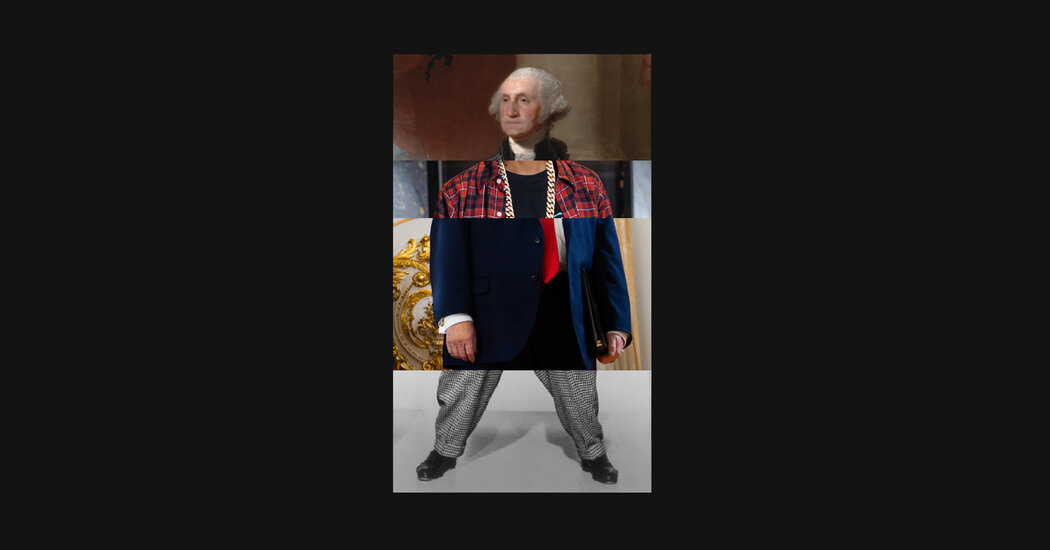
Freedom
It began with the chance to define a new set of laws and governance, to reject the inherited trappings (or traps) of class.
Aspiration
The term “American dream” wasn’t officially coined until 1931, when the popular historian James Truslow Adams published the best seller “The Epic of America.” It codified the idea of the dream as “a land in which life should be better and richer and fuller for every man, with opportunity for each according to ability or achievement.” Which later came to mean material attainment and conspicuous consumption.
Stability
For some, however, the dream had less to do with aspirational excess than with the allure of security: a sense of belonging expressed through assimilation as well as actual belongings. The brass ring could resemble a house in the suburbs, a dependable job and the assurance that every generation would be more prosperous than the last.
Reinvention
The one thing all of these versions of the American dream have in common is their belief in the power of reinvention, and the right of every person to pursue the myth of perfection in any way available, be it physical, philosophical or even technological.
Ultimately, the look of the American dream is no more static than the dream itself. As Jim Cullen, the author of “The American Dream: A Short History of an Idea That Shaped a Nation,” said, it is “most authentically experienced as a struggle to achieve, not a destination.” And it is worn that way, too.
Produced by Michael Beswetherick, Chevaz Clarke, Antonio de Luca, Christy Harmon and Erin Kelly
Photo Illustration by The New York Times. Images by Gilbert Stuart; National Portrait Gallery, Smithsonian Institution; Casey Kelbaugh for The New York Times; Allison Robbert for The New York Times; American Stock/Getty Images
Photographs and artwork by: William Clarke; National Portrait Gallery, Smithsonian Institution; Rischgitz/Getty Images; Gilbert Stuart; National Portrait Gallery, Smithsonian Institution; John Trumbull; DeAgostini/Getty Images; Joseph Siffred Duplessis; National Portrait Gallery, Smithsonian Institution; Bettmann/Getty Images; Topical Press Agency/Getty Images; Ed Vebell/Getty Images; Universal History Archive/Universal Images Group, via Getty Images; Transcendental Graphics/Getty Images; Heritage Art/Heritage Images, via Getty Images; John Singer Sargent; via Art Institute of Chicago; David LaChapelle/Interview; Theo Cockerell For London Life/Historia, via Shutterstock; Susan Wood/Getty Images; Hulton-Deutsch Collection/Corbis, via Getty Images; Jim Wilson/The New York Times; Paul Chinn/The San Francisco Chronicle, via Getty Images; James White/E! Entertainment; Hulu
Videos by: Associated Press; Reuters; Ballerina Farm; Parkwood Entertainment LLC, under exclusive license to Sony Music Entertainment, and SC Enterprises, under exclusive license to Roc Nation; Roc-A-Fella Records, LLC; Lightyear; Andrea Cremascoli via Getty Images; Archive Farms via Getty Images; Periscope Film LLC Archives – Footage via Getty Images; Curious Cumulus Productions, Inc. via Getty Images; Viacom Media Networks via Getty Images; Ted Sawicki via Getty ImagesWireImage Video via Getty Images; MPI Stock Footage Archive via Getty Images, Periscope Film LLC Archives via Getty Images; Petrified Films via Getty Images; Grinberg, Paramount, Pathe Newsreels via Getty Images; Bader Media via Getty Images; Starparade via YouTube; Barry Gibb, The Estate of Robin Gibb and Yvonne Gibb, under exclusive license to Capitol Music Group; WireImage Video via Getty Images; Atlantic Records
