

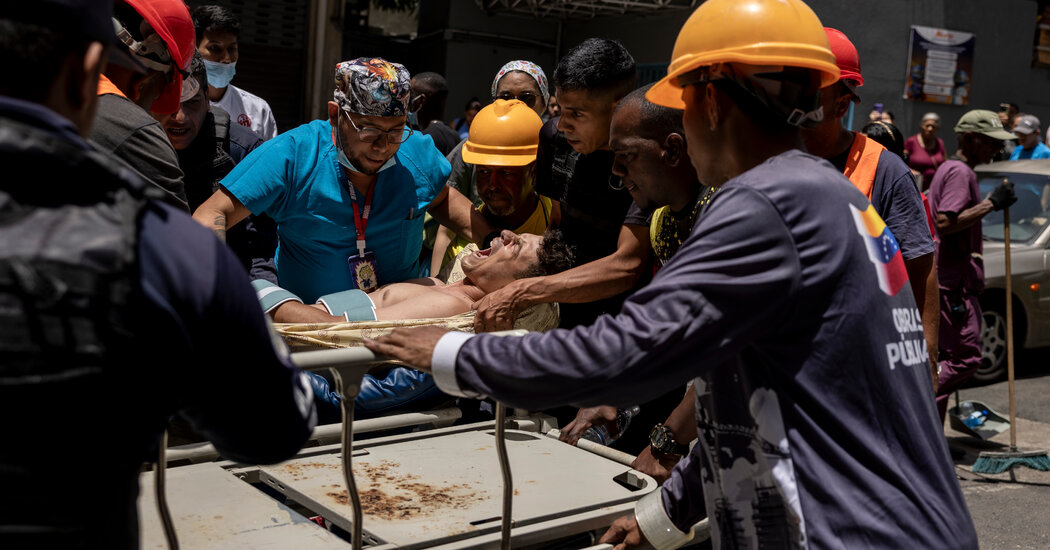
Children with battered faces and broken legs. A patient facing his third night on a gurney in a hospital yard, his IV held up by a tree branch. A morgue designed to hold two bodies was packed with 30. Deprived of electricity, the morgue’s refrigeration units failed, and the heat accelerated decomposition. The stench was overwhelming.
Two days after a pair of history-making earthquakes struck Venezuela, hospitals and morgues in Caracas and the nearby state of La Guaira were overwhelmed with patients, with the dead and with family members hoping to find their loved ones alive. Doctors who have spent years working in woefully underfunded public hospitals said they had never seen so much pain at once.
The scene inside and outside the region’s hospitals on Friday laid bare just how unprepared Venezuela’s government was for this disaster. The country’s medical system has been one of the chief victims of an economic crisis and chronic government mismanagement that dates back more than a decade.
On Friday, patients lay outside in hospital yards; rubble surrounded clinics. And in the absence of state help, citizens and medical volunteers showed up, carrying water, medicines and supplies.
Field hospitals sprung up, too, including one in a bus terminal in the city of Catia La Mar.
At a hospital in Caracas known as Periférico de Catia, a five-year-old girl had arrived after being pulled from debris. As a doctor waved an ultrasound wand over her abdomen, the girl kept repeating, almost in a whisper: “There was an earthquake.”
Her voice trembled, as did her hands. Others in her family were not so lucky; her nine-year-old brother and her grandmother, who were with her when the building fell, had died, said one of the girl’s godmothers.
Images circulated online of children who had been found in the debris without their parents, including a six-month-old baby whose face was red and scratched as if it had been clawed.
