


In late 2021, Amber Salzman interviewed for a job that she had no intention of taking. A relatively new start-up company, called Epicrispr Biotechnologies, was looking for a chief executive, and it was keen on vetting Salzman — who had decades of experience in the pharmaceutical industry — for the role. She had said yes to the meeting only as a favour to a recruiter, who had helped her to fill a key position at another company she had worked with. Joining the start-up wasn’t something she was enthusiastic about.
Halfway through the meeting, she changed her mind. Salzman had watched as Stanley Qi, the founder of Epicrispr, drew diagrams on a whiteboard explaining that the company wanted to make a genetic therapy — not by editing the code itself, but by changing the chemical markers attached to DNA, which can switch genes on or off. Then Salzman asked another team member: “‘What disease are we going after?’ And she said, ‘FSHD’.”
How ageing changes our genes — huge epigenetic atlas gives clearest picture yet
Salzman knew the condition all too well. FSHD, short for facioscapulohumeral muscular dystrophy, is an inherited disorder in which muscle problems first begin in the face and upper body and can spread to other parts, sometimes requiring wheelchair use. Salzman’s husband of more than 35 years had several cousins and a grandmother with the disease, although he had not inherited it himself.
Her family’s experience of this disorder had always been on her mind, but Salzman had never seen a way to make a difference in her previous positions: “At the time, nobody really understood what caused it.” But the conversation with Epicrispr gave her a chance to address the disease.
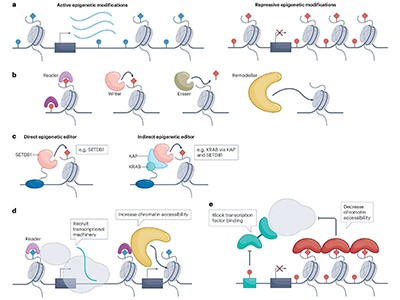
She took up the company’s offer to become its chief executive. In doing so, Salzman joined a niche group of drug developers trying to advance a technique called targeted epigenetic editing. The idea is to remove or add epigenetic markers — essentially chemical groups that sit on DNA (and the proteins that it is wound around). Depending on which chemical group is present or absent, genes can be activated or switched off.
Some existing medications influence epigenetic markers, but these drugs act broadly and lack specificity. This new cadre of scientists has found ways to precisely alter the epigenetic markers influencing specific genes. Epicrispr, based in South San Franscisco, California, is one of several companies working on such therapies. At the International Research Congress on FSHD, held in late June in Chicago, Illinois, it became one of the first to announce data from an epigenetic-editing trial.
Epigenetic markers have a huge impact on how our cells interpret DNA. Changing the epigenetic tags on a genome is akin to using an audio mixing board to alter a piece of music to sound like the works of composer Franz Schubert or pop star Taylor Swift, says biologist Fyodor Urnov at the University of California, Berkeley. Urnov helped to pioneer the use of various gene-editing technologies and co-founded an epigenetic-editing company called Tune Therapeutics in Seattle, Washington.
Epigenetic editing: from concept to clinic
The tools being deployed in this new era of epigenetic editing put a twist on standard gene editing, which involves using the CRISPR system to cut DNA. That system is precise, but even so, it can lead to cuts in the wrong place, which can disrupt or damage genes. “Epigenetic editing is a truly exciting concept for therapeutics because there is no chance of off-target DNA mutations being made, as is the case with gene editing,” explains Jessica Tyler, a molecular biologist at Weill Cornell Medicine in New York City.
Most epigenetic-editing platforms, rather than making changes to the DNA itself, modify the markers attached to DNA. That is thought to be safer for two reasons: first, the system can’t mistakenly cut in the wrong place, and second, it reduces the possibility that the DNA could rearrange itself — which is a risk whenever DNA breaks. In addition, preclinical experiments in human cells show that epigenetic modifications are reversible.
But epigenetic forces are potent, and researchers should proceed with caution, says Yann Joly, a bioethicist who heads McGill University’s Centre of Genomics and Policy in Montreal, Canada. “Epigenetic regulation plays a central role in development and reproduction,” he says. The community needs to ensure that epigenetic therapies are delivered safely and without unintended consequences, he says.
Dead right
In 2012 and 2013, several independent groups published a series of papers describing the original CRISPR–Cas9 editing system and its application1–3. In conventional CRISPR, a guide RNA finds the target sequence in the genome, and a Cas9 enzyme then cuts the DNA. The discoveries garnered huge attention for their potential to rewrite DNA. But at the time, most people might not have appreciated that biologists were already contemplating how to adapt CRISPR editing to modulate gene expression, rather than break or rewrite the genetic code.
One such biologist was Qi, who had worked in the lab of CRISPR pioneer Jennifer Doudna at the University of California, Berkeley. He wanted to know how to control a cell’s programming, rather than altering its code.
He launched his lab at the University of California, San Francisco (UCSF), and started working out how to modify the CRISPR–Cas9 system so that it would still grab on to the targeted DNA but wouldn’t snip the sequence after reaching it. In 2013, Qi and his colleagues, including biochemist Jonathan Weissman, also at UCSF at the time, and Doudna, landed on modifications that achieved just that4. They called the repurposed Cas9 ‘dead’ because it lacked its normal enzymatic cutting activity.
World-first: therapy to make cells young again trialled in a person
Next, the team deployed a guide RNA to lead the dead Cas9 to the right place, along with a protein that could turn gene expression on and off. The tests showed that the system worked in human cells and was highly precise5. “That’s when we knew this was a transformational tool,” says Weissman, who is now based at the Massachusetts Institute of Technology in Cambridge.
Not long after the publication of these key papers, Qi moved his lab to Stanford University in California. There, he continued to improve on the dead-Cas9 system and found a smaller version — called Cas12F — that could more easily be delivered to cells (the typical Cas9 protein, from bacteria, is relatively large).
Qi and his teammates found Cas12F in archaea, organisms that resemble bacteria in some ways but are evolutionarily distinct and have different cell walls. Whereas Cas9 is made up of around 1,300 amino acids, Cas12F consists of around 500. To deliver the payload to cells, the recipe for dead Cas12F is coded into a virus, known as adeno-associated virus, which is considered harmless to the body. The virus is infused into the body, and cells then produce the Cas12F construct themselves. The protein then gets to work on the target epigenetic markers.
Meanwhile, the company that Weissman co-founded, nChroma in Boston, Massachusetts, has made improvements to another component of the system: the methyltransferase element, which modifies the epigenetic markers. The firm hasn’t disclosed which one it is using but says that it is efficient and small. “I think that’s part of our secret sauce, frankly,” says Jenny Marlowe, chief development officer at nChroma.
Treatment try-outs
In 2025, a team including scientists at nChroma published a study in mice and monkeys showing that their approach worked6. The team’s epigenetic-editing system, encapsulated in lipid nanoparticles and delivered intravenously, could quash the production of a protein called PCSK9, which promotes ‘bad’ cholesterol. A single injection lowered monkeys’ levels of this type of cholesterol by around 70%.
Other epigenetic-editing therapies are moving into clinical testing. In January, nChroma began administering the first doses of an experimental epigenetic silencer against the hepatitis B virus to people with chronic infection. According to the World Health Organization, an estimated 240 million people worldwide have chronic hepatitis B — which can cause liver failure and cancer. A vaccine exists, but data from 2019 suggest that 15% of children around the world do not receive the full immunization regimen, and an increasing number of parents in countries such as the United States are refusing it for their children because of health misinformation.
To make matters worse, existing drugs cannot fully clear hepatitis B from the body because the pathogen has a nasty trick up its sleeve: bits of its genome integrate into a person’s DNA and from there, generate proteins that alter the immune response against it.
