

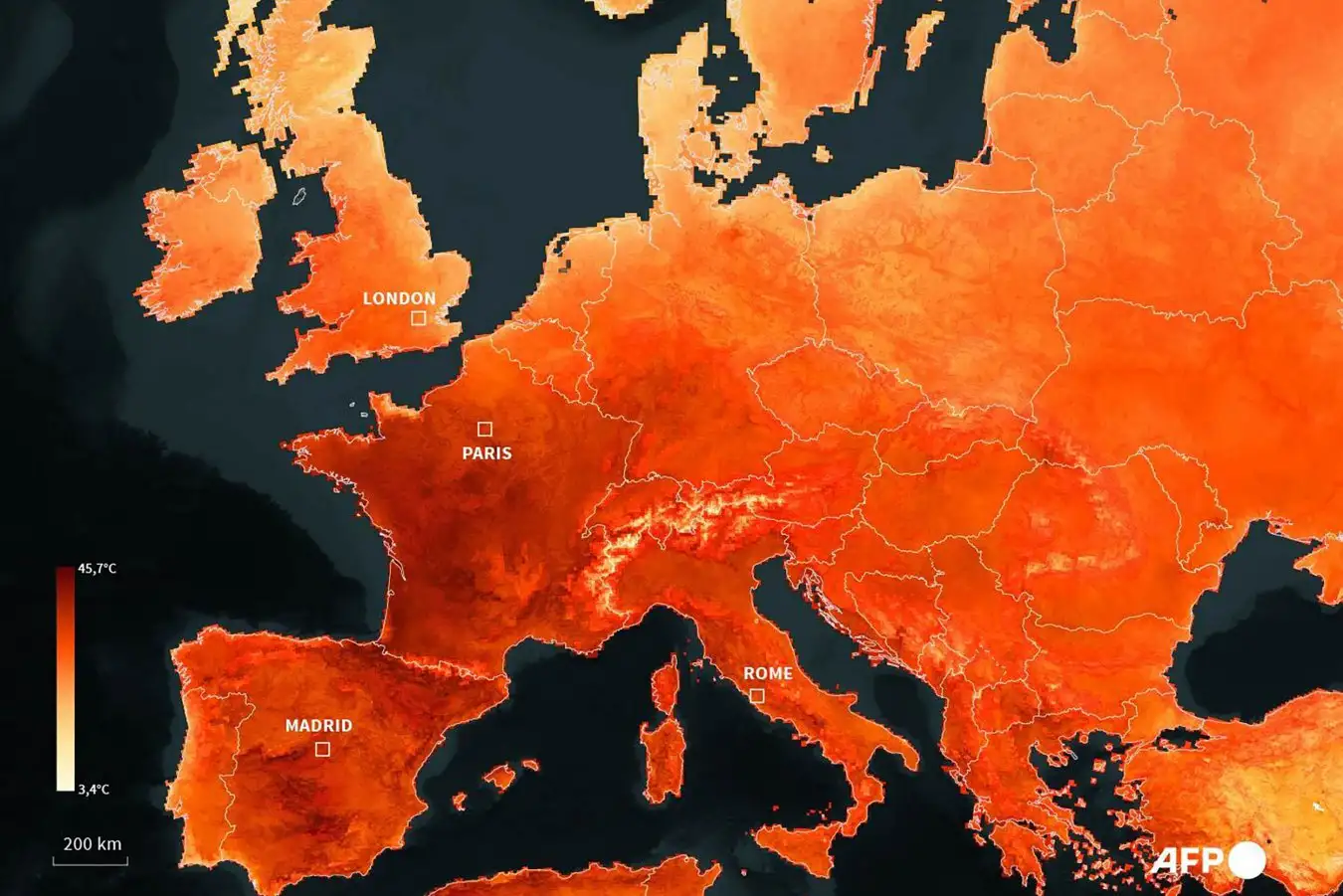
Extreme heat was felt across much of Europe on 24 June
Sylvie HUSSON/AFP via Getty Images
This week’s heatwave is the hottest ever recorded in Europe, as well as the most humid, and it is likely to cause thousands of deaths.
Although a potential “super El Niño” is forming in the Pacific Ocean, this did not play a role in the heatwave, a study by the World Weather Attribution network of scientists has found. Instead, global warming is clearly to blame.
The study analysed how likely the average daily maximum temperature projected for 26 to 28 June in western and central Europe would have been in the cooler climates of 1976 and of 2003.
While the weather pattern – a low-pressure heat dome that is trapping hot air from the south – is not unusual, the temperatures are. 50 years ago, a typical June heatwave would have been about 3.5°C cooler, and the temperatures seen over the next three days would have been a less than one-in-10,000-year occurrence.
Daytime temperatures have exceeded 44°C (111°F) in one French town, and nighttime temperatures have remained above 30°C (86°F) in parts of Spain.
“This event would not have been possible in June without climate change,” Theodore Keeping at Imperial College London said at a media briefing on 25 June. “The three-day nighttime temperatures would not have been possible at any time of year without climate change.”
The humidity has also been unprecedented, reaching more than 50 per cent in many British cities. Dew-point temperatures have been in the low 20s, as compared to the single digits during the July 2022 heatwave that set the UK’s temperature record.
The wet-bulb globe temperature, which measures not just air temperature but also humidity, heat radiation and air movement, has broken or is expected to break records in almost half of European cities, the study found.
Humidity amplifies health risks because it slows evaporation, making sweating less effective. While older people or those who have a chronic illness are in particular danger, so are migrants and people experiencing homelessness.
“What we see very clearly… is how unequal the effects of this heatwave are and how that really demonstrates the inequality that widens due to climate change,” said Friederike Otto, also at Imperial College London. “Because it’s of course people who are particularly vulnerable who are most likely to lose their lives.”
While it’s too soon to look at excess mortality, a previous study found a smaller heatwave in June and July of 2025 killed 2300 people in London and 11 other European cities.
“The health impacts of this heatwave are likely to be extremely high across large parts of northern and central Europe,” said Keeping.
Heatwaves will become even more intense and frequent unless we rapidly cut fossil fuel emissions, the researchers stressed. And Europe, the fastest warming continent, is not ready, as it has an ageing, urban population living in cities built for a cooler era. In the UK, only 5 per cent of homes have air conditioning.
Besides AC, Europe should invest in passive cooling like building insulation, ventilation, green roofs and walls and trees along streets, they said. It should also expand its heat response to include oft-forgotten groups like people with mental health conditions and those who are pregnant, said Carolina Pereira Marghidan at the Red Cross Red Crescent Climate Centre.
“Europe has heat action plans, but research has also shown that sometimes they do not cover all the groups that may be vulnerable,” she said.
Topics:
