

From old photographs of Black life in Princeton and Ithaca to the body politics she knows more intimately, Onome Daniella Olotu’s forthcoming Lagos solo exhibition moves between the places she has lived in and the identities she has encountered along the way. Okechukwu Uwaezuoke writes
“Watching a bonfire from the height of a four-storey building while trying to balance on one leg…” That is Onome Daniella Olotu’s dramatic, indeed funny, way of describing what it is like to observe Nigeria from the US and Europe. “While I have love for Nigeria, there is deep sorrow in my heart from the grief of seeing what she could or could have been, in terms of ‘working systems’ compared to where I am living,” says the 33-year-old.
From that “height”, she notices what works elsewhere and, by comparison, what does not work at home. She still hopes that some of what works there might work here too.
Going abroad has not made her any less Nigerian. If anything, it has made her more conscious of what she wants to retain. She refused, for instance, to acquire an accent simply to “fit in”. People understood her well enough. So why change the way she spoke?
Olotu’s first solo exhibition in Nigeria, after several solos and group shows abroad, is at Soto Gallery in Ikoyi, Lagos, from November 4 to December 15. Before We Know Ourselves, a title the curator settled on while putting the exhibition together, is divided into the Postcard Series and the Mask Series.
In “Sage Hall, 1875”, a 10 x 8-inch painting from 2025, Sage Hall at Lawrence University in Appleton, Wisconsin, occupies the right side of the canvas. Its steep gables, central tower and arched windows are set against the painted surface.
On the left, handwritten words disappear into a thick, bumpy smudge of magenta and pink before ending with the legible “Your Cousin, Onome”. Above them is a green vintage postage stamp crossed by a dark cancellation mark. At the lower right, an old multi-storey building pushes out of the pink.
Then there is “Sunday Gist at Griggs Corner Amoco” (Postcards from Princeton). Three women in vintage clothes and hats stand beside a classic blue car outside Griggs’ Corner Amoco petrol station. The 2024 painting looks like an oversized postcard, complete with a stamp bearing actress Hattie McDaniel and a red postmark dated July 11, 1983.
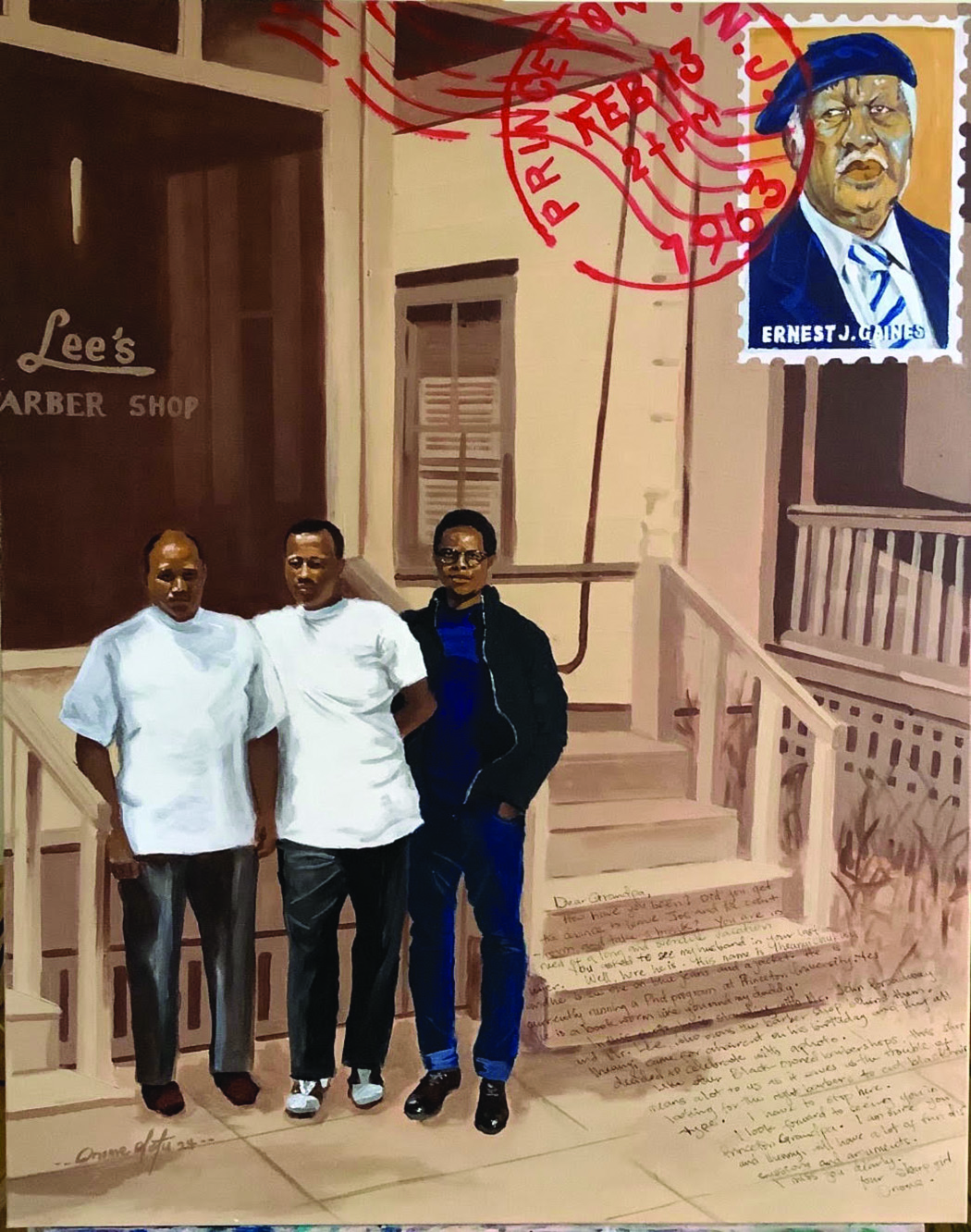
In “Mr Lee, John Broadway, and Iheanyi at Lee’s Barber Shop” (Postcards from Princeton), three men stand on the steps outside Lee’s Barber Shop. A commemorative stamp bearing novelist Ernest J. Gaines’s portrait sits in the upper right, crossed by a red postmark: “PRINCETON, N.J. FEB 13 2 PM 1963”. At the bottom right, a handwritten letter addressed to “Dear Grandpa” contains family news and references to the barbershop and Princeton landmarks.
The Princeton paintings began when Olotu noticed how few Black families she saw around her and discovered that the Witherspoon-Jackson community had once been much larger. She began talking to educator and historian Shirley Satterfield and other residents, while digging through the collections of the Historical Society of Princeton and the Arts Council of Princeton. The research opened up family histories going back four generations and more.
Olotu describes the paintings as postcards she might have sent home, recording Black life in Princeton before the community changed. But some of the old photographs are already so evocative that the paintings have little left to do.
The paintings are more convincing when Olotu gets in the way of the photographs. Handwritten words intrude into some of them. Pink and magenta spread across others, breaking up the surface. These colours are a long way from the sepia treatment usually given to old photographs. They make the paintings look like paintings, rather than simply old photographs dressed up for display.
Postcards from Ithaca draws on photographs and documents from the History Center in Ithaca and Cornell University’s Rare Manuscript Collections. Olotu picked out images that reminded her of arriving in a new place and worked on them in paint. The reconstructed postage stamps commemorate people whose contributions she wants to draw attention to. But the cancellation marks run straight across their faces.
In the Mask Series, Olotu turns the spotlight to the human body. The 10 paintings include the six-part “The Crime of a Little More Flesh” I–VI, drawing on the experiences of her sister and other big-bodied people dealing with body shaming and body dysmorphia. Her figures are stretched, enlarged and blurred, their bodies pushed out of shape. Scratched lines and bits of screen-printing run across them.
Some are disturbing. But when the same devices keep turning up, they begin to lose their bite. The better ones make the viewer work a little harder.
Has making these works changed her answer to what it means to be in places that continually question her presence?
“Honestly, no,” she replies. Instead, it has challenged her “to remain authentic and be better”. She calls it “flipping the script”. People question what they do not understand, she says, or what they deliberately refuse to understand.
She quotes Chimamanda Ngozi Adichie: “A single story creates stereotypes, and the problem with stereotypes is not that they are untrue, but that they are incomplete.”
The politics, discussions and policies around immigration have left her with more questions. If Nigeria functioned the way it was supposed to, would she be here, “looking over my shoulders and getting little panic attacks when I read the news”?
No, she wouldn’t.
