

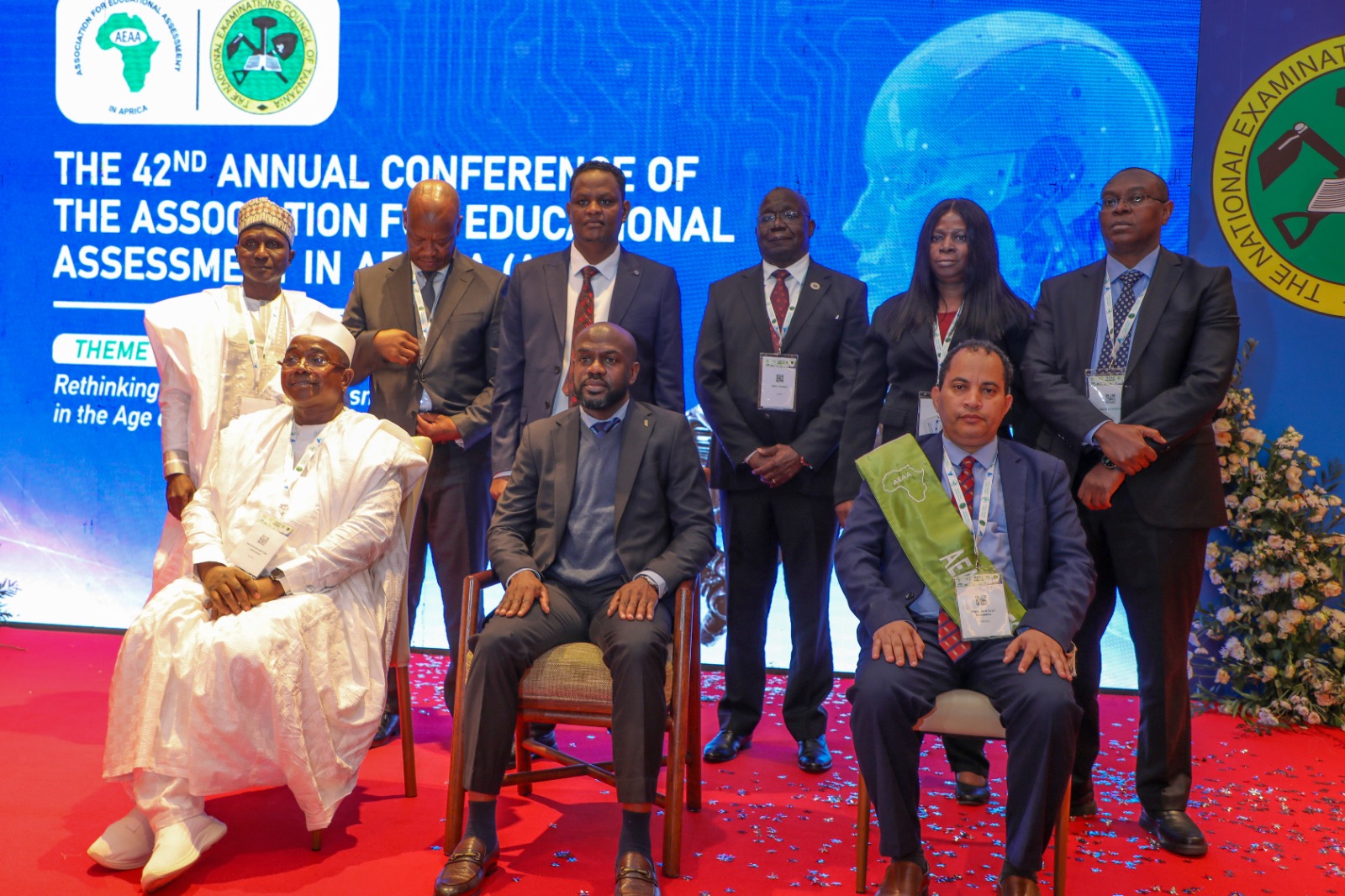
The decisions taken at the 42nd Annual Conference of the Association for Educational Assessment in Africa (AEAA) in Arusha, Tanzania, have placed Nigeria at the centre of Africa’s emerging conversation on Artificial Intelligence and educational assessment. With Professor Dantani Ibrahim Wushishi elected Vice President of the association and Abuja chosen to host the 2027 conference, the Arusha meeting has effectively handed Nigeria an opportunity and a responsibility to help shape how Africa conducts examinations in the age of AI
Nigeria’s emergence as a key player in Africa’s educational assessment leadership has coincided with a defining moment for examinations worldwide: the rapid integration of Artificial Intelligence into learning and assessment.
With Professor Dantani Ibrahim Wushishi, Registrar and Chief Executive of the National Examinations Council (NECO), elected Vice President of the Association for Educational Assessment in Africa (AEAA), and Abuja selected to host the association’s 2027 conference, Nigeria now has an opportunity to help shape how the continent measures knowledge, competence and skills in the digital age.
The decisions were taken at the 42nd Annual Conference of the AEAA in Arusha, Tanzania, where examination administrators, researchers, policymakers, educational leaders and assessment specialists from across Africa gathered to discuss the theme, “Rethinking Educational Assessment in the Age of Artificial Intelligence.”
The conference came at a time when education and employment are being reshaped by technologies capable of performing tasks that schools and examination bodies have traditionally rewarded, including information retrieval, language translation, data analysis and content generation.
For Nigeria, the developments in Arusha present an opportunity to contribute to a transition that could influence the credibility of qualifications, the identification of talent and the development of skills across the continent.
Assessment And National Development
Educational assessment is central to how societies identify talent, recognize competence and determine whether learning has taken place. Its influence extends beyond examination halls to universities, workplaces, government planning and economic productivity.
When assessment systems are credible, employers can place greater confidence in qualifications, institutions can rely on academic records and students can expect their efforts to be evaluated fairly. Weak assessment systems, however, can undermine confidence in credentials and make it more difficult to distinguish genuine knowledge from superficial familiarity.
Media expert and communication development enthusiast, Abdullahi O Haruna Haruspice, said the growing importance of assessment should be understood within the broader transformation of education and work.
“Artificial Intelligence is changing the way knowledge is produced, accessed and applied. It is therefore important that our examination systems evolve to measure not only what candidates can remember, but also their ability to think critically, solve problems, exercise judgment and apply knowledge in real-life situations,” he said.
His observation reflects a central concern in the debate over AI and education: whether existing examination models adequately measure the competencies required in economies where machines increasingly perform routine cognitive tasks.
A country may invest heavily in schools, teachers and educational infrastructure, but without reliable mechanisms for determining what students know and can do, it becomes difficult to evaluate the effectiveness of those investments.
Assessment, therefore, is not merely an administrative exercise. It provides information that can support educational planning, institutional accountability and workforce development.
The Arusha Conference and Nigeria’s Role
The election of Professor Dantani Ibrahim Wushishi as Vice President of the AEAA and the selection of Abuja to host the association’s 43rd Annual Conference in 2027 placed Nigeria within the association’s continuing leadership and knowledge-sharing activities.
The developments also create a platform for Nigeria to participate more actively in continental discussions on assessment standards, examination administration and the application of emerging technologies.
Haruna said Nigeria’s role should extend beyond hosting an international gathering.
“Hosting the AEAA conference in Abuja should be seen as an opportunity for Nigeria to demonstrate practical solutions in educational assessment. The country has the scale and institutional experience to contribute to conversations on examination integrity, digital assessment, data use and access to technology,” he said.
The significance of the Arusha conference lies in the questions it raised about the future of assessment. As AI becomes more capable of generating answers and performing intellectual tasks, examination bodies must consider whether conventional methods remain sufficient for measuring learning.
The challenge is not simply to introduce new technology into existing systems. It is to determine what knowledge and competencies should be assessed, how they should be measured and how results can remain credible.
Moving Beyond Traditional Examination Models
For much of the last century, examinations relied heavily on standardized questions, memorization and the reproduction of information under controlled conditions. These methods remain useful for measuring certain forms of knowledge, but they do not always provide a complete picture of a candidate’s analytical ability, creativity or problem-solving skills.
Artificial intelligence introduces possibilities for more responsive assessment. Adaptive testing systems can adjust the difficulty of questions based on a candidate’s responses, potentially producing a more detailed picture of knowledge and competence.
AI can also support the analysis of examination data. Rather than using results only to determine who passed or failed, examination bodies can examine patterns in performance across subjects, schools and regions. Such information can help identify learning gaps and inform educational interventions.
According to Haruna, the value of AI in assessment lies in how effectively it supports human judgment and institutional decision-making.
“Technology should not replace the professional responsibility of educators and examination administrators. It should provide better information, improve efficiency and support decisions that are transparent, fair and focused on learning outcomes,” he said.
This distinction is important because technological adoption alone does not guarantee better education. The quality of the data, the design of the assessment and the procedures used to interpret results remain significant.
The transition to AI-enabled assessment also raises questions about the balance between standardized testing and the need to measure higher-order competencies. Examination bodies may need to explore assessment methods that examine how candidates apply knowledge, evaluate information and respond to unfamiliar problems.
NECO And Institutional Capacity
Nigeria’s examination system operates on a large scale, with millions of candidates participating in examinations administered by national and other examination bodies. The size and complexity of the system create demands for efficient administration, secure processes and credible results.
Under Professor Dantani Ibrahim Wushishi’s leadership since 2021, NECO has pursued reforms relating to modernization, digitalization and institutional strengthening. These efforts form part of the broader need to improve examination administration and maintain confidence in the council’s operations.
The council’s international engagement also places it within wider discussions about educational assessment in Africa. Its participation in continental forums provides opportunities to share experience, examine emerging practices and contribute to discussions on examination standards.
However, leadership in AI-enabled assessment will require more than institutional recognition. It will demand sustained investment in infrastructure, professional development, research and systems capable of operating reliably at scale.
Haruna said examination bodies must approach the transition with clear objectives.
“The adoption of AI must be guided by the actual needs of the education system. It should help examination bodies improve the accuracy of assessment, strengthen examination security and generate useful information for policymakers. It must not become technology for its own sake,” he said.
For Nigeria, this means that the opportunity presented by the AEAA leadership position and the Abuja conference must be connected to practical institutional development.
Examination Integrity In The Digital Age
Examination malpractice remains a challenge for educational systems. Question paper leakages, impersonation, collusion and other forms of cheating can compromise the credibility of results and weaken confidence in qualifications.
AI-supported tools may assist examination bodies in addressing some of these challenges. Identity verification, analysis of unusual examination patterns and the identification of similarities across scripts are examples of areas where technology can support existing monitoring procedures.
Such tools, however, require appropriate safeguards. False alerts, inaccurate identification and the misuse of candidate data can create new problems if systems are deployed without adequate oversight.
The responsibility of examination administrators is therefore to combine technological capabilities with sound procedures, trained personnel and mechanisms for reviewing disputed decisions.
A credible examination system must protect both the integrity of its results and the rights of candidates.
The emergence of AI also creates new questions about academic honesty. As students gain access to systems capable of generating essays, solving problems and producing answers, examination bodies must determine how to distinguish independent learning from machine-generated responses where that distinction is relevant to the assessment.
This will require clear rules, appropriate examination design and continued attention to the purpose of each assessment.
Inclusion Must Accompany Innovation
Nigeria’s digital development presents opportunities for the modernization of assessment, but access to technology remains uneven. Differences in electricity supply, internet connectivity, digital literacy and educational infrastructure can affect the ability of students and institutions to benefit from AI-enabled systems.
If these disparities are not addressed, technological reforms could create additional barriers for candidates in underserved communities.
Haruna stressed the importance of ensuring that modernization does not compromise equal opportunity.
“Digital transformation must be inclusive. Students should not be disadvantaged because of where they live or the infrastructure available in their schools. Before introducing advanced assessment technologies, we must consider access, affordability, reliability and the support systems required for successful implementation,” he said.
This means that investments in AI assessment should be accompanied by improvements in infrastructure, teacher training, candidate orientation and accessible examination arrangements.
It also requires careful consideration of data protection, algorithmic transparency and the procedures for addressing errors or complaints.
The objective should be to use technology to improve assessment without allowing access to technology itself to become an unfair determinant of examination outcomes.
Abuja 2027 And The Opportunity Ahead
The 43rd AEAA Annual Conference in Abuja will take place against a background of continuing changes in education and technology. Discussions are likely to include the use of AI in assessment design, examination security, data governance, fairness and the development of competencies relevant to the changing workplace.
For Nigeria, the conference offers an opportunity to present its experiences, learn from other African examination bodies and participate in the development of assessment practices suited to the continent’s diverse educational environments.
Haruna said the country should use the period before the conference to focus on practical preparations.
“Nigeria should arrive at Abuja 2027 with evidence of what it has achieved, the challenges it has encountered and the lessons it has learned. The conference should be an opportunity to discuss workable solutions that can be adapted across African education systems,” he said.
The conference will also provide an opportunity for stakeholders to examine the institutional requirements of AI adoption. These include the training of examination personnel, the development of reliable digital systems, the protection of candidate information and the establishment of procedures for evaluating the accuracy of automated tools.
The discussions should remain focused on educational outcomes rather than technology alone. AI may offer new capabilities, but its value will depend on whether it improves the quality, fairness and usefulness of assessment.
From Opportunity To Implementation
The developments in Arusha have given Nigeria a platform within Africa’s ongoing conversation about the future of educational assessment. The election of a Nigerian examination administrator to an AEAA leadership position and the selection of Abuja as the next conference venue create opportunities for the country to contribute to the development of assessment practices across the continent.
Yet the significance of these developments will ultimately depend on what follows.
Nigeria’s examination bodies will need to consider how emerging technologies can be incorporated into existing systems, how candidates can be protected from unfair outcomes and how assessment data can be used to support educational improvement.
The country’s scale and institutional experience provide a basis for participation in these discussions, but meaningful progress will require sustained action, investment and collaboration.
As AI changes the way knowledge is created, accessed and applied, educational assessment must continue to evolve. Nigeria’s role in that process will be shaped by its ability to combine technological innovation with fairness, institutional credibility and access.
The Arusha conference has opened an opportunity for Nigeria to contribute to Africa’s examination future. Abuja 2027 will provide another platform for that conversation. The work between both events will determine the extent to which Nigeria can translate its emerging continental role into practical contributions to educational assessment.
