
This article is an on-site version of our FirstFT newsletter. Subscribers can sign up to our Asia, Europe/Africa or Americas edition to get the newsletter delivered every weekday morning. Explore all of our newsletters here
Good morning and welcome to FirstFT. In today’s newsletter:
-
US billionaires line up to bankroll Republicans’ election push
-
European Commission president endorses Canada’s pitch to become an “associate member”
-
The Federal Reserve should defy Trump and raise borrowing costs today, say economists
-
The world’s best-performing sovereign wealth fund gives its verdict on equities
You can listen to today’s top news stories in the FT News Briefing podcast.
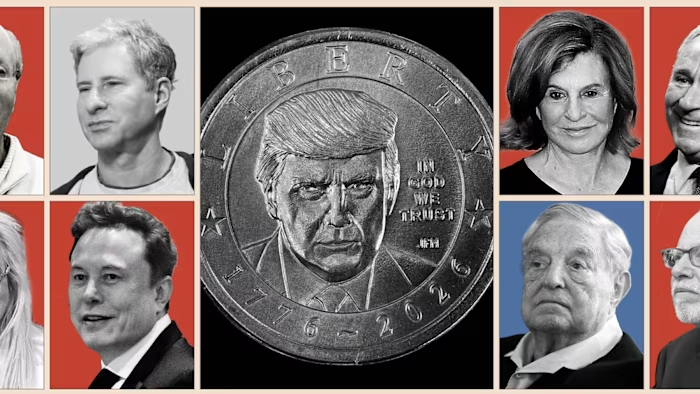
US mega-donors are overwhelmingly backing the Republicans in this year’s midterms race, according to FT analysis, as billionaires from Silicon Valley to Wall Street bankroll President Donald Trump’s party ahead of November’s crunch ballot.
Sixteen of the country’s 20 largest donors have ploughed money into the GOP’s campaign, with billionaires such as SpaceX chief Elon Musk, Blackstone boss Stephen Schwarzman and hedge fund manager Paul Singer giving tens of millions of dollars, even as the party trails the US Democrats in opinion polls.
Investor George Soros is the standout Democratic donor, giving a total of $102mn in the 2025-26 election cycle. Other mega-donors have channelled cash to candidates pushing deregulation of cryptocurrency, with some building huge war chests around the digital assets. Candidates promoting AI have also benefited from the huge cash injections, as have those pushing for gambling industry deregulation.
“What you’re seeing is a mild break from expectations,” said Stanford political scientist Adam Bonica, who has studied donations from America’s wealthy since 1980. It is not unusual for top donors to lean Republican, but the balance in this election is “especially skewed”. Read more here.
Here’s what else we’re keeping tabs on today:
-
Nato: Mark Rutte, the alliance’s secretary-general, meets UK Prime Minister Andy Burnham in London.
-
US monetary policy: The Federal Reserve concludes its two-day rate-setting meeting, in which it is widely expected to raise borrowing costs by a quarter point.
Join us tomorrow for a live Ask an Expert Q&A with John Gapper, the FT’s chief UK business columnist, who will be answering your questions on the UK Budget and the outlook for British business. Submit your questions here.
Five more top stories
1. US and Chinese determination to dominate AI makes it harder for the two countries to find common ground on safety, think-tanks and technology companies say. Analysts will closely watch the summit meeting next week between US President Donald Trump and Chinese President Xi Jinping for signs their governments can co-operate on AI risks.
-
‘We don’t need new regulations’: Nvidia chief Jensen Huang and Meta boss Mark Zuckerberg have pushed back against efforts to co-ordinate a slowdown in research in the name of safety, saying companies should address risks individually instead.
-
Opinion: The main Trump-Xi summit achievement will be it happening at all, writes senior trade writer Alan Beattie.
2. European Commission president Ursula von der Leyen has endorsed Prime Minister Mark Carney’s pitch for Canada to become an “associate member” of the EU, in a bold proposal from Brussels to deepen ties with Ottawa amid pressures from the US and China.
-
The EU is poised to ban the use of social media, certain gaming platforms and AI chatbots by children under 15 without parental supervision.
3. Exclusive: OpenAI has held early conversations with investors about raising another private funding round at a $1.2tn valuation before its planned initial public offering, according to people familiar with the matter. The investment would follow a March round in which the ChatGPT maker raised $122bn at an $852bn valuation.
4. The US has charged five individuals in connection with what it called a “global assassination network” controlled by Russia in a sweeping indictment that includes claims of a murder-for-hire plot on American soil. The Department of Justice said the group was paid to conduct surveillance and plotted to kill dissidents in the US and Lithuania.
5. The so-called Clarity Act, a landmark crypto regulation bill backed by the digital currency industry, failed to advance in the US Senate yesterday, as Democrats insisted on stronger limits on Trump’s ability to profit from the industry. The US president reported earning more than $1bn from his crypto businesses last year.
Nuclear fusion’s moment of truth
Private nuclear fusion companies are attracting billions of dollars from Silicon Valley investors and energy majors, all lured by the promise of abundant, cheap and clean energy. But insiders warn that as competition for funding intensifies, fusion companies are making overly optimistic claims about the cheapness of the electricity they hope to produce, writes Ryohtaroh Satoh.
We’re also reading . . .
-
Iran’s hidden leader: Mojtaba Khamenei’s absence from public view has been a source of speculation.
-
Tax competition: Switzerland’s 26 cantons compete fiercely for companies, wealthy residents and the revenues they bring, writes Mercedes Ruehl.
-
Stocks slump: New Zealand’s sovereign wealth fund, which is the world’s best performing, expects the recent outperformance in global equities to ease after it reported 14 per cent growth in the year to June.
Chart of the day
The US Federal Reserve should defy Trump and raise borrowing costs today, according to the majority of economists polled by the University of Chicago’s Booth School of Business on behalf of the FT, with most expecting a quarter-point increase.

Take a break from the news . . .
The art market has long followed new wealth, from Italian Renaissance-era merchants to the 20th century’s investment bankers. Today’s cohort of wealthy tech bosses is gradually making its presence in the collector community felt.

Thank you for reading and remember you can add FirstFT to myFT. You can also elect to receive a FirstFT push notification every morning on the app. Send your recommendations and feedback to [email protected]
Recommended newsletters for you
The State of AI — A series of conversations between the FT and MIT Technology Review on the geopolitics of tech. Sign up here
