

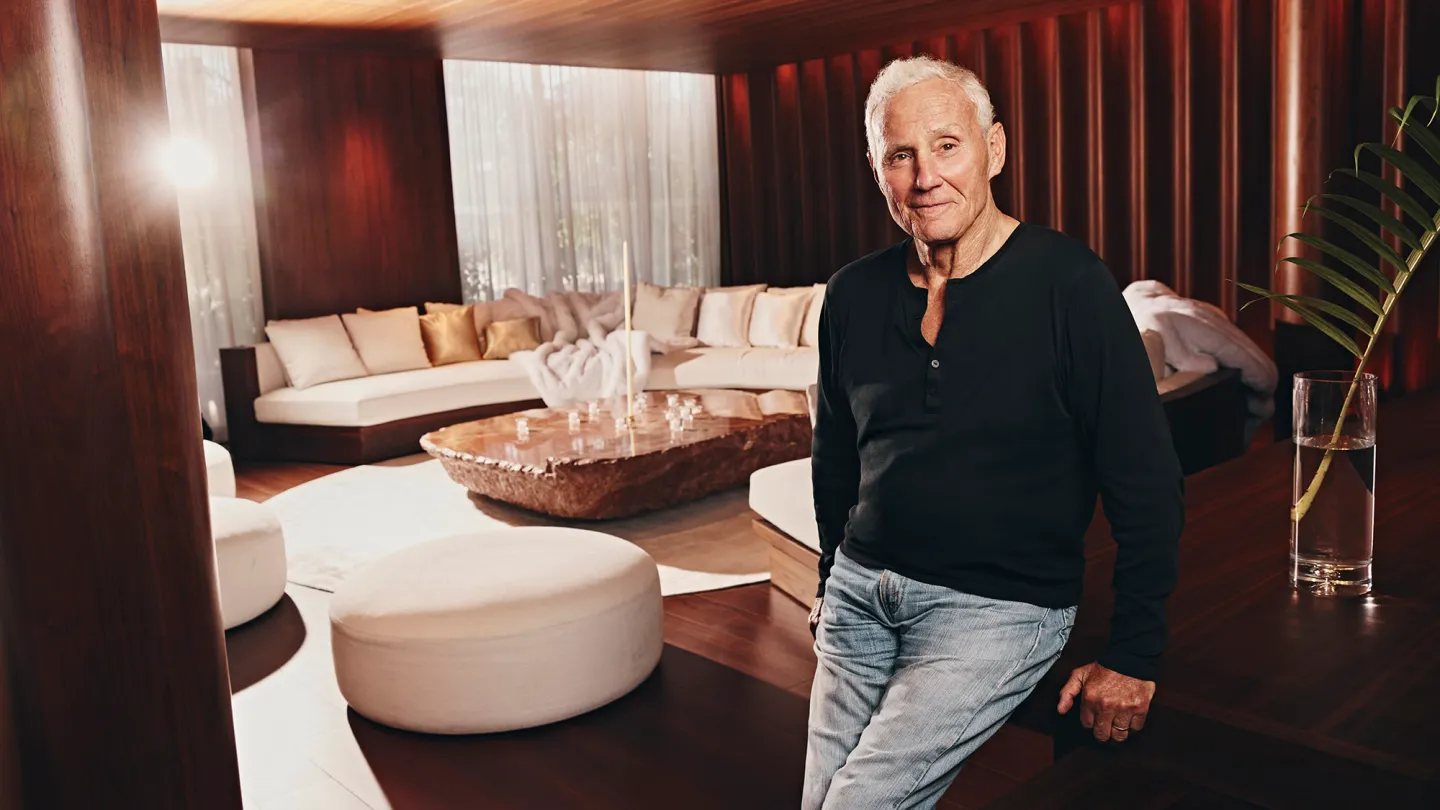
Ian Schrager has spent nearly half a century inventing places people remember more vividly than the things they did inside them. With his late partner Steve Rubell, the Brooklyn-bred impresario compressed a cultural epoch into Studio 54’s 33-month original run — and then, improbably, did it again in a second industry. Morgans, which he opened in 1984 in New York, is generally credited with inventing the boutique hotel; the Royalton, the Paramount, the Delano and the Mondrian followed, and with them the ideas every design-conscious hotel on earth now takes for granted: the lobby as a social ecosystem rather than a waiting room, the bar as a destination for people who aren’t staying there, the hotel as a scene. EDITION, his long partnership with Marriott, exported the formula at scale. An entire category — “lifestyle hospitality,” a phrase he’d probably hate — is essentially his invention, franchised out to competitors who have made billions from it.
The latest chapter is PUBLIC, built around what he calls “luxury for all,” and he is bringing it to Los Angeles inside a building freighted with somebody else’s mythology. The low-slung former motel at 8300 Sunset Blvd. was The Standard, which André Balazs opened in 1999 and ran until it closed in 2021. Balazs was Schrager’s erstwhile rival, chasing the same crowd through the boutique boom, and The Standard was his loudest answer to it: Guests checking in were treated to the view of young models in underwear lounging inside a glass fish tank behind the front desk. Until Schrager swooped in, the space had been sitting dark for five years.
PUBLIC West Hollywood, designed with the British minimalist John Pawson, puts 137 rooms into that shell and strips out the conventions Schrager has decided are dead weight: the traditional front desk, elaborate room service, the black television bolted to the wall. In their place, three food and entertainment venues, a nightclub, a pool, guest rooms built around private screens the size of a small cinema and a 16,000-square-foot rooftop “park,” with swings, greenery and 360-degree views. It is his third major act in Los Angeles, after the Mondrian and the West Hollywood EDITION, and probably his most contrarian: a determinedly democratic hotel (with room prices that are only slightly outrageous for Sunset Boulevard) in a city that has spent a decade retreating behind members-only doors. Thanks to Schrager’s penchant for perfection, getting it open has taken longer than announced — the debut was set for spring, then July 15; now the launch is scheduled for fall 2026.
He met me in the lobby in mid-August, trim and still cocky at 80, humming with the same restless energy that made him famous at 31. He is not a man resting inside his own legend. And best not to mention retirement.
“I sometimes think about doing something else,” he says. “But there’s really nothing else I like to do.”
You’re opening PUBLIC on the site of The Standard, a hotel lots of people remember very fondly. When you take over a property with that kind of history, do you try to preserve any of it?
No. Not at all. I always try to do something entirely new, unrelated to anything that happened before. What went on there is irrelevant to me. I look at the physical property, what’s happening at the moment, what’s happening culturally, what people are interested in, and try to come up with something brand new.
In other words, what happened at The Standard stays at The Standard.
As it should! (Laughs.)
Ian Schrager
Photographed by Daniel Prakopcyk
You’ve said the best hotels reflect the spirit of their city. What’s the spirit of Los Angeles in 2026?
In two words: free spirit. Within an hour, you have the mountains, the desert, the ocean. There are very few places in the world with that kind of optionality to living. To me, California was always Mecca — I’m from New York originally. In the ’60s and ’70s, it was as if the country tilted over and everybody who wasn’t tied down rolled into California, and it set the cultural milieu ever since.
I’m not talking about the clichés. I’m talking about what’s inherent about it. It’s a place full of contradictions, and they come together in funny, strange ways, and something comes out that’s meaningful to people.
The Mondrian had a very different energy — more exclusive, more luxe. How is this hotel different, and how are you different?
It’s 30 years later. I’m different, times are different, people are different. Their likes and dislikes, their dreams and nightmares are all different. My job is to hit the sweet spot among all those contradictory things and do something that resonates with people from all different walks of life, all different ages, all different strata of wealth.
Los Angeles is overrun with private clubs and exclusive house parties. You’re proposing “luxury for all.” Why do you think the city wants something more democratic?
The traditional notion of luxury is old-fashioned and outdated. The idea that luxury is only for people who happen to be rich is ridiculous. Luxury is for anybody who wants it and can appreciate it. It appeals to a sensibility, not to a pocketbook, not to some definition an economist makes up.
By the way, there’s nothing more boring than being in a room full of rich people. You want to be with people from other walks of life. That diversity is the spark of life. If we only get one group, one walk of life, only rich people — anybody could do that. If we do that, we failed.
So what’s the cheapest room going to be?
I’m not really sure. A couple of hundred dollars, I suppose. If people who don’t have money can’t enjoy this, there’s something wrong about it. It can’t only be for rich people.[PUBLIC West Hollywood’s booking site lists opening rates starting at $564 a night.]
But you built Studio 54 and the Palladium by carefully curating the crowd. You and Steve — or your doorman — decided who got in. Is there really no gatekeeping at all at PUBLIC?
The only difference is that in the past, I did the selecting. Now a person’s sensibility does it. If this resonates with you, you’ll come. If it doesn’t, you won’t. So I have nothing to say about it, nothing to do with it. Either it touches you in some emotional, visceral way or it doesn’t. Makes my job a lot easier, by the way.
The project will appeal to people who think simplicity is the ultimate sophistication. Some will think it’s not enough. Some will think it’s too much. That’s fine. That’s the way it’s supposed to be. It’s not for everyone.

Ian Schrager
Photographed by Daniel Prakopcyk
Studio also gave famous people room to misbehave in relative privacy. Can that kind of freedom exist now that everyone has a camera?
I don’t think those fundamental human characteristics ever change. They’re the same now as they’ve always been. But I rely on a person’s sensibility. I don’t have any problem with people taking pictures, but if it became an intrusion on the other people here, I’d stop it the same way I’d stop any intrusion. I have guests. I’m in the service business.
This isn’t something we arrive at intellectually. We experience it, we feel it, we respond. I don’t really have any hard-and-fast rules, to tell you the truth. I’ll see the way people use it. They tell me how they’ll use this space. I don’t tell them.
You designed PUBLIC with John Pawson after years of working with Philippe Starck. Do you ever clash with your designers?
We never clash because the very talented people I work with know that I want the same thing they want. I want to blow people away.
And that’s the brief? “I want to blow people away”?
They come to it knowing that. They know my standards, they know my demands. That’s the only reason I continue to do it — my payoff is when people come in and they’re blown away. I don’t say that to be arrogant or presumptuous, but we’re trying to do something very special. I have never once in all the years I’ve been in business had a falling out or an argument with a designer I work with. Not once.
The detail you’re most excited about — is it the Keith Haring-inspired murals in the bathrooms, the screens in the rooms?
I love the screens. You’re in Hollywood, the movie capital of the world — how about an 8-foot-by-12-foot screen in every room, floor-to-ceiling, that you can watch during the day with the daylight coming in and at night? Everybody has their own private screening room. And there’s no big, black TV on the wall with all the wires behind it when you walk in.
People respond to things that are new and innovative, but not so new that they make people uncomfortable. Just new enough that people feel they’re seeing something they haven’t seen before.
A young Schrager, owner of Studio 54, at the control board of the club’s DJ booth in 1978.
Mary DiBiase/NY Daily News via Getty Images
And you turned the roof into a park — three-quarters of an acre, with swings.
We had this giant roof, and we wanted to do something with it. To take a hotel in the middle of West Hollywood and turn it into a resort — three-quarters of an acre where you feel like you’re on an island in the Caribbean — that was so cool to me. I love the contradiction of it all.
You’ve also done away with the traditional front desk and most room service. Does more democratic just mean that people have to schlep their own coffee?
It means you’re not going to pay $27 for a cup of coffee. You go down and get the coffee and pay a reasonable price. You reduce the amount of labor, which is what unavoidably increases the cost of providing the product. People don’t care if room service arrives with white gloves and gold epaulets when they’re paying an $8 service charge. They care whether the coffee is hot, whether it’s good, whether they’re getting it on time. It’s a return to the fundamentals, without all the accoutrements of old-fashioned luxury. You’ve got to be willing to throw those rules out. That’s the part I love.
You’ve pioneered ideas that turned into hospitality clichés. Does being copied annoy you?
I hate to say it in public, but yes. It’s my idea. It’s my baby. Through the years, I thought I’d get used to it, but I never have.
When I got started, I could have gone one of two ways. I could have tried to do more hotels than anybody else — hundreds of them. That didn’t interest me. I wanted to do the best hotels. Every one is a one-off, starting from scratch, trying to do something that blows everyone away.
A rendering of the luxe library.
Courtesy of Ian Schrager Company
Have you ever sued anyone over it?
No. That would make me look petty, I think. But these things come from love. They’re my ideas. They’re like my children.
Is there another hotelier you admire? Barry Sternlicht built W out of a lot of the same ideas.
(Laughs.) Oh, Barry. I care about him, even though I think what he did was very derivative of what I did. I think he might be the first to say that. But a hotelier I really admire is Steve Wynn. He doesn’t do what we do at all — he does something completely different. But he’s another guy who’s absolutely obsessed with every single detail, and I have great respect for that. He has his own vocabulary, his own way, but he’s trying to overwhelm the customer like I do.
You spent years working with Marriott on EDITION. Was that partnership difficult for someone as independent as you?
Thank God they had Arne Sorenson, a brilliant CEO and a very nice man. We came from different perspectives, but we respected each other and we worked through it. After Arne became ill and passed on, it became more difficult to continue in the same spirit. I could never take my foot off the pedal. But a big company always wants to take everything from a familiar catalog. I don’t want anything from the catalog. We bridged that gap for 12 or 15 years, but then we decided it was time for both of us to move on.
Tina Brown once told me the secret to a great magazine is a little bad taste. Does a great hotel need some bad taste?
Well, a great hotel has to be a little subversive. It can’t be safe and corporate. But I don’t know about bad taste! You can’t have bad taste when people are sleeping and bathing and eating there. If they’re not comfortable, they’re not going to enjoy it. A magazine can push tasteful boundaries. In the hotel business, there’s no tolerance for mistakes.
Studio 54’s original run with you and Steve lasted only 33 months. Why does its legend endure decades later?
It’s not a question of time. It’s whether something really captures your imagination — something unique that happened while you were alive. Studio was one of those circumstances. It’s inexplicable if you weren’t there. People talk about the decadence, but Steve and I were just two kids from Brooklyn who were handed this lightning bolt. Everything was quite innocent. We were just trying to survive and to nurture it. And we were more surprised than anyone when it took off.
A rendering of the pool at Schrager’s soon-to-open hotel in West Hollywood, formerly The Standard.
Courtesy of Ian Schrager Company
If you could transport one element of Studio into PUBLIC, what would it be?
The willingness to say anything goes — as long as it doesn’t hurt anybody and it isn’t illegal.
You got into hotels almost accidentally. How did Studio 54 lead to Morgans?
We sold Studio 54 to somebody who happened to be in the hotel business, but he didn’t give me all cash — he gave me promissory notes. When he couldn’t pay, I traded the notes for his interest in a hotel. That was Morgans. I was obliged to do it. If I hadn’t, I would have wound up with nothing. I knew nothing about hotels except that it was a hospitality business. In nightclubs, people weren’t supposed to sleep over — although sometimes they did. I’d taken care of people at night, now I had to take care of them during the day. It seemed more civilized.
What’s the biggest mistake people make trying to get into an exclusive hotel or club?
Trying to be something they’re not. Be true to yourself. Love who you are, be proud of who you are and come in with that confidence.
Is that a confidence you’ve always had?
I always had it, though I doubted it sometimes, like everybody else. As you know, I had a few unpleasant years. My secret was that I was never afraid of failure. If you’re afraid, you don’t try anything, you don’t take any risks. I was always willing to take a shot if I really believed in it.
When you’re a guest in someone else’s hotel, what’s the first thing you check?
The courtesy and politeness of the people working there. I’m coming into their house. If they’re not going to treat me the way my parents treated guests who came to ours — like they’re the owner and I’m the guest — that’s an absolute no-no.
Are you going after an industry crowd?
We aren’t thinking in those terms. I just want to attract people who appreciate the effort we made. If you come in oblivious to what we’re trying to do here, that’s not enjoyable for me. But if you can see the details — that the wood is an eighth of an inch apart, not a quarter of an inch — those are the guests we want.
Each guest room is equipped with giant screens. Says Schrager: “You’re in Hollywood, the movie capital of the world — how about an 8-foot-by-12-foot screen in every room, floor-to-ceiling, that you can watch during the day with the daylight coming in and at night?”
Courtesy of Ian Schrager Company
You’re 80. You don’t need to do this. Do you think you still have something to prove?
No. I just love it. I still get turned on by it. I can’t wait to see people’s reaction. As long as I’m going further than I did before, I’m happy. If I reach the point where I have nothing to contribute, I’ll stop. It’s not the money. I enjoy making something people are going to walk into and think is good.
Even after 40 hotels, that’s still what turns me on. Coming here on opening night, ducking around the corners, looking to see — when people come in, do they like it? Do they hate it? I don’t even know. And then I start to see their eyes widen. This is someplace special. That’s my payoff. It’s a high that you can’t beat.
This story appeared in the Sept. 9 issue of The Hollywood Reporter magazine. Click here to subscribe.
