

The Central Bank of Nigeria says the benefits of Nigeria’s economic stabilisation will soon begin to reach households and businesses. The bigger question is whether the financial system has enough affordable credit to make that promise real.
Olayemi Cardoso, CBN governor, said on Tuesday that improving macroeconomic conditions would increasingly translate into better outcomes for households and businesses as monetary and fiscal reforms take stronger effect. Cardoso, who was represented by Philip Ikeazor, the deputy governor, at the 19th Annual Banking and Finance Conference of the Chartered Institute of Bankers of Nigeria in Abuja, acknowledged that the improvement in economic indicators had yet to be fully reflected in living conditions.
That makes credit the next test of Nigeria’s recovery. Inflation has fallen sharply from the peaks that followed the removal of petrol subsidies and foreign-exchange reforms. The monetary policy rate stands at 26.5 percent, external reserves have strengthened, and real GDP grew 4.43 percent year-on-year in the second quarter of 2026. But macroeconomic stability does not automatically become cheaper capital.
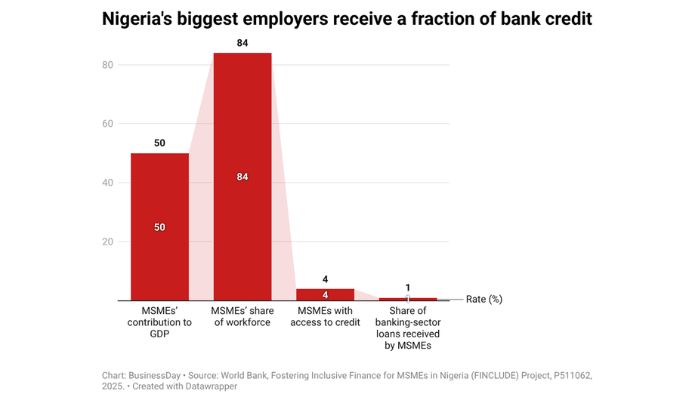
Private-sector credit rose to about N83.26trn in June 2026, showing that bank lending is expanding. Yet the distribution of that credit remains a much bigger concern than the headline volume. The World Bank says Nigerian MSMEs account for nearly half of GDP and employ more than 84 percent of the workforce, but only about 4 percent have access to credit, and they receive just 1 percent of banking-sector loans.
That is the contradiction at the centre of Nigeria’s next phase of reform: the banking system is becoming stronger while many of the businesses that could convert that strength into investment and jobs remain financially constrained. Muda Yusuf, chief executive of the Centre for the Promotion of Private Enterprise, estimates that the real sector faces a financing gap of more than N50trn, covering manufacturing, agriculture, agribusiness, MSMEs, supply chains and export-oriented businesses.
Yusuf argues that the problem is structural rather than simply a shortage of liquidity. High lending rates, short loan tenors, stringent collateral requirements and inadequate long-term capital continue to restrict productive investment. The distinction matters. Nigeria does not simply need more money in the banking system. It needs more of that money to reach productive businesses on terms that allow them to invest, expand and hire.
The CBN has already strengthened the supply side of finance through the banking-sector recapitalisation programme. But stronger bank balance sheets do not automatically mean stronger lending to smaller businesses.
Banks still have to price credit for inflation, foreign-exchange risk, uncertain cash flows, collateral quality and the cost of enforcing contracts. For an MSME borrowing at rates around 30 percent, the interest bill can remain prohibitive even when inflation has fallen to the mid-teens. This is where Cardoso’s promise of transmission meets the practical economics of business finance.
For a manufacturer, the benefit of lower inflation is limited if machinery finance remains too expensive. For a farmer, macroeconomic stability matters less if working capital is unavailable before planting. For a retailer, lower headline inflation does little if borrowing costs consume the margin on inventory. The CBN therefore faces a more complicated task than simply maintaining the gains already made. It must ensure that monetary stability creates the conditions for credit to become cheaper, longer-term and more widely available without reigniting inflation.
That challenge is reflected in the World Bank’s financing programme for Nigerian MSMEs. The bank’s FINCLUDE project is designed to expand access to finance for smaller businesses and use guarantees and other instruments to mobilise private capital into firms that commercial lenders often consider too risky. The broader policy problem is that commercial banks, which depend heavily on relatively short-term deposits, are not naturally structured to provide all the long-term capital required for industrial expansion.
That is why development-finance institutions, credit guarantees, longer-tenor refinancing and cash-flow-based lending matter. Better credit information and stronger contract enforcement matter too. Yusuf has put the policy tension succinctly: “Price stability and development finance should not be treated as mutually exclusive objectives.”
Read also: Tinubu, CIBN task banks on financing real economy, improving living standards
The argument is not that the CBN should abandon its inflation mandate to force banks to lend. It is that monetary stability and productive finance need to reinforce one another if the recovery is to become durable. The banking industry’s own leaders appear to recognise the same problem.
At the CIBN conference, the emphasis was increasingly on moving from macroeconomic milestones to microeconomic outcomes. CIBN President Dele Alabi said the gains in macroeconomic fundamentals needed to cascade down to households, individuals and businesses, while the World Bank said job creation should become a key measure of whether the reforms are working.
President Bola Tinubu made a similar argument at the conference, saying the current phase of reforms should convert stability into investment, investment into production and production into jobs. That is precisely where credit becomes important.
Nigeria’s second-quarter GDP figures provide some evidence that the recovery is becoming broader. Agriculture grew 4.39 percent year-on-year, up from 2.82 percent a year earlier, while services expanded 4.60 percent from 3.94 percent. Non-oil GDP grew 4.31 percent.
Those sectors have a broader potential link to household incomes and employment than an oil-led rebound alone. But growth in these sectors will not automatically translate into jobs unless firms have the capital to expand capacity and productivity.
So, the next phase of Nigeria’s recovery should be judged by more than inflation, reserves, GDP and bank capital. The harder metrics are already visible: who receives bank credit, how much they pay, how long they have to repay it and what they do with the money.
If credit growth mainly strengthens the balance sheets of established borrowers, Nigeria could end up with a stronger banking system without a sufficiently broad investment recovery. If more capital reaches smaller manufacturers, farmers, traders and service businesses on viable terms, the effects should eventually appear in investment, productivity, business formation and productive jobs.
Cardoso’s Tuesday assurance therefore sets a clear challenge for the CBN. The macroeconomic gains may be arriving. The question is whether the financial system can carry them the final mile to the businesses and households that have yet to feel them. Stability is the foundation. Credit transmission is the test. Jobs and higher incomes are the verdict.


