

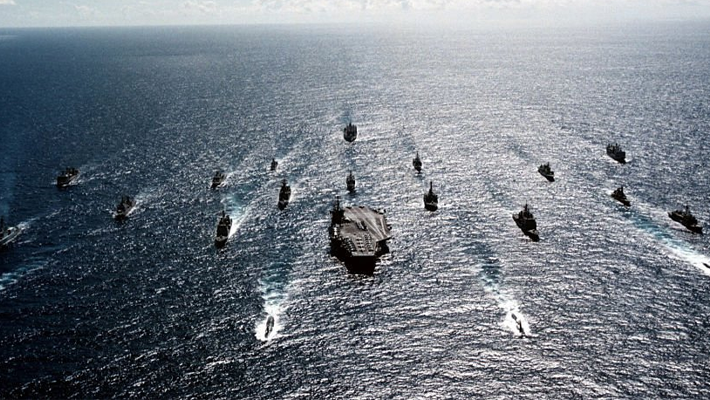
The United States military said it destroyed three Iranian oil tankers on Saturday after alleged attempted missile attacks on US naval vessels, escalating the latest confrontation between Washington and Tehran.
The strikes came as the six-month conflict remains deadlocked, with Iran maintaining its grip on the Strait of Hormuz while the US continues efforts to enforce a counter-blockade around Iranian ports.
US Central Command (CENTCOM) said the targeted vessels were linked to Iran’s Islamic Revolutionary Guard Corps (IRGC), which it accused of launching unsuccessful attacks against American warships.
“Following Iran’s failed attacks, CENTCOM permanently disabled the IRGC crude oil carriers M/T Downy off the coast of Kharg Island and M/T Stark 1 near Jask,” it said in a statement.
The command said another vessel, the unladen crude oil carrier M/T Kylo, was also destroyed in the Gulf of Oman after American forces struck it several times.
“American forces also completely destroyed the unladen crude oil carrier M/T Kylo… in the Gulf of Oman, striking the vessel in multiple critical locations to render it inoperable after the crew was directed to abandon ship.”
Footage released by CENTCOM showed large fireballs and thick flames rising from the vessels after they were struck by projectiles.
According to the US military, the three tankers belonged to “part of a multibillion-dollar shadow network that funds the IRGC and its regional proxies”.
The latest military action came alongside Washington’s broader economic pressure campaign against Tehran, with the US announcing sanctions targeting entities with financial connections to Iran.
The CENTCOM commander, Admiral Brad Cooper, said the strikes were intended to impose an economic cost on Iran following its alleged attacks on American vessels.
“If you shoot at two of our ships, we will impose an even higher economic cost — taking out three of yours,” Cooper said.
Iranian media reported several explosions earlier on Saturday around Kharg Island, the country’s major oil hub in the Gulf.
The latest confrontation follows Iran’s claim on Thursday that its forces had attacked US military bases in Kuwait and the United Arab Emirates.
Tehran said the attacks were retaliation for civilian deaths at a wedding, which it attributed to an American strike.
US Vice President JD Vance said the reported wedding strike was under investigation but expressed doubts about the account.
The Iranian Red Crescent said four people were killed in the incident, which occurred in a southern coastal town on Tuesday night.
Vance said he was “sceptical” of the reports while defending the administration’s broader assessment of the conflict.
‘Small potatoes’
The Trump administration has sought to minimise the significance of the six-month confrontation as domestic opposition to the conflict grows ahead of the US midterm elections.
Vance said he “wouldn’t call it a war”, while also claiming that “right now, there is no active shooting” despite the latest exchanges between the two countries.
US President Donald Trump similarly described the conflict as “small potatoes” for the United States, saying: “It’s not a big thing.”
Iran’s security chief, Mohsen Rezaei, meanwhile, warned Washington that Tehran had adopted a “new strategy” that “will shatter your foundations”.
The United States has continued to increase pressure on Iran over its control of the Strait of Hormuz, a strategic waterway through which about one-fifth of global oil supplies previously passed.
A fragile ceasefire broke down in July following attacks on commercial vessels operating in the strategic waterway.
Trump has repeatedly threatened to claim sovereignty over the Strait of Hormuz, including posting a map depicting it as a “new US territory”.
Vance has also maintained that Washington would not resume negotiations with Tehran until Iran ends attacks on commercial shipping through the waterway.
However, rising fuel prices have increased political pressure on Trump’s Republican Party ahead of the midterm elections.
The administration has consequently intensified efforts to project a return of oil flows through the Strait towards pre-war levels.
“Their control over the Strait of Hormuz is effectively gone,” Vance said of Iran on Thursday.


