

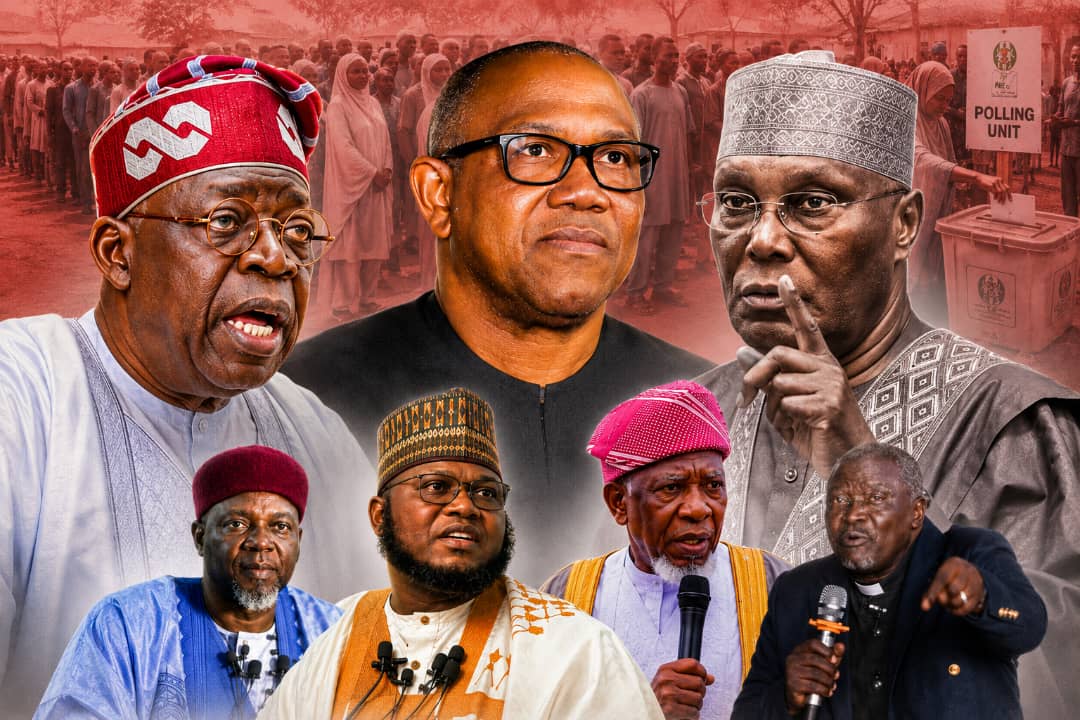
As campaign activities for the 2027 general elections get underway, clerics and politicians have quickly resorted to old rhetoric and tricks to mobilise support for their candidates.
But Nigerians are challenging the attempts to use rhetoric and financial inducements to sway voters.
The presidential candidate of the opposition African Democratic Congress (ADC), Atiku Abubakar, was trying to put the personal records of President Bola Tinubu and the religious composition of his ticket on the front burner of the campaigns, before reopening the debate about fuel subsidy.
In a recent interview with JKD Media, Atiku recounted how he refused to nominate Mr Tinubu as his running mate under the Action Congress of Nigeria (ACN) in 2007 because he opposed a Muslim-Muslim ticket.
He also recounted taking the same position in 2015, when former President Muhammadu Buhari was considering selecting Mr Tinubu as his running mate.

In the interview anchored by Yusuf Mamman, Atiku asserted a firm position on the issue.
“I don’t believe in a Muslim-Muslim ticket because it does not bode well for the country,” he said.
However, Atiku acknowledged an unsuccessful bid to become the running mate to M.K.O. Abiola in 1993, who eventually picked Babagana Kingibe, a fellow Muslim. Had Abiola selected Atiku instead, as demanded by the Shehu Yar’Adua camp to which Atiku belonged, it would also have been a same-faith ticket.
Political analysts view Atiku’s rhetoric as a deliberate political framing designed to capitalise on current religious sentiments.
In Nigeria, the selection of presidential and vice-presidential candidates had been driven primarily by political calculations.
For instance, in the 1979 presidential election, Nnamdi Azikiwe, the candidate of the Nigerian People’s Party (NPP), chose fellow Christian Ishaya Audu as his running mate. Mr Audu, a physician from Kaduna State, was a former Vice-Chancellor of Ahmadu Bello University, Zaria.
Similarly, Obafemi Awolowo, contesting under the Unity Party of Nigeria (UPN) in the same election, selected Philip Umeadi, a Christian from Anambra State, as his running mate.
Before then, under military rule, Joseph Wey served as Chief of Staff, Supreme Headquarters – a position considered equivalent to vice president- for nine years in the Yakubu Gowon regime. Both men were Christians.
Also, Mr Buhari had Tunde Idiagbon, a fellow Muslim, as his deputy in their military government of December 1983 to August 1985.
The new rhetoric
Two clerics have been vocal about framing the 2027 elections as a demographic contest between Nigeria’s two dominant faiths.
Jos-based clerics Sani Jingir and Ezekiel Dachamo face severe backlash for their public postures on the forthcoming polls.
Mr Jingir, a strident promoter of the APC Muslim-Muslim ticket in the 2023 presidential election, recently reiterated his stance at a mass wedding organised by the Kano State Government for 1,500 couples.
Speaking in Hausa, the Islamic cleric said:

“I am one of those who raise the flag of Islam; I am calling on people to come and let us do Muslim-Muslim again. I know this statement pains the non-Muslims; there are Christians and other religious groups.
“I didn’t stop them from doing their campaigns, calling for Christian-Christian tickets. In a democracy, the majority carries the vote,” Mr Jingir said.
“I am a Muslim who preaches Islam. If I say Muslim-Muslim, what have I taken away from them?” he added.
He urged Muslims to register and vote in large numbers, arguing that the election outcome would demonstrate their demographic dominance in the country.
“Let us show the world that those non-Muslims who claim they outnumber us in Nigeria are lying. When the votes were counted in 2023, Allah helped us and defeated them; they even came in third position,” he stated, referring to Peter Obi, the Labour Party presidential candidate, who himself was caught in an audio recording framing the poll as a religious war.
Mr Jingir is a factional leader of Jama’atu Izalatil Bid’ah Wa Iqamatis Sunnah (Izala), a reformist Salafi movement founded in Jos in the 1970s. The sect promotes a puritanical interpretation of the Quran and Hadith.
However, his deputy, Yusuf Sambo, is reportedly backing Atiku.
Mr Sambo retorted that Nigeria needs a leader who will treat all faiths and groups with fairness and justice, citing other clerics who disagree with Mr Jingir.
Ezekiel Dachomo’s rhetoric
Mr Jingir’s supporters defended his controversial comments in Kano by juxtaposing them with those of Mr Dachomo, a Christian preacher.
A video captured Mr Dachomo describing killings by bandits in Plateau State as a direct consequence of Nigerians electing Muslims as president and vice president.

“We must be very careful with the issue of a Muslim-Muslim ticket in the 2027 election.
“When it comes to the state level, God will show us what to do. However, at the federal level, we will demonstrate that we are the majority, as per the Nigerian census. This is what will happen.
“This is a battle we are fighting—they are engaging in both political and physical warfare while we are sleeping. Let us stand up and show the world that Christians are the majority in Nigeria.”
Endorsement went wrong
Corruption allegations are another issue being exploited in the campaign.
A Kaduna-based Islamic cleric, Musa Yusuf, at a recent gathering, commended the APC for appointing former Zamfara State Governor Abdulaziz Yari as its presidential campaign’s director-general.
Mr Yusuf, popularly known as Asadussunnah, praised Mr Yari for his philanthropic efforts, citing a recent donation of ₦1 million in Zakat to about 250 clerics each.
Mr Yusuf urged Nigerians to support the APC candidate because of Mr Yari.
Even before Mr Yari’s appointment to the presidential campaign council, another cleric, Jalo Jalingo, had praised him on Facebook, comparing him to one of Prophet Muhammad’s companions.
Both clerics’ comments sparked a backlash on social media. Critics accused them of compromising their moral authority by praising a public official facing corruption charges.
A Kaduna-based cleric, Ustaz Bn-Al Qasim, blamed corrupt politicians for the economic hardship and insecurity in Nigeria.
“I felt ashamed after seeing one of our colleagues praise a senator simply because he donated money to some of us, even going so far as to liken the lawmaker to Uthman ibn Affan, a companion of the Prophet. Please, do not set such a dangerous precedent.
“In a real sense, those individuals being praised are among those whom Nigerians hold accountable for their suffering. Bestowing a gift of one million naira upon each cleric does not elevate him to the status of a companion of Prophet Muhammad.
“Rather than distributing one million naira to individual clerics, politicians should foster a conducive economic environment where every citizen can compete and thrive.
‘Let them rehabilitate our roads and schools; we do not need their handouts. What we require is a system that allows people to prosper independently.
“No politician should be commended for distributing funds, as that money belongs to the public. These politicians believe they are clever—they retain billions while doling out a mere fraction of their illicit gains as ‘gifts,’ expecting our praise and a guaranteed path to paradise”, Mr Al-Qasim said.
Who is Yari?
Mr Yari currently represents Zamfara East in the Senate, after serving as the governor of the troubled North-west state of Zamfara between 2011 and 2019.

PREMIUM TIMES reported in 2021 how the Federal High Court in Abuja ordered the final forfeiture of funds held by Mr Yari in Zenith Bank and Polaris Bank. The court noted that the former governor failed to explain how he acquired the large sums in both naira and US dollars.
Also, the anti-graft agency, ICPC, secured an interim forfeiture order against Mr Yari in February 2022 from Justice Obiora Egwuatu of the Federal High Court, Abuja.
The order affected 10 high-value properties traced to the former governor and his associates, located in Abuja, Kaduna, Zamfara State, and Maryland, USA.
ALSO READ: ‘I may not be alive to contest in 2027 election’ – Peter Obi
Mr Yari was repeatedly detained by the Economic and Financial Crimes Commission (EFCC).
In May 2022, he was arrested over his alleged role in an alleged N84 billion fraud involving Ahmed Idris, former Accountant-General of the Federation.
Investigators alleged that Mr Yari received roughly N22 billion from the diverted funds through linked proxy companies.
His appointment as the director-general of the APC 2027 Presidential Campaign Council renewed public scrutiny.
Anti-corruption activists observed that multiple figures appointed to key campaign roles—such as former governors and key political allies—similarly face active or dormant petitions and investigations before the EFCC and ICPC.
How to redefine political rhetoric – Expert
Ibrahim Siraj, a professor at the Department of Mass Communication at Bayero University, Kano, stated that the rhetoric of both clergymen, Jingir and Dachamo, is dangerously divisive.
“We believe that Plateau State is a region plagued by historical volatility; their harsh and uncompromising stances reflect a localised climate of conflict,” Mr Siraj said.
“What these leaders must recognise is that both Muslims and Christians are victims of the violence in Jos; neither side holds a monopoly on suffering. Unfortunately, this shared sense of victimisation is actively fueling their hostile discourse.
“Rather than holding political leaders accountable for the mismanagement of resources that directly contributes to this bloodshed, these clerics are using their platforms to trade political leverage”, he warned.
Mr Siraj said it is wrong to reduce a complex political contest to a mere demographic battle between two dominant religions.
He said attention should instead focus on electing competent leaders capable of providing good governance, regardless of their religious identity.
“Through their rhetoric, these clerics have reduced the presidential contest to a contest of numerical superiority and an existential struggle over national ownership. This is a profound disservice to Nigeria at a critical juncture when citizens are desperately seeking reasonable, responsible, empathetic, and sensitive leadership’” he said.
“While the ongoing events in Plateau State remain a deeply concerning issue for all Nigerians, local volatility must not be exported to other regions under the guise of political discourse. A capable and principled leader can emerge from either faith, and this unity of purpose is what the electorate must champion”, Mr Siraj stated.
He urged religious leaders to refrain from abusing their moral authority.
“When public discourse centres on religious division, it distracts from systemic inequalities and shields underperforming public officials from scrutiny.
“Religious and civic leaders must use their platforms to unify communities around shared democratic values rather than exploiting grievances for short-term political leverage.
“Nigerians must reject inflammatory rhetoric and demand policy-driven leadership; we can dismantle the politics of identity and build a country where governance is measured by its service to the common good”, Mr Siraj stated.
Discover more from Premium Times Nigeria
Subscribe to get the latest posts sent to your email.
