

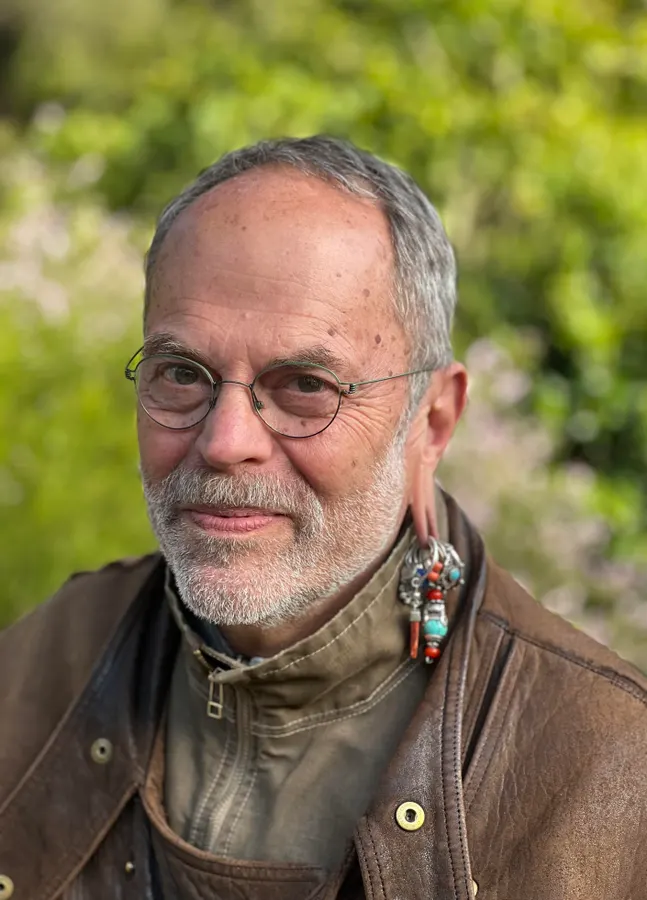
Joe Rohde, former Walt Disney Imagineer and author of the upcoming book, Floating Mountains: The Art of Imagining the Impossible.
Melody Malmberg
When guests walk into Disney’s Animal Kingdom in Orlando, Florida, they likely don’t think about the teams that designed the park and its ethos. They are concerned with getting on the best rides in the park, seeing animals up close in hyper-realistic environments, and probably snapping a picture with Mickey Mouse. But behind all the smoke and mirrors that make a theme park like Animal Kingdom operate is a team of people whose creative minds come together to solve problems and ensure the people exploring the park have a good time. One of those creative minds is former Walt Disney Imagineer Joe Rohde.
While many people who enter a Disney park might not know who Rohde is, his fingerprints are all over Disney’s theme parks and resorts around the world. Besides being on the small team who designed and helped construct Animal Kingdom into what it is today, he’s worked on countless projects like the Mexico Pavilion at Walt Disney World’s EPCOT, Guardians of the Galaxy – Mission: BREAKOUT! at Disney California Adventure Park at the Disneyland Resort and Aulani, Disney’s resort in Hawaii. Rohde retired from Disney after a career spanning four decades.
Even though he no longer works for the mouse, Rohde continues to share his insight into the world of creativity and how people can harness their own creative prowess. This idea led Rohde to his upcoming book, Floating Mountains: The Art of Imagining the Impossible, releasing on September 8, 2026.
“The book is definitely an attempt to write something that reaches out beyond just Disney fans to people who are generally interested in creativity, the sources of creativity, group creativity, and how to manage it,” Rohde tells me in a one-on-one interview during the recent D23: The Ultimate Disney Fan Event.
Rohde’s Theory Of Collaboration
Throughout the book, Rohde discusses his theory of collaboration, which is the central message of the treatise. “This [is the] theory that if we can create a center that is none of us, so we are all commonly equally owners of the center idea, then we can all sort of work towards a common expression of this idea,” he explains to me. “[This] frees us up to be both a critic and an assistant to anyone else.”
He also says this theory of collaboration allows people to worry less about individual weaknesses. “Part of it is to get people to not worry so much about their own insecurity, about their own personal ability, because it folds into this bigger picture of a group of people. So you fill the niche that you’re suited to fill. And then you contribute to others through that strength, and you’re covered by others for the weaknesses,” Rohde says.
The Major Crossover
LAKE BUENA VISTA, FL – MAY 24: In this handout photo provided by Disney Resorts, a view of the new Pandora: World of Avatar attraction inside Disneys Animal Kingdom during the dedication ceremony on May 24, 2017 at Disneys Animal Kingdom inside the Walt Disney World Resort in Lake Buena Vista, Florida. The World of Avatar opens on May 27, 2017. (Photo by Steven Diaz/Disney Resorts via Getty Images)
Getty Images
Rohde recognizes himself as a teacher and shares that he began his career in education before moving to Walt Disney Imagineering. “I think there’s lots of weird crossover between teaching and Imagineering. You’re taking information, and you’re bundling this information and you’re presenting it to people in a way that they should find attractive and interesting,” he says. “I think from the things that I built, especially because the stuff that I worked on is very information-laden, it’s heavier with information. You don’t have to necessarily pay attention to the information, but it is there.”
This is much of how Rohde’s projects, especially at Animal Kingdom work. The layers of detail around complex topics like religion, conservation and more are present. As guests come to the park, whether for the first or the 100th time, they can learn more and dive deeper into the meanings of aspects of real life that are presented in a theme park. “That’s kind of the ultimate goal: that people are so inspired that they want to go find their own things,” he says.
One real-life example of the hope that Disney patrons will learn something after visiting Animal Kingdom is the upcoming Tropical Americas land. The space encompasses the now-defunct DinoLand U.S.A., and one of the new attractions will be an Indiana Jones-themed ride based in a Mayan Temple. “[The Maya] would deliberately bury these temples in a bigger temple. Which meant the one that’s inside is perfectly preserved, and that’s what we wanted to show people because people have this mental image of what these things look like that’s based on these beat-up old ruins,” he explains. “Imagine all the people that will look at this thing and go, ‘Wait a minute, this looks like nothing I expected. So what’s going on here?’ And then they have to go find out, and who knows what they learn.”
Building A Mountain
ORLANDO , FL – APRIL 7: Atmosphere at the Grand Opening of Expedition Everest at Walt Disney World on April 7, 2006 in Orlando, Florida. (Photo by Gustavo Caballero/Getty Images)
Getty Images
In Floating Mountains, Rohde says that at the time it was built, Expedition Everest- Legend of the Forbidden Mountain was one of the most impactful and important additions to Animal Kingdom. In the early 2000s, when the rollercoaster was being built, Rohde’s team faced a large challenge.
“It’s kind of the first time we had to really address this problem of, ‘We have a park that started from the idea that we’re going to do an animal park, a park about nature, about the value systems that come from animals, and yet we have an assignment that is very much about a theme park. And we’re going to have to find a way of blending these things together so that they seem to make sense,’” he says.
What came from that problem is one of Disney’s best roller coasters, with a deep story about traversing Mount Everest in Nepal with the looming fear that the regional legends of the yeti are actually true.
Books And Travel
D23 EXPO 2022 – The Ultimate Disney Fan Event presented by VISA – brings together all the worlds of Disney under one roof for three packed days of presentations, pavilions, experiences, concerts, sneak peeks, shopping, and more. The event, which takes place September 9, 10, and 11 at the Anaheim Convention Center, provides fans with unprecedented access to Disney films, series, games, theme parks, collectibles, and celebrities. (The Walt Disney Company via Getty Images) Joe Rohde
The Walt Disney Company via Getty Images
As Rohde’s Disney teams continued to work on projects, and even today, he emphasizes the importance of books and travel.
“We have a very limited time in these countries to do research. They’re not the longest trip I’ve ever ever taken, like a three-week-long trip. That seems long, but it’s to see most of India that’s not that long,” says Rohde. “I would tell people before you go, I want you to read these books, not just thumb through the books, read the books.”
For his teams, reading books about destinations they would be traveling to for work meant they could move past basic questions and to something more interesting and timely for the projects, accelerating the learning process during a time-constrained operation. “Read so that by the time you get there you can ask smart questions. That having been said, you cannot really replace the experience of being in places,” he explains.
Through reading, collaborative creativity, and a sense of wonder about the world, Rohde has changed the theme park landscape forever. And with Floating Mountains, he continues to push these ideas forward to a new generation of creative people, regardless of whether they want to work in a theme park ecosystem.
