

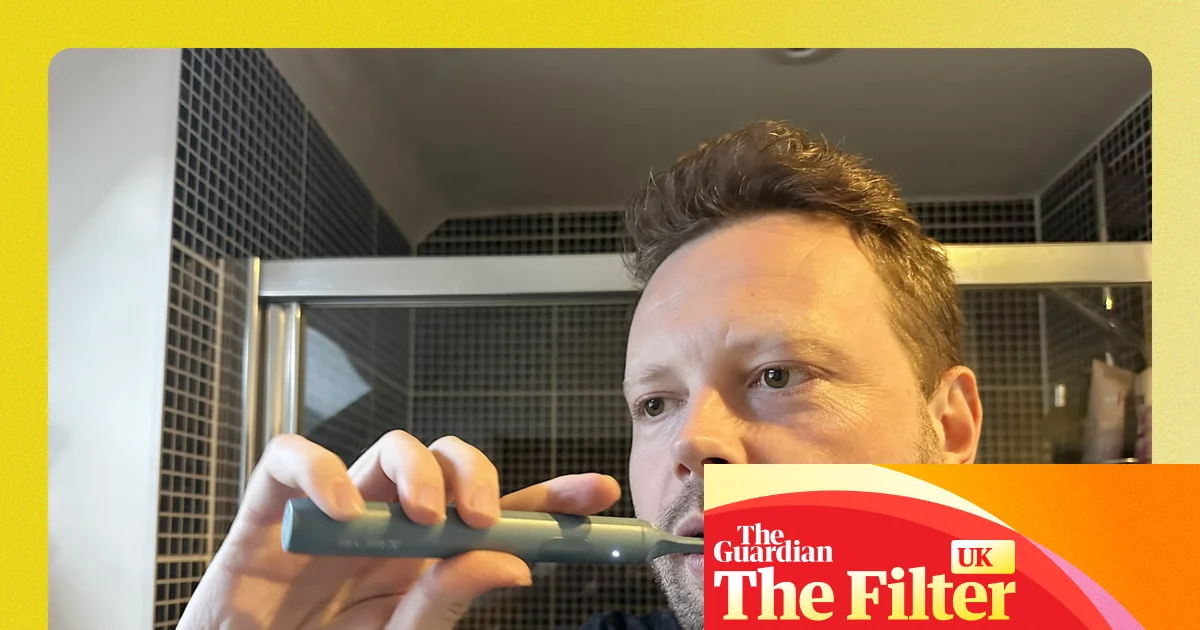
When I wrote the Filter’s guide to the best electric toothbrushes, one brand I didn’t need a sample from was Suri. I already owned one of its brushes, drawn in by its impressive commitment to sustainability in a sector that seemed blissfully unbothered by the climate crisis unfolding around us.
Unfortunately, a few things held it back from taking the top spot, and I’m pleased to say that these have mostly been addressed with the Suri Pro 2.0. Is it the best you can buy? Still not quite, but the gap has significantly closed, and there are fewer caveats than ever when giving it a recommendation.
If you care about sustainability in any way, it’s the best choice. And now there are fewer drawbacks to doing the right thing.
How I tested
It doesn’t take a great deal of imagination to figure out how you test a toothbrush: brush, brush and brush again. Fortunately, Suri was decent enough to give early reviewers a month-long loan, rather than expecting us to burn through several tubes of toothpaste in a matter of hours.
Equally fortunate was the fact that, although I’d donated most of the toothbrushes from the group test to Causeway (as explained here), I held on to our current favourite, the Spotlight Sonic Pro, as a point of reference. Plus, I already had my personal Suri toothbrush, so I could see where the improvements existed.
Suri Pro 2.0 electric toothbrush: what you need to know
My beef with the original Suri toothbrush was essentially twofold. First, it didn’t feel as powerful as its rivals, offering 30,000 brush strokes per minute (BPM), compared with others that went as high as 62,000.
The second was a deeper problem: the spring pin chargers felt temperamental, and I personally got through three over the years, deeply damaging the sustainability of the product as a whole. This was likely partly my fault (from not adequately drying brushes before charging, causing them to rust), but I wasn’t the only one with the problem.
Suri has addressed both of these weaknesses, and some others that hadn’t bothered me. While the first is a relatively minor tweak – it still vibrates at 30,000 BPM, but with what I’m told is a “more powerful sweeping motion, delivering 25% higher intensity”, whatever that means – Suri Pro 2.0 now charges via wireless induction, both on the charging stand and in the optional carry case. No more spring pins to rust or snap.
Other improvements include the introduction of a pressure sensor, a quieter motor (50dB rather than 54), a bundled plant-based brush head cover if you want to ditch the travel case, and a travel lock to stop it turning on by mistake. As someone whose luggage was once delayed by an electric toothbrush prompting a bomb threat, I can’t believe “not being mistaken for a terrorist” wasn’t on my wishlist of upgrades, but there we go.
Finally, the optional travel case has been upgraded to include a battery. This isn’t for charging the brush, but to power a built-in UV-C light Suri claims kills bacteria on the go. The UV light was a feature on the original brush, too, but it required a USB-C cable to work, making it a little-used extra for me.
All of this comes in the form of a brush that looks virtually indistinguishable from the original, as you’ll see in the photos. This feels like an odd choice from a marketing perspective, but it does have the advantage of meaning the recyclable plant-based heads are interchangeable between the first-generation Suri and the 2.0, as well as the newer Core 1.0.
Specifications
Type: sonic
Modes: two (clean and polish)
Power: 30,000 BPM
Pressure sensor: yes
Battery life: 1+ month
App: no
Warranty: one year (extended to two years with registration)
What we love
The main thing we love about Suri Pro 2.0 is the same thing we loved in the first-gen brush – the heads are plant based, made from cornstarch with castor oil bristles. Suri will recycle these free of charge, and provide a self-addressed compostable bag to put your used heads in when you’ve collected four. A pack of three costs £14.99, but if you subscribe, you’ll get two sent out every six months for £8.98. Cheaper than some of the big brands, but more expensive than some third-party heads.
As a brush, it’s light and easy to use. One press of the button turns it on, with a friendly buzz every 30 seconds reminding you to move on to the next quarter of your mouth before it shuts itself down after two minutes. There are two modes, one gentle and one slightly firmer for a stronger clean.
As for those refinements, the pressure sensor is a very good addition indeed. If you push too hard, the brush will buzz three times and then fall asleep. As soon as you reduce the pressure, it’ll stop playing possum, with the timer continuing from where you left off. (Note that you can inadvertently turn this off – something that wasn’t in the review unit’s manual, causing me to think the device might be broken. If your pressure sensor stops working, try pressing and holding the power button for five seconds with the brush switched on. When a light flashes, turn the brush off and back on, and the pressure sensor should be restored.)
The wireless charging system is a huge improvement, too. Just pop Suri Pro 2.0 on to the USB-C charging stand or into the case (connected to a USB-C cable), and charging starts immediately. Despite losing the unreliable spring pins, the new stand is still magnetic, so the brush handle won’t topple without a push.
Speaking of magnets, one of my favourite design elements of the original is present here too. Each Suri comes with a magnetic wall mount to prevent cabinet clutter. No screws required: just remove the tab and stick it to a wall or mirror with the pre-applied adhesive.
While the brush looks nearly identical to the first generation, the case is far nicer to hold and carry, with smoother edges, rather than the first generation’s sharp angles. The built-in battery makes it easier to get into the habit of using the UV-C light, even if it’s not what I’d call an essential feature.
There’s also now a plant-based head cover in the box. To prevent accidental activation, a travel lock mode has been added, requiring a five-second press to switch on and off. This is handy if luggage is at a premium and even the slimline case is too bulky, letting you keep your toothbrush head free from fluff and other detritus.
What we don’t love
I generally agree with Suri that toothbrush features such as Bluetooth and connected apps are gimmicks. However, having tested a host of sonic toothbrushes, I do think that 30,000 BPM is still underpowered, even with the supposed higher intensity.
To put that into perspective, on the Spotlight Sonic Pro, the 30,000 BPM setting is called “gentle”, and it has four settings that go all the way up to 50,000 BPM. Whether it’s down to the speed or less planet-friendly bristles, all I can say is that after a cider-heavy night at the pub, Spotlight remains notably more effective at eliminating that disgusting furry tooth feel than Suri. (This is not one of my regular toothbrush tests, but it’s an effective one.)
Using both the original Suri and the Suri Pro 2.0 side by side, I couldn’t feel much of a difference, though it’s possible that things are happening on a level only visible to dentists. Initially, the Pro 2.0 was only available with the battery-powered travel case at £105, but the company now sensibly allows you to buy the brush on its own for £85. This not only brings the price down significantly, but also avoids creating more e-waste in the long run.
Finally, it’s a pity that there’s currently no way to trade in the first-generation Suri brush for its successor. I would be surprised if this remained the case for ever, given its commitment to minimising e-waste.
Sustainability
On that note, Suri’s sustainability credentials remain second to none in the world of toothbrushes. Admittedly, this isn’t especially high praise, but nonetheless, the company’s visible positive environmental choices should be applauded.
The plant-based heads can be recycled free of charge, as previously mentioned. The body is built from aluminium, the packaging is moulded paper, and the Suri works with ClimatePartner to measure and offset its manufacturing emissions.
after newsletter promotion
There are limitations to this. There is still a lithium-ion battery on the inside, and some plastic involved, as well as a battery in the optional travel case (something Suri previously avoided on environmental grounds). Suri says there are practical reasons for these ecological compromises, and the company holds itself to account by tracking emissions and publishing annual sustainability reports. You can read the 2025 document here, which states that Suri recycled two tonnes of returned brush heads last year, among other things.
Suri Pro 2.0 electric toothbrush: should I buy it?
All in all, Suri Pro 2.0 is a huge improvement over the first generation. The enhancements are thoughtful and address real gripes I had, while not feeling the need to lean into gimmicks such as Bluetooth connectivity. A toothbrush I could previously only endorse with a “but” is now an easy recommendation, even if it’s still not the most powerful brush around.
Ironically, I’ll now add a “but” – albeit one I imagine Suri will be happy to read. As the company itself points out, almost every toothbrush that has ever been built still exists, whether it’s in a cabinet or a landfill, broken or working.
With that in mind, if you need an electric toothbrush, then Suri Pro 2.0 should definitely be on your radar. If you already have one that works well enough, make a mental note and consider picking one up when the time comes (and when it does, you can find out where to recycle your old electric toothbrush locally here).
Suri Pro 2.0 vs …
Suri Core 1.0 electric toothbrush
In August 2026, Suri released a new brush: the Core 1.0. Despite launching at £65, the entry-level addition kept many of the features new to the Suri Pro 2.0, including a pressure sensor, the improved charging mechanic, the travel lock and the plant-based caps for on-the-go use.
The latter two are especially important, as Suri Core 1.0 doesn’t come with a travel case, nor will it work with the existing one (it fits, but rattles around and won’t charge). That, for me, is a minor inconvenience, and the other compromises Suri has made don’t feel like compromises at all. The battery lasts up to a month rather than over one, and the body is made from bio-circular plastic made from food-waste materials including used cooking oil and other waste feedstocks instead of aluminium.
Yes, the power drops to 28,000 BPM, but as outlined in the review above, it’s not like Suri Pro 2.0 was a high-power option anyway. And with the removal of the case meaning less future e-waste and lower transit emissions thanks to a substantial weight reduction, it’s now my number-one choice for sustainable shoppers.
Read our full Suri Core 1.0 review
Odonta PowerPlus electric toothbrush
Even without the case, the Suri Pro 2.0 isn’t the cheapest option at £85. The current budget champion is the Odonta PowerPlus, which does nothing wrong for its svelte £29.99 price.
You get a maximum of 42,000 BPM across five brushing modes, a pressure sensor, three-week battery life and IPX7 water resistance. While it can’t match Suri for sustainability, the bristles are bio-based polyamide nylon 1010, which is made from castor oil rather than the fossil fuels used in most toothbrush heads.
Alternatively, the company makes a brush called the PowerLite for the same price. This is smaller and lighter, but makes some sacrifices along the way. Battery life is doubled for worry-free travel, but it loses 2,000 BPM of power, the pressure sensor and the wireless charging cradle (instead relying on USB-C).
Laifen Wave Pro electric toothbrush
If you’re looking for pure performance, our current top electric toothbrush champion is the Laifen Wave Pro. Its secret weapon is that it oscillates and vibrates at the same time, unlike rival toothbrushes that make you pick one or the other.
This led to the freshest-feeling mouth I’ve experienced in my time testing brushes (and I’ve now tested 31 for the Filter). There are three modes on the brush, each of which can be customised in the accompanying app, letting you get up to 66,000 BPM of sonic power and/or up to 60 degrees of oscillation. In all, there are around 1,000 possible combinations (and you can delete the app once it’s set up, if you like).
Add in a sleek design, 70 days of battery life and a device that seems to charge on any wireless charger, and you’ve got a product that should impress you and your dental hygienist.
For more, read our guide to the best electric toothbrushes
Alan Martin is a writer who has been putting products – including phones, gaming devices and wearables – through their paces for more than a decade. Although he wouldn’t call teeth brushing a hobby, it’s something he’s been doing for decades with a degree of aptitude that has largely satisfied dentists
This article was amended on 27 August 2026. Due to information provided, an earlier version stated that the toothbrush provided 33,000 BPM rather than 30,000.
