

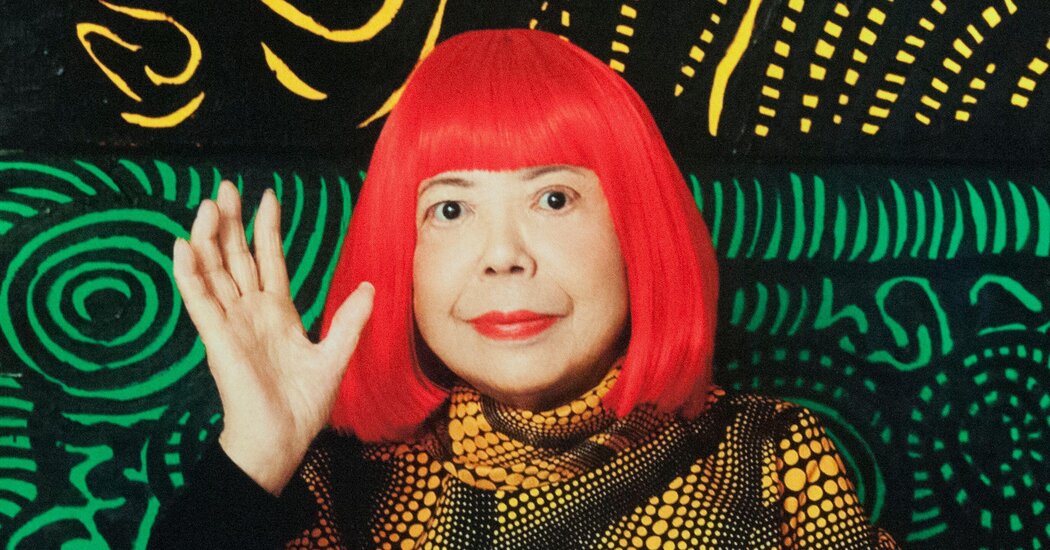
Her persistent effort to establish herself and her art as an international brand paid off. In the 21st century, as Japanese contemporary art and popular culture gained global attention, interest in her work soared, as did prices for it. She herself referred to the phenomenon as “Kusamania.”
When one of her 1960 “Infinity Net” paintings sold for $7.1 million at Christie’s in 2014, it was the most expensive work by a living female artist ever bought at auction. She was represented by David Zwirner Gallery in New York.
In recent years, Ms. Kusama made lucrative arrangements to endorse commercial products, from cosmetics to cars. With her dot-patterned wardrobe and fluorescent page-boy-cut wigs, she was an instantly recognizable pop star, invited to contribute to international art shows and awarded shows of her own, often of new work produced with a platoon of assistants.
One museum show, “Love Forever: Yayoi Kusama 1958-1968,” which was organized by the Los Angeles County Museum of Art and the Japan Foundation in 1998, and which traveled to the Museum of Modern Art, celebrated her early years. In 2011-12, a larger retrospective appeared at the Tate Modern in Britain, the Whitney Museum of American Art in New York, the Centre Pompidou in Paris and the Reina Sofía in Madrid. In 2017, a major survey of her work was organized by the Hirshhorn Museum in Washington, D.C. In the same year, a Yayoi Kusama Museum opened in Tokyo.
Also in 2017, an article in Vice magazine pointed out repeated anti-Black comments — specifically, racist descriptions of Black people — that Kusama had made in her 2002 autobiography. In 2023, on the occasion of a solo exhibition at the San Francisco Museum of Modern Art, when the accusations resurfaced, the artist publicly apologized for those comments.
Iterations of the poetic, endlessly reflective “Infinity Room” — a mirror-lined chamber housing an intricately twinkling LED light display — have been box office gold for museums and galleries, either as part of larger exhibitions or on their own. They’ve drawn enormous crowds, with visitors lining up for hours and entering one at a time for 45 seconds each, basically long enough to take a selfie, an exercise in aestheticized narcissism that the artist understood and endorsed.
