

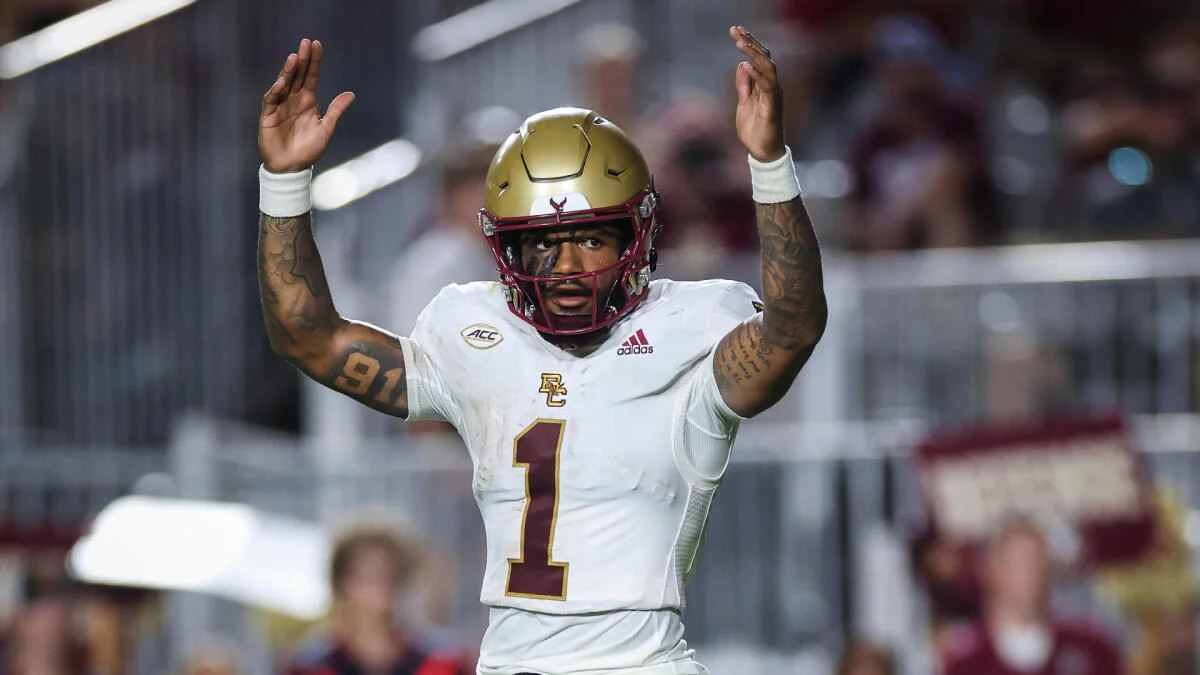
Former Florida State quarterback Thomas Castellanos has signed with Texas Tech out of the transfer portal, just days after a Kentucky judge granted a temporary injunction in an eligibility lawsuit that included Castellanos and former Missouri basketball standout Mark Mitchell. Because Castellanos now has an injunction, he will not be affected by the new ruling in the Colorado lawsuit that took away eligibility for qualified athletes in the Class of 2022.
Castellanos completed 58.3% of his passes for 2,760 yards, 15 touchdowns and nine interceptions while also rushing for 557 yards and nine touchdowns last season for the Seminoles after transferring from Boston College. He led Florida State’s memorable upset last season over Alabama in Week 1.
Big Ten, SEC ban NFL players from returning to play: What to expect as power conferences threaten suspensions
Brandon Marcello
Castellanos will likely serve as the backup to starter Will Hammond for the Red Raiders, who are once again the heavy favorites to win the Big 12.
McGuire: Red Raiders will still sign ex-NFL players
Texas Tech is also keeping further player addition options open as recent temporary restraining orders and injunctions continue to blur the line between college football and the NFL. Red Raiders coach Joey McGuire acknowledged this week that his program is monitoring the developing legal landscape and could pursue an addition if the right player becomes available.
McGuire insisted Texas Tech has not contacted NFL coaches or evaluated players potentially facing roster cuts, though he suggested other programs may have already taken those steps. Still, the Red Raiders will explore every legal avenue to improve a roster with College Football Playoff expectations.
In this new era, competitive advantages disappear quickly and Texas Tech has invested too heavily to watch from the sideline if former college players suddenly receive another opportunity to enter the transfer portal.
“We’ve been monitoring the last week or so on how we can add, if possible, somebody to make this team better,” McGuire said Tuesday. “I understand both sides. We are not looking at anybody that is in the NFL that possibly could be cut. We haven’t called any NFL coaches. We haven’t scouted any NFL players, like I think some teams have done, but we’re definitely going to look.”
Big Ten, SEC lead way with ban of ex-NFL players
The Big Ten and SEC have banned NFL players from returning to those conferences. Each has threatened suspensions for programs attempting to go against that decision.
In Texas Tech’s case, the last day to drop or add classes for the fall semester is Sept. 4. McGuire said part of the reason for the chaotic nature of this preseason rush to add former college football players is due to the NCAA’s five-for-five decision coming down this month, rather than later into the season.
“You want to make these rules to eliminate as much [chaos as possible] because in the world we live in right now, everybody’s going to sue,” McGuire said. “It’s going to happen. You can say, ‘Well, it’d be a lot harder if you sue in October and you can’t get into school.'”
Earlier this month, 16 former college football players were successfully granted a TRO by a Louisiana court, including former LSU edge rusher Jack Pyburn, former James Madison linebacker Trent Hendrick, Ole Miss starters Dae’Quan Wright, Zxavian Harris and Wydett Williams, and SMU running back TJ Harden.
The Big Ten passed the ex-NFL integrity test, and forced the SEC’s hand in the process
Richard Johnson
Lane Kiffin and LSU are trying to sign Wright and Harris, but the SEC’s decision this week to bar former players from coming back complicates matters and could lead to another legal war.
Coaches at a crossroads over signing ex-pros
McGuire said Texas Tech is happy with its current roster entering the season, a group that includes the sixth-best transfer class this cycle. However, like other coaches have publicly stated this week, he’s not one to close a door that could potentially be propped open during an ever-changing landscape in college athletics.
Prior to the Big Ten’s NFL-player ban, Ohio State’s Ryan Day called the idea of adding a former college football player “frustrating,” but admitted it was something the Buckeyes would have to explore if a player who could help the team was available.
“I told myself I would stop saying this is crazy,” Day told the media earlier this week. “So I’m not gonna say that. But to think that we’re in a situation where we’re this late in the season and our rosters are not locked in is frustrating at the very least. But I’m not gonna sit here and keep saying that. So what does that mean for us? That’s the bottom line. Well, I think, in my opinion, the conferences have to decide if there’s a point where their rosters have to be locked in.
“Because once some of these guys become available, adding them to the roster is going to provide (an) advantage for certain teams. So we’re certainly having conversations. I’ve had conversations with Tony Petitti about this. I know he’s all over it and trying to do what’s best for the conference.
“But we also, if there are teams that have some players out there who are cut from NFL rosters that are gonna be on other teams, we have to at least consider it and look at it,” he added. “Do I like anything about it? Absolutely not, but we gotta do what’s right for Ohio State. So it’s sort of a day-to-day thing right now. And like anything, we’re just gonna try to adapt. But I think we would all agree, maybe not everybody, but that there has to be a certain point where your roster gets locked in.”
Alabama’s Kalen DeBoer didn’t go into as much detail with his opinion, but did say the court’s ruling did offer opportunity for the potential of a late addition.
“There’s a possibility out there. I can’t control that. I can’t worry about that. Just got to see how things work,” DeBoer said this week.
Oregon’s Dan Landing is strongly opposed to adding an NFL player to his roster and took a firm stance against the idea.
“I think there are a lot of negatives that are involved around this,” Lanning said after practice. “One, once you go to the NFL, to me, you’re in the NFL. You don’t get the opportunity to come back. Two, most of us have built our rosters. You have a limited roster now.
“So if you’ve invited somebody back to your team, that means you’re kicking somebody else off your team to match your roster limits. I don’t think that’s fair to players who worked all summer, all spring, and put themselves in position to be ready to work for a team.”
