
asks SAMUEL AKPOBOME OROVWUJE
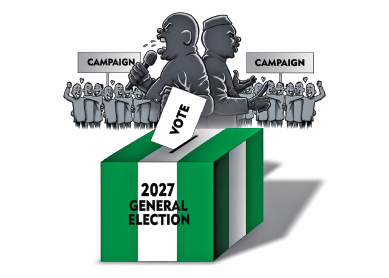
Nigeria is once again entering the familiar theatre of political campaigns. Slogans will multiply, manifestos will be launched, rallies will fill public spaces, politicians will promise renewal, prosperity and transformation, and social media will become a battlefield of competing narratives. Yet beneath the excitement lies a more fundamental question: what happens to the Nigerian whose income can no longer keep pace with the cost of living?
This is the question that should define Nigeria’s political conversation.
The country cannot afford another election in which poverty, inflation, unemployment and insecurity are reduced to campaign slogans. Nigeria’s national question is no longer simply about who governs. It is about what kind of society political power is producing and whether economic growth is actually improving the lives of ordinary citizens.
The evidence is troubling. The World Bank estimates that Nigeria’s national poverty rate increased from 61 percent in 2024 to 63 percent in 2025, meaning that about 140 million Nigerians were living below the national poverty line. The Bank attributes the worsening situation partly to high inflation and weak income recovery.
That figure should shake the political establishment.
A country cannot continue to describe itself as an emerging economic power while such a large proportion of its population struggles to meet basic needs. The challenge becomes even more serious when poverty is understood beyond income. The National Bureau of Statistics has previously estimated that about 133 million Nigerians were multidimensionally poor, meaning that deprivation extends to areas such as education, healthcare, employment and living conditions.
These are not merely statistics. Behind every percentage is a household making difficult choices: whether to pay school fees or rent, buy food or medicine, repair a vehicle or pay transport costs, remain in an expensive city or return to a rural community with fewer opportunities.
And yet, political campaigns often speak as though Nigeria’s economic crisis exists only in statistical reports. Inflation provides perhaps the clearest illustration of this disconnect.
The latest National Bureau of Statistics figures show that headline inflation fell from 15.91 percent in June 2026 to 15.43 percent in July 2026. That is an improvement and should be acknowledged. But the headline number conceals a worrying development: food inflation increased to 20.31 percent in July, from 17.52 percent in June. Food inflation also increased by 5.56 percent month-on-month in July.
For ordinary Nigerians, food prices matter more than economic language.
A reduction in the inflation rate does not mean that prices have returned to where they were before the crisis. Inflation measures the rate at which prices are increasing; it does not reverse previous price increases. Therefore, when inflation falls from 30 percent to 15 percent, Nigerians are still confronting a significantly higher price level. The increase is simply occurring more slowly.
This distinction is crucial as politicians prepare for another electoral contest. Government can legitimately point to improving macroeconomic indicators. The World Bank projects Nigeria’s economy to grow by about 4.2 percent in 2026, while fiscal conditions and investor confidence have shown signs of improvement. But the central political question remains: when will macroeconomic stability translate into improved household welfare?
Growth that does not generate sufficient jobs, income and purchasing power will eventually lose its political meaning. This is where the pandemic of empty campaigns becomes dangerous.
Nigerian politics has become remarkably skilled at producing promises but considerably less effective at producing measurable accountability. Every election brings ambitious pledges on employment, infrastructure, education, healthcare, agriculture and poverty reduction. Yet citizens are rarely given a clear scorecard showing what was promised, what was delivered, what failed and why.
The 2027 general election should be different. Candidates should be required to explain how their policies will affect the everyday economy. How many productive jobs will be created? What will happen to food prices? How will household purchasing power improve? What will happen to electricity costs? How will agricultural productivity increase? What specific interventions will reduce poverty? How much will each programme cost, and where will the money come from?
These are not unreasonable questions. They are the minimum questions that citizens should ask before giving anyone political authority.
The tragedy is that Nigeria often measures government activity rather than government impact. We celebrate the number of roads commissioned, buildings constructed, contracts awarded and programmes launched. But the citizen’s experience of government is much simpler. Can the family afford food? Can the child remain in school? Can the graduate find meaningful work? Can the small business operate without unbearable energy and transport costs? Can a worker’s salary maintain a reasonable standard of living?
These are the real indicators of governance.
Nigeria’s political class must also confront the consequences of the reforms undertaken since 2023. Fuel subsidy removal and exchange-rate reforms were defended as necessary steps to correct long-standing distortions. They have also contributed to severe short-term pressures on households. The political debate should therefore move beyond the simplistic question of whether reforms are “good” or “bad”. The more important question is whether the reforms are being accompanied by sufficiently strong measures to protect vulnerable citizens and expand productive opportunities.
Reform without social protection can deepen hardship. Social protection without economic transformation can become an expensive temporary solution.
Nigeria needs both. The country needs an economy capable of producing wealth beyond oil, expanding manufacturing, and modernising agriculture, supporting small businesses and creating productive employment for its young population. It needs reliable electricity, efficient transportation, better education and accessible healthcare. It needs institutions capable of preventing public resources from disappearing into corruption, waste and poorly executed projects.
Above all, Nigeria needs to rebuild the relationship between citizens and the state. That relationship cannot be restored through campaign rhetoric. It requires evidence. Political parties should publish costed manifestos and establish measurable targets. Governments should publish annual performance reports against those targets. Parliament should scrutinise outcomes rather than merely approving budgets. Civil society and the media should interrogate official claims. Citizens should demand evidence rather than allowing political loyalty to replace accountability.
The coming election should therefore be an economic referendum as much as a political contest. Nigerians should ask every candidate a simple question: How will your government make ordinary Nigerians materially better off?
Not in ten years. Not in an abstract future. What will change within the first year? What will change within four years? What measurable indicators will demonstrate success? The answers must go beyond slogans.
Nigeria’s estimated 63 percent poverty rate, combined with food inflation above 20 percent, provides a powerful warning that economic recovery cannot be declared complete merely because selected macroeconomic indicators have improved.
The national question is therefore no longer simply about the structure of the Nigerian federation, the distribution of political offices or the competition among elites. It is increasingly about who benefits from the Nigerian economy and who bears the cost of political and economic decisions.
That is the question the campaigns must answer. Nigeria does not need another election dominated by personality, propaganda and empty promises. It needs a national conversation about poverty, purchasing power, jobs, productivity, inequality, public services and human dignity.
The politician who understands this will understand the mood of the nation.
The Nigerian people are not asking for miracles. They are asking for an economy in which work provides dignity, food is affordable, education offers a pathway to opportunity, healthcare does not destroy household finances, and government can demonstrate where public money goes and what it achieves.
The pandemic of empty campaigns must therefore end.
This political season and the 2027 general elections should not be about who can shout the loudest. It should be about who can present the most credible plan, defend it with evidence and accept responsibility for delivering it.
Nigeria’s national question is ultimately a question of human welfare: who will answer for the millions struggling with poverty, inflation and diminishing purchasing power—and who will finally turn political promises into measurable improvements in their lives?
That is the question Nigerians should carry into the polling booth.
Orovwuje is Pubic Affairs and Governance Issues Analyst. Orovwuje50@gmail.com
