

The growing culture whereby the Nigerian governors and other top political leaders abandon their states and official duties and converge on other states where off-cycle governorship elections are being held should be outlawed in future amendment of the Electoral Act, as it threatens Nigeria’s fragile democracy, Ejiofor Alike reports
Nigerian governors, principal officers of the National Assembly, ministers and other political appointees have developed a notorious culture of abandoning their states and official duties and invading other states where the Independent National Electoral Commission (INEC) is conducting off-cycle governorship elections.
On the surface, the presence of governors in states holding governorship elections is to show solidarity with their colleague-governor, and mobilise support for the candidate of their political party.
But the real motive for the unusual presence of these political leaders is simply to mount pressure on INEC officials and security agents and explore opportunities to manipulate the people’s will in favour of their political party.
They normally embark on this anti-democratic mission several weeks ahead of the election by setting up national campaign councils made up of governors and other political leaders from the different parts of the country.
Instead of allowing the political parties in the affected states to set up campaign councils internally to deal with local elections in their states, campaign committees made up of external forces are constituted at the national level to interfere in the democratic rights and internal affairs of states in a country that runs a federal system of government.
With their unguarded actions and utterances, these external forces create tension and an atmosphere of apprehension, bullying and intimidation in the state that is preparing for the governorship election.
The August 15 governorship election in Osun State was not different.
In a federal system of government, governors have no authority or control over other states outside their own states.
But some governors made unguarded utterances, which were a direct interference in the affairs of the people of Osun State.
Prominent among these governors was Senator Monday Okpebholo of Edo State, who threw caution to the winds and mocked his Osun State counterpart.
Few weeks to the election, Okpebholo, who is neither a resident of the state nor a stakeholder in the politics of the state, launched a blistering attack on Governor Adeleke, mocking his penchant for dancing and accusing him of neglecting governance.
However, Okpebholo betrayed his real motive when he insinuated that his attack on the governor was not due to his genuine concerns for the welfare of the people of the Osun State but to settle personal scores with Adeleke for associating himself with the former Edo State governor, Godwin Obaseki.
Okpebholo said, “That man is Obaseki’s friend; you know, we kicked Obaseki out of Edo; so, we have to kick his friend out of this place too. Edo people ‘chop’ Obaseki’s money but they never vote for him, but they kick him out; so, we have to kick his friend out of this place too.”
Okpebholo’s inglorious attempt to influence the choice of Osun people elicited angry reactions from both Adeleke and Edo State governor’s supporters, which aggravated tension and apprehension in Osun State ahead of the election.
In his reaction, Governor Adeleke’s nephew and Afrobeats singer, David Adeleke, popularly known as Davido, made mockery of Okpebholo by displaying a very poor West African Examinations Council result, which allegedly belongs to the Edo State governor, on his Instagram Story.
Davido accused Okpebholo of leaving Edo State to attack his uncle in Osun.
Apparently worried that Governor Hope Uzodimma of Imo State might use his position as the Chairman of the 276-member APC National Campaign Council for the governorship election to truncate the will of the people of the state, Davido had appealed to the Imo State governor to use his influence to ensure a peaceful and credible governorship election in the state.
However, the musician did not mention Uzodimma’s name but had referred to him as “Our daddy from Imo State.”
But in an unguarded utterance, one of Uzodimma’s overzealous aides identified as his Senior Special Assistant on Electronic and Creative Media, Ambrose Nwaogwugwu, issued a statement, advising Davido to prepare to employ Governor Adeleke as a dancer after his electoral defeat.
Although Uzodimma issued a counter statement through his Chief Press Secretary (CPS) and Special Adviser on Media, Mr. Oguwike Nwachuku, dissociating himself from the statement issued by Nwaogwugwu, the implication of the subtle threat message released by the overzealous aide was not lost on Nigerians.
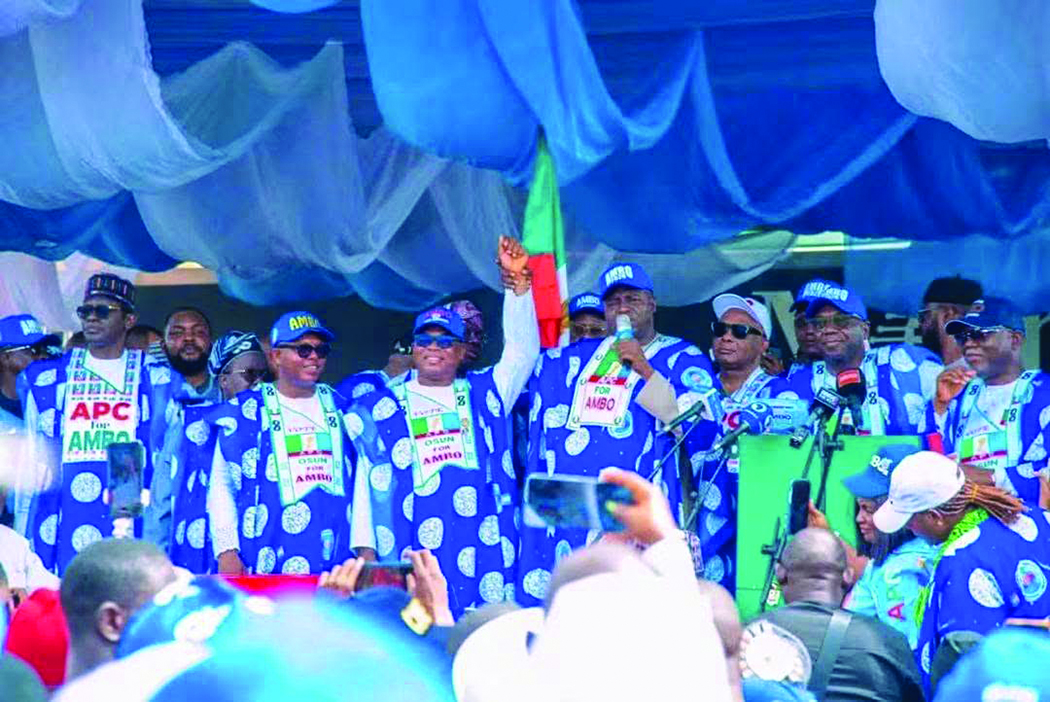
However, Uzodimma’s assurance and Davido’s appeal did not stop the Senate President, Senator Godswill Akpabio; Speaker of the House of Representatives, Tajudeen Abbas, and no fewer than 10 APC governors from trooping to Osogbo when they were neither election observers nor INEC officials.
No wonder Adeleke was said to have defeated the APC’s governorship candidate, Bola Oyebamiji and about 10 APC governors, who campaigned for him.
However, their presence in Osun State could not guarantee victory for the APC.
While boasting that he would have succeeded where these governors and APC leaders failed, the Minister of the Federal Capital Territory (FCT), Nyesom Wike claimed that if President Bola Tinubu had wanted APC to win at all cost, he would have sent him there and Adeleke would have lost the election.
Many believe that Wike’s revelation apparently confirmed the fears that political leaders’ real motive for converging on states holding off-season elections is to manipulate the results of the polls.
Reacting, former President Goodluck Jonathan warned that the growing practice whereby influential government officials converge on states where off-cycle elections are being conducted could threaten Nigeria’s fragile democracy.
Jonathan, in a statement titled “Osun and the Need to Set New Boundaries for Political Conduct in Off-Cycle Elections,” posted on his verified X handle, @GEJonathan, last Tuesday, said the practice is “unusual” and should not become the norm in a democratic society.
“The growing practice whereby serving governors, senior political office holders, party leaders and other influential government functionaries, accompanied by large numbers of aides and heavy security details from outside a state, converge on states where elections are being conducted” could have serious consequences for Nigeria’s democratic stability.
The former president recalled that when similar circumstances occurred during the Anambra and Ekiti governorship elections in 2013 and 2014, respectively, when he was president, he ordered party leaders and senior government officials to leave the states immediately.
The campaign for governorship election is an internal affair of each state and should be left for the people of the affected state to handle.
The presence of political leaders from other states and the increasing deployment of political power and governmental influence during off-season elections is not compatible with the principles of free, fair and peaceful democratic competition, and should be outlawed during future amendment of the Electoral Act to save Nigeria’s democracy.
