

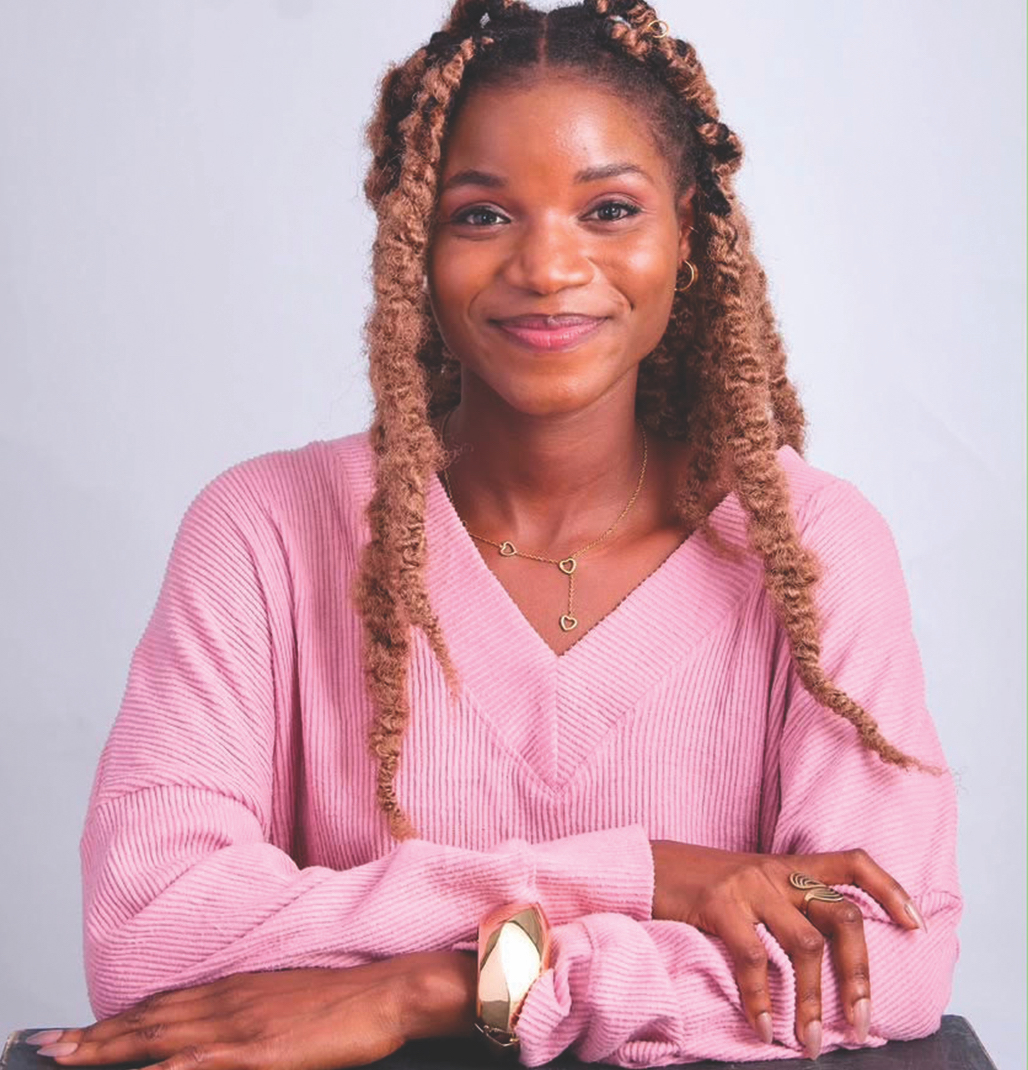
In Faith Omole’s first solo exhibition, the simple mark morphs into a cryptic language of identity, memory and cultural inheritance. Okechukwu Uwaezuoke writes
Colour, in fact, does the main work here. Neon-like motifs—almost a kind of luminous calligraphy, evoking both Nsibidi writing and contemporary street-art scribble—seethe against the deep violet backdrop, leaving an impression of frenzied movement and heat. From this termite-dense, near-black field of Adinkra-like symbols, spirals and Uli-inspired motifs, human figures begin to resolve themselves, their forms becoming more distinct as the eye gets accustomed to the visual thicket.
In all, 12 such motif-strewn works are on display, each inviting viewers to look beyond the immediate image and consider the meanings lurking within each mark. They leave room for viewers to bring their own experiences and associations to the encounter.
Small wonder, then, that Faith Omole chose ÀÀMÌ—a Yoruba word for sign, mark or symbol—as the title of her first solo exhibition. Presented by Fehinti Contemporary, it opened on Saturday (August 22) evening at The Art Hotel, its venue partner, in Victoria Island, Lagos. The exhibition is supported by Svetlo, Sevigram, Vascan, Mirthline, Creative Co. And Iwalewa Gallery of Arts.
According to Fehinti Contemporary, it is “an invitation to pay attention to the marks we encounter, the meanings we give them and the stories they can carry”.
For Omole, too, the exhibition grows out of an exploration of “human connections with one another, with the divine and with the environment”. Losing her father when she was only two left an absence that continues to shape her understanding of love, loss and belonging. “My works transform these experiences into reflection on vulnerability, trust and healing,” she says. “Inspired by my continuous exposure to symbolic systems, I seek to preserve, archive and reimagine ancient visual languages across different cultures, building a lasting body of knowledge which future generations can carry forward.”
A cursory glance through the displayed paintings alone should suffice for the viewer to understand that, with this artist, a mark is rarely just a mark. Beneath it can lurk a memory, a cultural residue, a declaration of identity or an idea that words cannot quite articulate. Her paintings—or, better still, the impressions they leave on viewers—hover somewhere between recognition and interpretation: an image may appear familiar while remaining cryptic.
Omole, who describes herself as largely self-taught, is interested in that mysterious interplay between what is seen and what is understood. It has become the theme song of her studio practice. Rather than treating symbols as decorative accessories, she turns them into a kind of visual vocabulary. Around them gather memories, emotions and experiences, as though the paintings were stories with their sentences deliberately withheld.
The paradox is that symbols are supposed to make communication easier. After all, they condense complicated ideas into recognisable forms. Yet once transplanted from one context into another, they can become elusive, their meanings shifting along with them. Even their histories acquire new associations as viewers bring their own memories to the encounter. Omole seems less interested in resolving that ambiguity than in putting it to work.
Then there is her background in activism, which has also shaped this impulse towards storytelling. The paintings may indeed be concerned with belonging, cultural pride, resilience and personal reflection, but they avoid treating African identity as a museum specimen preserved behind glass.
Instead, Omole reworks inherited visual languages for a contemporary audience, allowing old symbols to enter new conversations.
The larger question lurking behind ÀÀMÌ is a deceptively simple one: how does a mark come to mean something?
The Kogi State native has developed a practice rooted in African identity, cultural symbolism and social consciousness. Her preferred medium is acrylic on canvas, but the paint is only part of the conversation. Traditional Adinkra symbols, cowries and other cultural motifs enter her compositions alongside expressive figures, creating layered images in which heritage and contemporary experience jostle for attention.
A work that leaves the artist’s studio with one set of intentions can acquire another life in the exhibition space. A viewer may recognise a symbol immediately; another may misread it; someone else may attach to it a memory that has little to do with what the artist intended. Provided, of course, that anyone lingers long enough to look.
The encounter is also the culmination of a practice that has been gathering momentum. Omole’s progression towards a solo presentation has been relatively rapid but hardly haphazard. Since her early group exhibitions in 2022 and 2023, she has appeared in a succession of exhibitions, art fairs, residencies and international presentations. Her résumé lists the Kuenyehia Prize exhibition in Accra, the Ga-Yoruba billboard project in New York, the Don’t Be A Square exhibition in Venice, the Abu Dhabi Art Fair, the RMB Latitudes Art Fair and several editions of +234 Art Fair. She has also participated in residencies including Kuta Art Foundation’s programme and the Reimagining Hope Residency at MADhouse.
Along the way, she has worked across different spheres of the art ecosystem—as a studio assistant, curatorial assistant, gallery manager and curator. She currently works as Gallery Manager and Curator at The Children Art Gallery in Lagos, while also serving as an Art and Fashion Business Development Officer at Malimbe Inflight Magazine. Her academic background, intriguingly, is not in fine art but microbiology, for which she earned a BSc from Obafemi Awolowo University in 2022.
Perhaps that unlikely route explains something about Omole’s practice. Artistic identity, for her, does not seem to be a fixed category. It is forged instead from different experiences, disciplines and inheritances. Her paintings, similarly, refuse to be confined within a single vocabulary.
Back to the exhibition, which is curated by Kelechi Omenka. It holds up a mirror to a moment when symbols are everywhere, from corporate logos and political insignia to religious emblems, fashion motifs and the shorthand of social media.Contemporary life is awash with signs, but the speed with which they are consumed leaves little time to wonder what they mean. Omole’s paintings ask for the opposite: a pause, a second look, perhaps even the admission that a familiar sign may not be quite as familiar as it first appeared. In an age of relentless scrolling, that is a surprisingly radical demand.
There is also something ambitious about choosing ÀÀMÌ as the title of a first solo exhibition. For an artist moving from the babel of group exhibitions to speaking in her own voice, the title carries a fitting challenge.
