

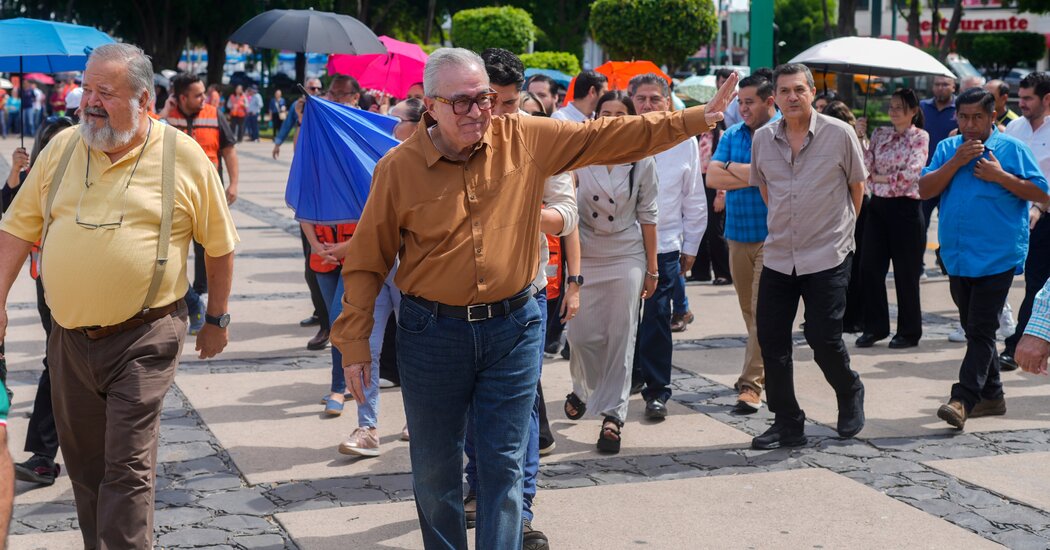
The Mexican governor accused by U.S. prosecutors of helping a cartel smuggle drugs announced on Friday that he was back in office, defying charges that set off a scandal in Mexico and inflamed tensions with the United States.
The governor, Rubén Rocha Moya, has said he was innocent and the victim of a political attack. Days after the indictment was unsealed in April, he said he would take a “temporary leave of absence” to focus on defending himself.
Three months later, he declared he was back in the governor’s office of Sinaloa state.
“I return to my responsibility as governor of Sinaloa with a clean, held-high conscience and with the strength of the truth on our side,” he said in a lengthy social media post on Friday.
Mr. Rocha’s return was met with widespread opposition. Governors and senators from his political party joined in releasing pointed statements, saying that he had acted alone and stressing the importance of respecting the continuing investigations. One influential Morena politician who had supported Mr. Rocha, Ricardo Monreal, called for him to go back on leave.
In the indictment, Manhattan prosecutors accused Mr. Rocha and nine other current and former Mexican officials, including a sitting national senator, of a broad conspiracy to help the powerful Sinaloa cartel import drugs into the United States. Prosecutors said that Mr. Rocha had accepted bribes and help getting elected in exchange for protecting the cartel, which has terrorized his state and Mexico for years.
Mr. Rocha, 77, is the highest-ranking member of Mexico’s dominant left-wing political party, Morena, to be indicted by the United States. The case against him is the Trump administration’s most significant public step in cracking down on the corruption that it says is at the heart of Mexico’s cartel problem.
The move caused a political crisis for President Claudia Sheinbaum, also of Morena. And it drove a wedge between the U.S. and Mexican governments as they were deepening security cooperation on combating the cartels.
In May, The New York Times reported that U.S. federal prosecutors had been instructed to use terrorism statutes to target Mexican officials believed to be complicit in the narcotics trade.
Mr. Rocha has long been dogged by accusations of protecting the Sinaloa cartel, a prolific supplier of fentanyl and a ruthless purveyor of violence.
Ms. Sheinbaum, who did not host her daily news conference on Friday because she said she had the flu, did not immediately comment on Mr. Rocha’s return. But she has repeatedly said that her government is not protecting the governor, has demanded more proof from U.S. officials about their case and has backed the Mexican authorities conducting their own investigation.
Mexican officials responded to the U.S. government’s extradition request in April by saying it lacked sufficient evidence.
The U.S. Department of Justice and the U.S. attorney’s office for the Southern District of New York, which filed the indictment, did not immediately respond to requests for comment on Friday.
The Mexican interior ministry called Mr. Rocha’s return “a personal decision” and said an investigation by the attorney general’s office was still open.
The Morena party said on Friday that it had no prior knowledge of his return and “distances itself from this decision.” It said it was committed to due process, the investigation and upholding accountability.
At least two former Sinaloa officials have been detained after U.S. indictments: Gerardo Mérida Sánchez, the former state security chief in Sinaloa, turned himself in to the authorities in Arizona in May; and Enrique Díaz, a former state finance official, was arrested in Europe.
By returning to office, Mr. Rocha regained the constitutional immunity granted by his elected position, experts said. He said on Friday that he had asked for the leave of absence because he wanted to participate in the Mexican government’s investigation as an “ordinary citizen” without immunity.
He said he had appeared before the Mexican attorney general’s office and answered questions with “truthfulness.” He pointed to an announcement by the office that stated that there was not yet sufficient evidence to support the U.S. prosecutors’ claims.
He labeled the accusations against him as “false,” attributing them to what he called the “political and interventionist motives of the national and foreign far right.”
He added, “I have committed no crime under our country’s constitutional and legal framework.”
Jorge Álvarez Máynez, a former presidential candidate and current head of the center-left Citizens’ Movement party, denounced Mr. Rocha’s return as a day of “national shame.”
Carlos Pérez Ricart, a left-leaning political commentator and an expert on organized crime at the Center for Economic Research and Teaching, a Mexican research group, called Mr. Rocha’s return a “grave political error.”
“It is one thing to reject Washington dictating guilt, but quite another to assume that Rocha retains the standing to govern Sinaloa,” he wrote on social media. “Governing requires more than just criminal innocence; it demands political authority.”
Mr. Rocha appeared to be undeterred by such criticism. On Friday, he said that not only had he returned to office, but that he intended to fulfill his term, which ends on Oct. 31, 2027.
