

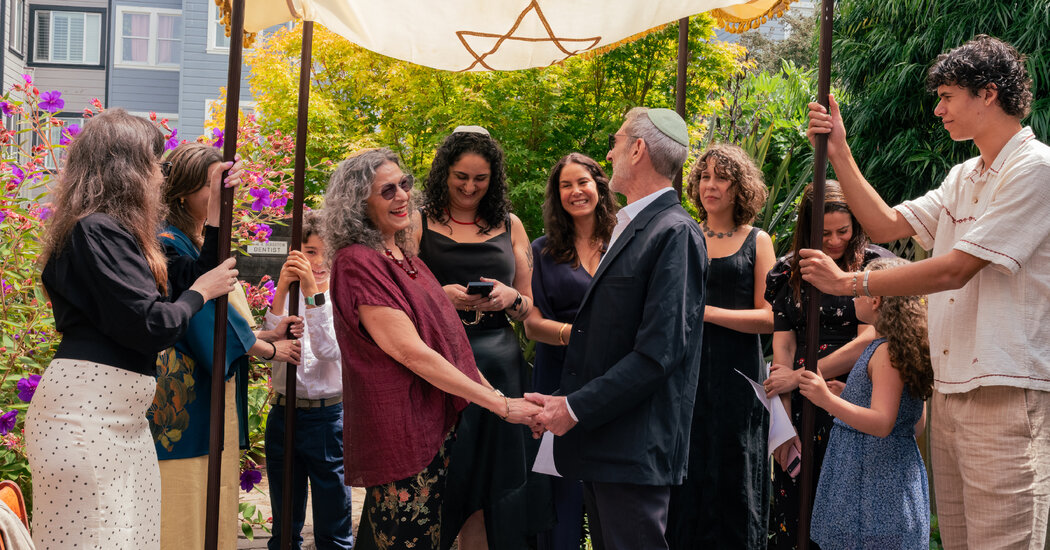
Before Melanie Miguel married Michael Shiloh on July 26, she called him her “past and future husband.”
Now he is simply her husband — for the second time.
The couple married in 1990 and stayed together for 18 years, separating amid mounting financial and health challenges and Miguel’s persistent desire to explore her attraction to women. More than three decades after first exchanging vows, they stood under a cream-colored satin huppah surrounded by their three daughters and four grandchildren to marry each other again. Miguel is 71, Shiloh 70.
“Today is not just a celebration of a wedding,” Ivria Sisson, their middle daughter, said during the ceremony. “It’s a celebration of love, resilience, forgiveness and the incredible gift of second chances.”
Miguel and Shiloh first crossed paths in 1986 as frequent participants in Israeli folk dance gatherings at the Jewish Community Center of San Francisco and Ashkenaz Music and Dance Community Center in nearby Berkeley.
At the time, Miguel was divorced with two daughters, then 8 and 10, and worked as the regional executive assistant for a company that leased shipping containers. Shiloh was married and worked as a hardware electronics designer.
At the folk dancing events, the two sometimes moved past each other during communal dances in circles or lines. But they were little more than friendly acquaintances.
Binge more Vows columns here and read all our wedding, relationship and divorce coverage here.
Still, “I definitely noticed Melanie,” Shiloh said. At the end of 1988, after separating from his wife, he invited Miguel to dinner under the guise of wanting advice on navigating divorce.
“I was very shy,” Shiloh said. “I thought that if I asked Melanie out for a date, she would say no.”
They had burritos in San Francisco’s Mission District, and both left knowing they wanted to spend more time together. On their second date, Shiloh visited Miguel’s San Francisco flat, where she showed him her “Naked Ladies,” three-inch female figurines she sculpted from clay.
“We just sat there for hours talking about art,” Miguel recalled. “He said he thought he was an artist, too, but he wasn’t sure what that would look like.” Today, Shiloh is a professor of interactive design at New York University Abu Dhabi who transforms corroded machine parts into electromechanical artwork that explores society’s relationship with technology. He exhibits his pieces around the world.
Shiloh grew up in Jerusalem, the son of a British mother and an American father. He left for the U.S. in 1977 to attend the University of California, Berkeley, where he received a joint bachelor’s degree in electrical engineering and computer science. Miguel, a San Francisco native whose family set down roots in the city in the 1860s, took classes at the College of San Mateo before leaving to marry her first husband at age 19 and work full time.
When she wed Shiloh in 1990, he had fully embraced her two daughters from her previous marriage, and five years later, the couple welcomed a third. They describe the years that followed as fun and full of parenting adventures. But as time passed, individual and shared pressures took a toll.
Miguel developed carpal tunnel syndrome that necessitated surgery on both hands and required her to stop working. Later, while training to be a home birth midwife and serving as a doula, she developed an extreme latex allergy when repeatedly exposed to latex in gloves and other medical supplies. Simply breathing in the particles could put her at risk for a potentially life-threatening anaphylactic reaction.
“It affected everything: gymnasiums where rubber balls were used, shoe stores, any celebration that had balloons,” she said. “Rubber bands could set me off. It was very frightening.”
At the same time, Shiloh was facing his own career struggles, which he would later attribute to his undiagnosed A.D.H.D.
“I didn’t have the words for it then, but it was very difficult for me to keep large, complex systems in my head, and as a result I ended up making lots of mistakes,” he said. “I moved from one job to another over a number of years.”
The work upheavals shook his sense of self, and the resulting financial troubles forced the couple to sell their house in San Francisco’s Sunset District. They did their best to support each other, but the compounding pressures weighed heavily on their relationship.
“We were under severe stress,” Shiloh said.
Around the same time, Miguel increasingly felt that denying the part of herself that longed to be with women amounted to a self-betrayal she could no longer bear. “I felt unseen,” she said. “Part of me was living a lie.”
She shared those feelings with Shiloh, and the pair separated in 2008, officially divorcing in 2012 after their youngest daughter graduated high school.
“I was very, very sad when Melanie said she felt that she couldn’t be married to me anymore, but keeping her in a situation where she wasn’t happy didn’t make sense,” Shiloh said. “I wanted her happiness above all.”
Miguel and Shiloh remained amicable co-parents during their separation and following their divorce. He had a 10-year relationship, and she dated several women, including one for four years. After discovering a passion and aptitude for teaching, he accepted the N.Y.U. teaching job in the United Arab Emirates 10 years ago, widening the physical chasm between them.
Then, in 2023, came a trip that changed everything.
It was a two-week family vacation to Israel to celebrate their grandson’s bar mitzvah. Miguel and Shiloh worked as a team to plan and execute the getaway for almost 20 travelers, spending more time together than they had in years. They realized how much they still enjoyed each other’s company, and when the trip ended, they found themselves missing one another.
Their eldest daughter, Naomi Rosenblum, shared with her mother the observation that her parents worked together seamlessly. They both are inquisitive artists with similar values, she noted. She reminded her mother that neither had forged a lasting relationship during their time apart and that Shiloh “was a catch.”
“After that conversation, it was just like, ‘Yeah, I do still love him. I never really stopped loving him,’” said Miguel, who is retired from her position as a health services manager at Rhoda Goldman Plaza, a senior assisted living facility in San Francisco, and spends her time hammering and chiseling stone sculptures that hint at the female form.
She began to imagine what it would look like to become a couple again. While the prospect energized her, her queer identity remained important to her. Rosenblum reassured her mother that she didn’t need to label herself and should feel comfortable identifying in whatever way felt most authentic.
“There’s more fluidity around queerness today,” Miguel said. “I still feel queer, and unapologetically so, and yet I love this man. I’m not attracted to most men, but I am attracted to Michael.”
When she told her former spouse she wanted to reunite, “he was very excited.” So were the couple’s children and grandchildren.
“They were like, ‘This is great. We want you to be happy. Now we can see you two at the same time. Now neither one of you will be alone,’” Miguel said.
The entire family’s joy was palpable at the couple’s July 26 wedding, which took place in the San Francisco garden of a friend’s home. Two of the couple’s grandchildren and two nieces held the poles supporting the Jewish wedding canopy, and their youngest daughter, Yasmine Shiloh, officiated after getting ordained through the Universal Life Church for the occasion.
“My parents have always shared a unique harmony,” she told the 30 guests, her mother and father becoming visibly emotional. “They get each other’s quirks and respect each other’s strengths.”
“Today,” she said, “they celebrate both their past and the new experiences they now bring to this chapter of their lives together.” Sisson, her sister, expanded on the sentiment. “It’s a love built on experience, wisdom and the conscious decision to choose each other again,” she said.
Shiloh now splits his time between Abu Dhabi and the San Francisco Bay Area, with Miguel visiting him in the United Arab Emirates during the academic year. They agree that their “remarriage,” as they call it, will benefit from all they’ve come to understand about themselves, and one another, over time.
“We learned in being with other people even more of what was important to us, what was missing that we saw in each other,” Miguel said. “We are both in much better places. We’ve learned to communicate and not put up defenses, and to really hear each other.”
On a foggy day typical of San Francisco summers, the sun broke through the gray just moments before the wedding began. It stayed out, bathing family and friends in warm afternoon light as they joined hands with Miguel and Shiloh after the ceremony to dance Israeli folk dances the couple first shared 40 years ago.
Among them was one performed to the song “Ma Navu,” Hebrew for “how beautiful.”
On This Day
When July 26, 2026
Where The San Francisco home of Miguel’s lifelong friend Jana Canellos and her husband, Ben Bergstein.
With This Sharpie, I Thee Wed When it came time to exchange rings, Shiloh slipped Miguel’s original gold band onto her finger. Since Shiloh works with machinery that could scratch jewelry, he decided he won’t be wearing one. Instead, his bride drew a wedding band on his left ring finger using a black Sharpie.
Symbolic Flowers The bride’s sister, Renée Miguel, designed floral arrangements with blooms from Rafa’s Wholesale Flowers. Miguel made anthuriums central to the centerpieces in honor of the siblings’ late mother, Ruth, whose 1953 wedding featured the tropical perennial in pink, red and white.
A Love Story in Pictures Photos spanning the couple’s decades-long relationship filled the pages of a journal where guests could share their congratulations and good wishes. The words “begin again” adorned the cover.
