

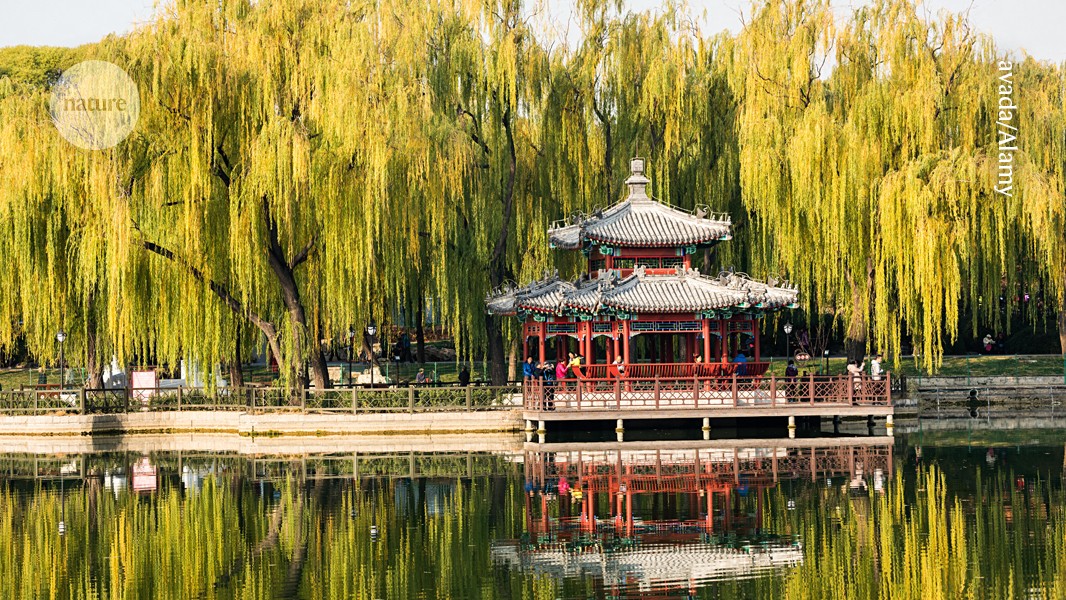
Weeping willow trees are found in many cities globally.Credit: avada/Alamy
Across Beijing, millions of weeping willows and poplar trees turn the megacity into a green metropolis. But compounds released by these trees are becoming a major contributor to air pollution1, finds a study.
Beijing is not alone. Many trees planted in urban areas — species that are often chosen for their quick growth and climate resilience — are worsening ozone emissions, suggests the study published in Science Advances today. Rising temperatures from global warming could exacerbate the problem.
Ozone forms when volatile organic compounds (VOCs) released by some vegetation, vehicles and chemical industries react with nitrogen oxides (NOx), which are emitted mostly by traffic and industry. A series of reactions between these compounds in the presence of sunlight causes ozone to form. Breathing in ozone can inflame or damage the airways, causing breathing difficulties, particularly in people with asthma or lung disease.
Co-author Bin Yuan, who studies atmospheric chemistry at Jinan University in Guangzhou, China, says that the team initially set out to understand the impact of human activity on ozone pollution. But they were surprised to find that urban vegetation was a much larger contributor to ozone emissions than previously thought. “When we got this data, we did not believe it the beginning,” Yuan says.
Many tree species emit VOCs, some more than others. Willow (Salix spp.) and poplar (Populus spp.) trees, which have been planted across many cities, release high levels of isoprene, a type of VOC that is produced as a byproduct of photosynthesis. Roughly 35% of the trees in Beijing are isoprene emitters, the team found.
Measuring emissions
The researchers collected air samples across Beijing to measure VOC concentrations and gathered ozone data at monitoring stations around the city. They found that vegetation accounted for about 10% of the total VOC emissions in Beijing between May and July 2021, the study period, and human activities, such as vehicle emissions and industrial chemicals, accounted for the rest.
Because VOCs don’t directly form ozone, the team needed another way to measure how much vegetation contributed to the city’s ozone pollution. To do that, they estimated how fast VOCs react with hydroxyls in the atmosphere. Hydroxyls react with VOCs to form peroxy radicals, which in turn react with NOx in the air to form compounds that turn into ozone in the presence of sunlight. The study found that vegetation accounted for 52% of the chemicals that go on to form ozone, with isoprene the dominant contributor.
Although total VOC emissions from human activities were higher than those from vegetation, their contribution to the formation of ozone was substantially less than that of plants.
The researchers also looked at tree species planted in 24 megacities to estimate their potential isoprene emissions. They also found that isoprene emissions in a large proportion of the cities they investigated, including Sydney and Melbourne in Australia, were predicted to be higher than in Beijing. In Sydney, for example, about 65% of the trees emit isoprene.
Ian Jamie, an environmental chemist at Macquarie University in Sydney, says that vegetation as a source of VOCs is becoming proportionally larger because other sources have reduced substantially over the last few decades. Emissions from vehicles, which used to be a large source of organic compounds, have reduced, he says.
Heat intensifies
VOCs and ozone production increase as temperature rises. The study found that at 35 °C, the hydroxyl reactivity rate with VOCs from vegetation was seven times higher than at 20 °C. As a result, the contribution of vegetation to the chemical reactivity rose from 21% at 20 °C to 74% at 35 °C.
