

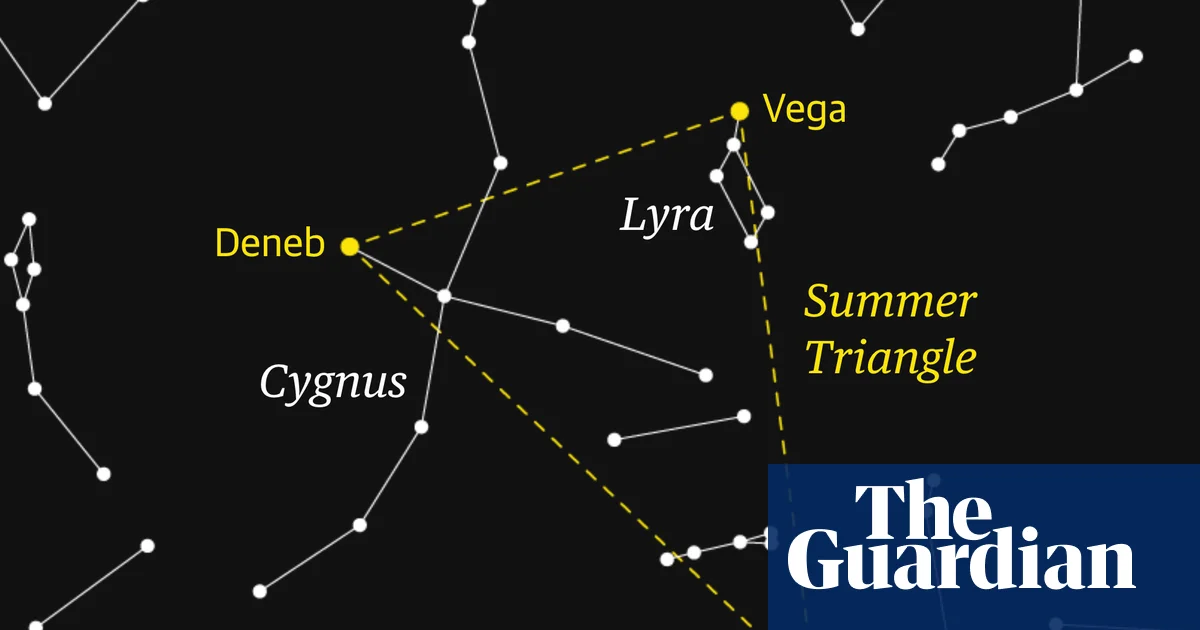
We turn our attention this week to one of the sky’s smallest constellations. High overhead from the UK after darkness falls, Lyra, the lyre, is easy to find thanks to the brilliant white star of Vega.
The chart shows the view facing south and looking up towards the zenith from London at 22:30 BST on 17 August.
As the fifth-brightest star in the night sky, Vega forms one corner of the summer triangle, with Deneb in Cygnus, the Swan, and Altair in Aquila, the Eagle, marking the other two.
Having located Vega, the rest of the constellation is easy to trace even though the stars are much fainter. One of the second-century astronomer Ptolemy’s original 48 constellations, Lyra has the distinction of being a star pattern that actually looks like the figure it is named after. It represents the harp played by the Greek poet Orpheus.
In Greek mythology, Orpheus played such beautiful music that he could charm wild animals, move rocks and even influence the gods. Becoming one of the Argonauts, Orpheus’s music protected the rest of the crew from the beguiling call of the Sirens.
Observers in the southern hemisphere can also find Lyra on August evenings, although it remains much lower in the northern sky.
