

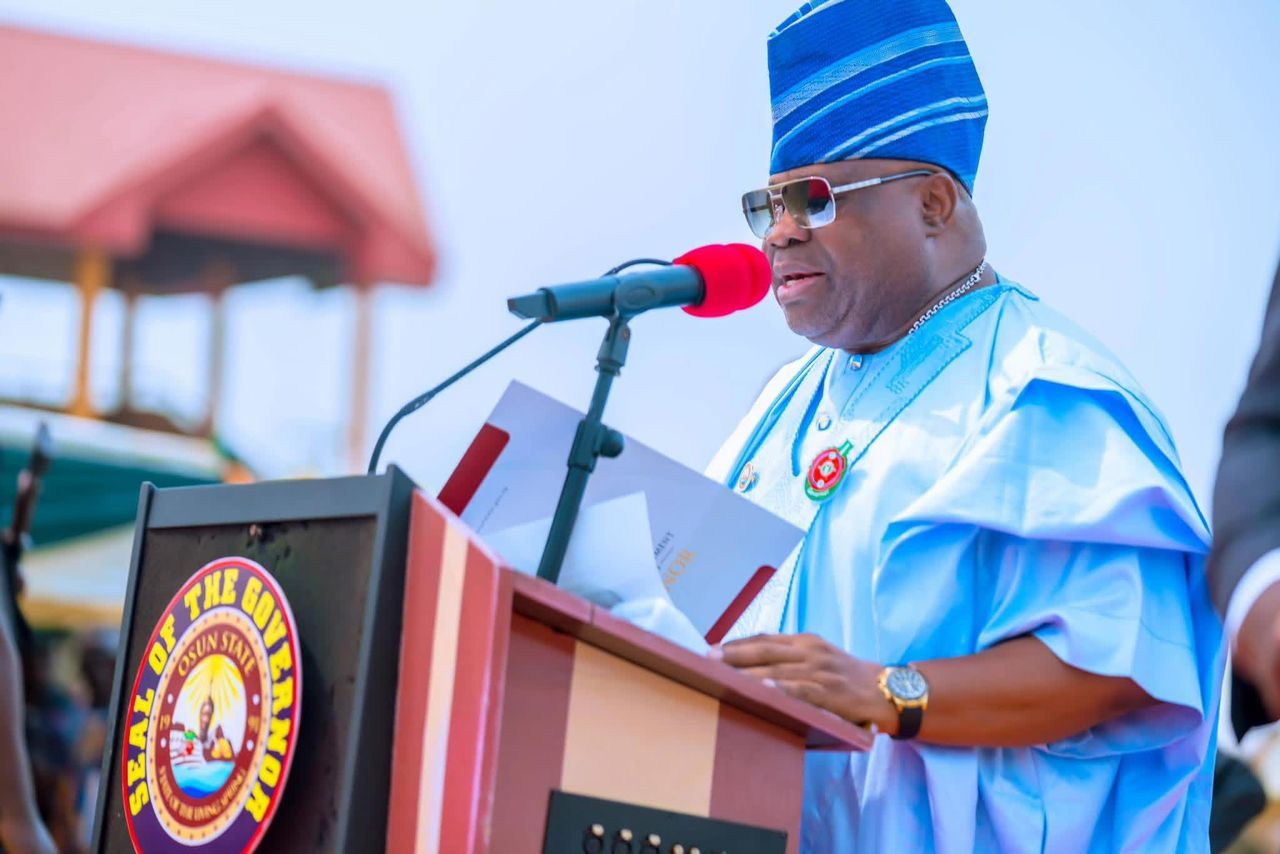
In November 2022, Ademola Adeleke took office as Osun State governor after defeating the incumbent, Gboyega Oyetola of the All Progressives Congress (APC), with 403,371 votes to Mr Oyetola’s 375,027.
Mr Adeleke campaigned on a five-point agenda centred on workers’ welfare, economic development, infrastructure, people-focused social services, and agro-industrialisation aimed at creating wealth and jobs.
He promised to ensure that public resources served the people of the state.
Upon assuming office, Mr Adeleke claimed he inherited a state facing substantial obligations, including salary and pension arrears, infrastructure deficits and a public sector burdened by accumulated liabilities.
The governor, who was elected on the Peoples Democratic Party (PDP) ticket, said Mr Oyetola left a debt of N75 billion in salaries and pensions. The claim contradicted the former governor’s farewell statement, wherein he said he left N14 billion in the state’s operating account and didn’t take a loan during his tenure.

Nearly four years later, as Osun voters return to the polls, the question is no longer simply what the governor earlier promised. Rather, it is whether the changes his administration said it has delivered have translated into measurable improvements in the lives of residents.
A PREMIUM TIMES assessment of the administration’s record shows a mixed picture.
The government has reduced the state’s debt, increased internally generated revenue and paid portions of inherited salary, pension and other obligations. He has also made visible investments in roads and other infrastructure, and implemented projects in various sectors such as education, healthcare, and agriculture.
However, the administration’s record remains contested as opposition parties criticise the quality and distribution of some projects. The concerns over education spending, public-sector management and the state’s prolonged local government crisis have also complicated the administration’s performance narrative.
Infrastructure, a visible part of Adeleke’s record
Infrastructure is perhaps the area where the administration’s footprint is most visible.
In 2022, Mr Adeleke promised to direct state resources towards what he described as home-grown infrastructure and to restore Osun’s deteriorating infrastructure.
Since taking office, his administration has embarked on road rehabilitation and construction, alongside major dualisation and flyover projects.
In October 2023, the governor unveiled a N100 billion infrastructure plan aimed at addressing infrastructure deficits across sectors and strengthening the state’s economy.
The plan included the rehabilitation of 345 primary healthcare facilities, provision of potable water, reconstruction of 31 schools and the construction of five flyovers, as well as street-lighting projects in Osogbo.
In March 2025, the administration unveiled a second-phase infrastructure plan valued at N159 billion, covering roads, healthcare, education and other projects.
The plan committed N2.76 billion for the renovation of 124 primary healthcare centres, N1.98 billion for school renovation and construction, and more than N101 billion for road infrastructure.
The government has since highlighted the construction and rehabilitation of more than 350 kilometres of roads and major projects, including the dualisation of roads in Ilesa, Ila and Iwo, and flyovers in Ile-Ife and Osogbo (Oke-Fia and LAMECO).

At an ARISE town hall last Monday, Mr Adeleke also said his administration had undertaken work on about 10 federal roads for which the state was yet to be reimbursed.
But the infrastructure record also illustrates one of the administration’s limitations: several of its flagship projects remained works in progress as the election approached.
Mr Adeleke’s administration has also faced criticism from opposition parties over the quality of some projects.
In late July, PREMIUM TIMES reported criticism surrounding defects in the newly constructed LAMECO Flyover in Osogbo after a part of the infrastructure developed cracks, triggering another political dispute over the quality of the administration’s projects. Opposition parties also accused the government of executing substandard projects.

The infrastructure record, therefore, presents both sides of Mr Adeleke’s tenure: an administration that has invested heavily in visible physical projects, but one whose success must ultimately be measured not only by the number of kilometres of roads or projects announced, but by their quality, durability and impact on residents.
Workers’ welfare
Workers’ welfare was another central promise of Mr Adeleke’s 2022 campaign. He promised to make salaries, gratuities and pensions a first-line priority.
His administration subsequently paid portions of inherited salary and pension arrears and approved promotion arrears for workers. The government also implemented the new national minimum wage and continued payments towards inherited obligations.
At the 2025 Workers’ Day programme, the Osun NLC chairman, Christopher Arapasopo, commended the administration for paying salary and promotion arrears and implementing the new minimum wage.
The government has also highlighted its payment of inherited pension liabilities as one of its major achievements. At a 2026 presentation of his record, Mr Adeleke said his administration had paid almost N100 billion in inherited pension debt.
While interventions represent an improvement from the obligations it claimed it inherited in 2022, they do not amount to a complete resolution of workers’ welfare concerns.
The administration also approved the 2026 promotion examinations and financial backing across public service agencies, while also engaging in recruitment through teaching commissions to help bridge staffing deficits in public schools.
Debt reduction
One of the measurable aspects of Mr Adeleke’s tenure has been debt reduction.
According to figures from the Debt Management Office cited by the Osun government, the state’s domestic debt fell from N148.37 billion in December 2022 to N83.32 billion by March 2025, a reduction of 43.84 per cent. Its external debt also fell from $91.78 million to $75.14 million over the period.
The administration also reported a sharp increase in internally generated revenue (IGR), from N27.72 billion in 2023 to N54.7 billion in 2024, representing almost a doubling within one year.
These are positive fiscal indicators. But higher IGR and lower debt do not automatically establish that the state’s finances have become structurally sustainable.
Osun remains substantially dependent on federal transfers, while the size of its budgets has expanded considerably.
For instance, in 2025, PREMIUM TIMES reported that the state budget increased to about N427.75 billion, with N251.67 billion expected from FAAC and about N109.87 billion projected from IGR.
Education
Mr Adeleke promised skills-based education and people-focused social services.
His administration has reported school rehabilitation and other interventions, while education has continued to receive substantial allocations in successive budgets.
But educational improvement requires more than counting renovated schools.
One independent indicator is student performance. Osun recorded a 72.64 per cent pass rate in the 2025 NECO Senior Secondary School Certificate Examination, according to an analysis published by this newspaper.
That is encouraging, but it would be misleading to attribute the entire outcome to the Adeleke administration without examining longer-term trends, teacher quality, student demographics and the condition of schools before 2022.
In January, 2026, Mr Adeleke earned the BusinessDay Award in honour of the state’s outstanding performance in Education and Human Capital Competitiveness.
A PREMIUM TIMES analysis of the 2026 budgets of South-west states also found that Osun allocated 12 per cent of its budget to education, below the 26 per cent benchmark recommended under Nigeria’s National Policy on Education. The analysis further found that the state spent 73.2 per cent of its 2025 education allocation.
The picture is therefore mixed: Osun has recorded encouraging examination outcomes and undertaken school interventions, but funding and implementation remain questions for an administration that promised a broader transformation of the sector.
Healthcare
Healthcare has also featured prominently in Mr Adeleke’s record.
The administration has conducted medical and surgical outreaches, reported the rehabilitation of health facilities and continued interventions in primary healthcare.
Its infrastructure plans have also included large-scale rehabilitation of healthcare facilities. The government said its first infrastructure programme covered hundreds of primary healthcare centres, while the second phase included another N2.76 billion allocation for the renovation of 124 primary healthcare centres.
However, critics argue that the renovation of health facilities does not resolve persistent problems such as shortages of medical personnel, equipment, drugs, and health insurance coverage and the ability of poor households to sustain treatment.
Agriculture and jobs
Mr Adeleke promised agro-industrialisation as a means of creating wealth and jobs, particularly for young people and women.
The administration has promoted agricultural mechanisation, purchased tractors and introduced youth-focused agricultural programmes. It has also expanded cooperative financing and other interventions targeted at artisans and small businesses.
But this is one sector where the government’s public messaging appears stronger than the available evidence of economy-wide transformation.
The local government crisis
If infrastructure represents one of Mr Adeleke’s strongest areas, the local government crisis represents one of its most consequential governance controversies.
The dispute over control of Osun’s 30 local governments became a prolonged political and legal battle involving the PDP-controlled state government and APC-backed former council officials. A clash between both parties resulted in the death of five people.
In February 2025, Mr Adeleke’s administration conducted local government elections and swore in new chairpersons. He subsequently directed them not to immediately occupy the council secretariats because rival officials backed by the APC were still occupying some of the facilities.
The dispute eventually contributed to the withholding of local government allocations by the federal government, creating a serious disruption to grassroots governance.
The Adeleke administration has blamed the federal government and the APC for withholding the funds, while the federal government has linked the decision to the legal uncertainty surrounding the councils.
READ ALSO: Adeleke cuts Osun’s domestic debt by N69.18bn in three years
The Supreme Court later struck out Osun’s suit challenging the withholding of the allocations, holding that the state Attorney-General lacked the legal standing to institute the case on behalf of the 30 local governments. The court, however, also criticised the federal government’s withholding of the funds.
Whatever the political arguments surrounding the dispute, its consequences for governance were significant.
While local governments are supposed to provide basic services closest to residents, the prolonged uncertainty over who controls their institutions and finances weakens grassroots administration and diverts political attention from service delivery.
This is, therefore, an area where Mr Adeleke’s administration cannot simply blame its political opponents. The dispute became a test of institutional restraint and political management, and Osun’s local government system emerged weakened.
Discover more from Premium Times Nigeria
Subscribe to get the latest posts sent to your email.
